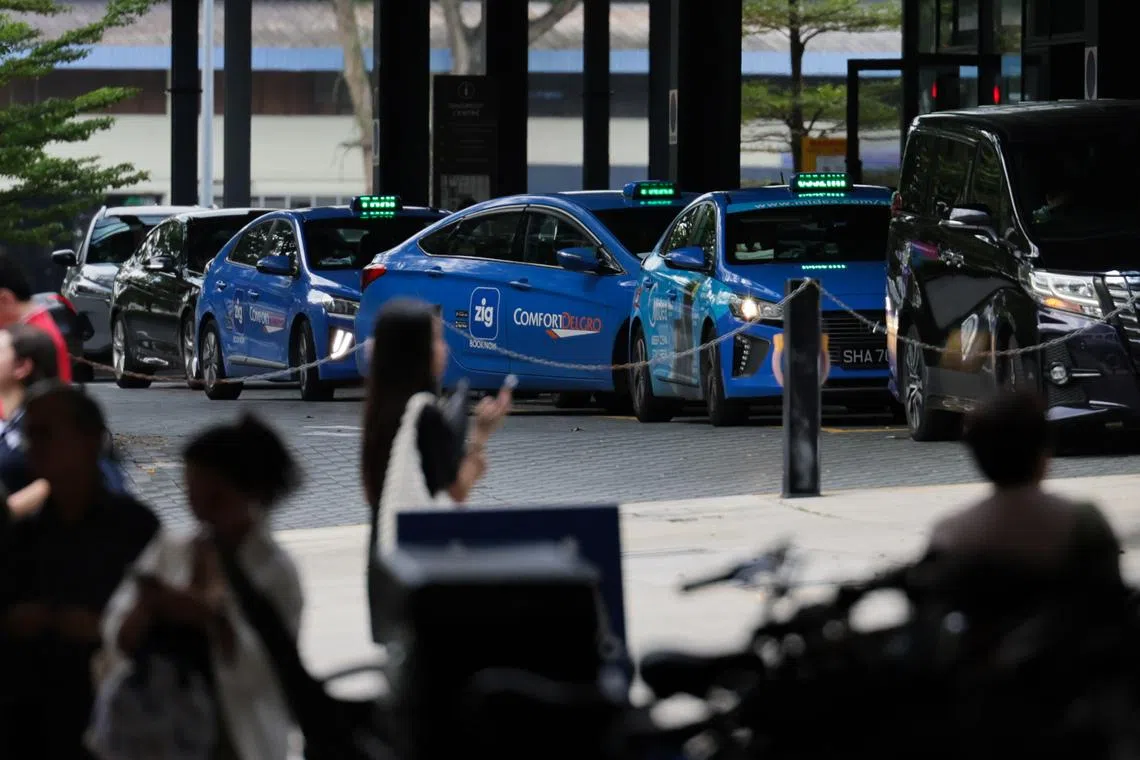
SINGAPORE – Private-hire drivers and cabbies welcomed a new support package to help them transition to jobs in the driverless vehicle sector, but added their key concerns include salaries and a loss of flexible work hours.
One question on the minds of cabbies and ride-hailing drivers The Straits Times spoke to is whether the new roles in the pipeline will have the same level of flexibility that their current jobs offer.
Private-hire driver Henry Loh, 55, said: “I’ve been driving for 16 years; I am my own boss. I’m very used to the flexibility of the hours.”
Taking up a new role – whether as a safety operator in the autonomous vehicle (AV) sector or a bus driver, after signing up for a career conversion programme – would mean losing that freedom, he added.
Similarly, cabby Sean Chan, 53, said moving from flexible to fixed work hours “doesn’t make sense” to him.
Chan left his full-time job about seven years ago and took up driving a taxi to stay active. After covering rental and fuel costs, he also uses his taxi to run errands for his family.
Every driver has personal aspirations and many choose the job because they value autonomy, he added. Despite the latest moves to help drivers, more can be done to understand drivers’ needs, he said.
The driver support package – which includes career conversion programmes, a paid training scheme and career guidance initiatives – is part of efforts to help drivers adapt to a fast-changing transport landscape, said Senior Minister of State for Transport Sun Xueling in Parliament on July 7.
A key plank of the package is a new training incentive scheme where drivers will get $20 an hour to attend eligible short-form courses. The three-year scheme starts in January 2027.
There are about 2,000 courses to choose from, and incentives are capped at 80 hours. That means drivers can claim up to $1,600 to offset vehicle rental fees and lost income while they study.
Cabby Tsang Tang Kwong, 63, said he usually earns $30 to $40 an hour, and sometimes as much as $50.
While the $20 hourly payout is enough for him – because he drives mainly to stave off boredom – he said those with families to support may feel it is not enough.
“Drivers are definitely losing out from what is being offered,” he said. “You give up one hour of work to attend a course, and you only get about half of what you could have earned.”
Loh, who is also general treasurer of the National Private Hire Vehicles Association, said the $20 would make sense only if training is held during off-peak hours.
Another cabby, Ban Kum Cheong, 55, said the incentive will appeal to some drivers but not others.
“For drivers like me who are not earning that much, it’s good,” he added.
However, even if drivers wanted to retrain in anticipation of a wider roll-out of driverless vehicles, contractual obligations could make switching jobs difficult, Ban said.
The National Taxi Association executive committee member said most taxi drivers sign one-year contracts with operators, while some are under contracts of two or even three years.
Ending those contracts early can incur financial penalties, an issue that needs to be addressed first, he said.
Private-hire driver Carmen Ortega, 39, who has been in the industry for about a decade, said it is important for drivers to receive the incentives quickly.
She said: “Many drivers need daily or weekly earnings because they might be paying rental every week or even daily.
“So when cash flow is affected, it becomes a big barrier for people to start a training programme that will affect their daily life.”
If the $20 hourly payout is made only at the end of the month, not many drivers can wait that 30 days because their expenses continue to be incurred every day, she added.
Keeping training courses shorter and spread over a longer period or allowing them to be completed online so they can continue driving before or after classes were also high on drivers’ wish lists.
Raymond Tong, 51, was a private-hire driver for a decade before becoming a safety operator and remote operator for Grab after retraining.
Asked what he would say to drivers who worry autonomous technology will replace human jobs, he said: “I think human drivers still have a big part to play in transport.
“And humans will still be needed to manage and operate the AVs. My fellow safety operators and I are the ones getting the AVs ready for work each day.”
One way forward for drivers, he added, is to explore a wider range of jobs and re-skilling opportunities.
Tong said: “Besides offering safety operator or remote operator roles, there could also be opportunities in maintenance and software engineering. Expanding into those areas would appeal to younger drivers, too.”
Ang Li Wei, who drove a taxi for 15 years before retraining as a safety operator, said: “My years of driving have helped me anticipate real-world traffic scenarios and support safe autonomous vehicle operations.”
Drivers, she added, will benefit from more regular updates on how the industry is evolving, what roles are emerging, and the skills needed for them.
Ang said: “The sooner that drivers understand where the industry is heading, the more time they have to prepare, upskill and make informed decisions about their future careers.”
NTUC assistant secretary-general Yeo Wan Ling said drivers have also asked for more flexibility in training, whether through flexi-time arrangements or expanded place-and-train opportunities.
She added that drivers are also looking forward to understanding what transition opportunities are out there which can translate into good livelihoods and career pathways – within the transport sector or outside of it.
“The tripartite partners are working on this now, and this will be a critical component of any transition,” said Yeo, who is also adviser to the National Private Hire Vehicles Association and the National Taxi Association.
Asked what more can be done for drivers, Ortega said two things to consider are: a limit on the commissions that ride-hailing platforms can charge, and introducing a minimum base fare.
She said: “With higher fuel prices now, even with the fuel surcharge, it’s not helping. And I know consumers cannot pay more.”
She added that Singapore can consider following in Indonesia’s footsteps by capping platform commissions.
Loh shared the view, saying drivers want higher base fares and lower platform commissions.
“A slight increase will give drivers more comfort and trust in the operator as well,” he said.