Hantavirus outbreak could just be the beginning: Scientists issue urgent warning about spillover of other rodent-borne viruses amid rising global temperatures
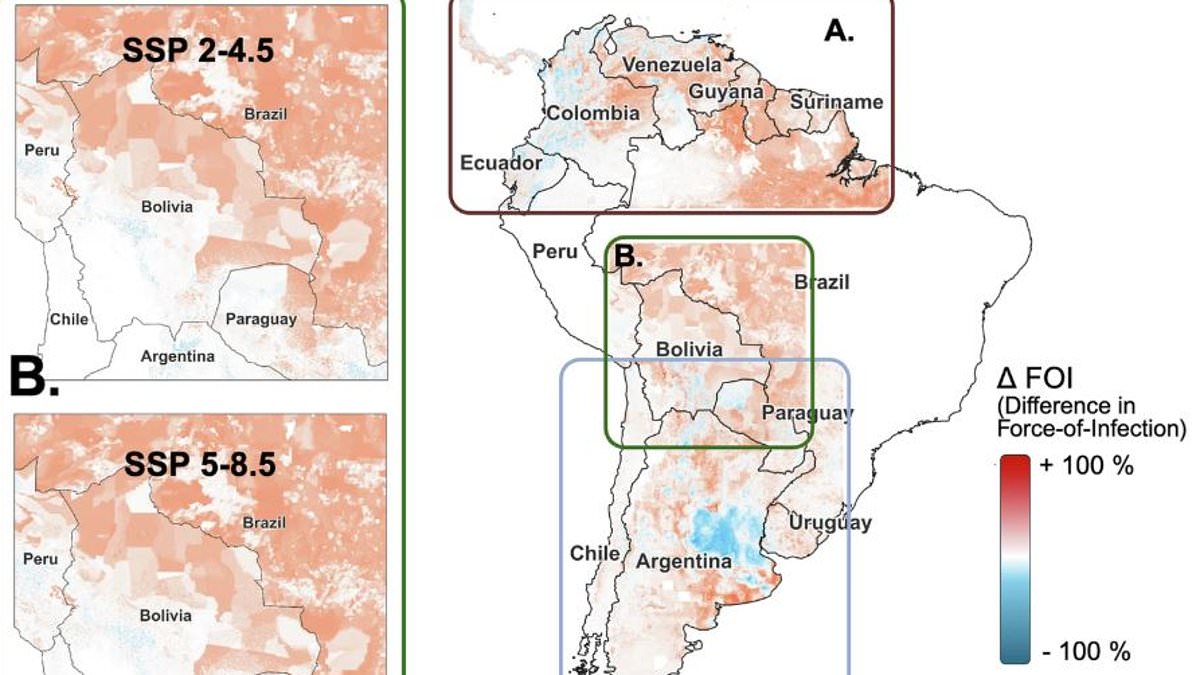
The recent outbreak of hantavirus on a cruise ship could just be the beginning, scientists have warned.In an ominous new study, researchers reveal that climate change will lead to enhanced 'spillover' of rodent–borne viruses.As global temperatures rise and rodent populations shift, deadly arenaviruses will be driven into areas that have never faced these diseases before.Researchers predict this will trigger outbreaks that threaten to reach 'millions' of people across South America.The warning comes as more than 20 Brits remain trapped aboard a cruise ship infected with rat–borne hantavirus off the coast of Cape Verde.Three passengers have now died after contracting the viral infection, including a Dutch couple and a German national.The Dutch–flagged MV Hondius had previously docked in Argentina, where both hantavirus and arenaviruses kill dozens every year.However, the researchers warn that similar outbreaks will only become more common the faster the climate warms. Scientists predict that climate change will lead to a massive spread of rodent–borne viruses in South America Like hantavirus, arenaviruses are hosted by rodents and usually spread to humans from animals rather than person–to–person infection.These extremely common but poorly studied infections include Guanarito virus in Venezuela and Colombia, Machupo virus in Bolivia and Paraguay, and Junin virus in Argentina.Infection causes severe hemorrhagic fevers with high hospitalisation rates, with fatality rates between five and 30 per cent.Since these diseases are spread by rodents, their impact is closely connected to changes in rodent habitats.However, studies have shown that the warming climate is producing dramatic changes in the ranges of disease–spreading animals.Previous research has shown that factors such as temperature and precipitation have a massive impact on the risk of rodent–borne diseases such as Lassa fever and hantavirus.Meanwhile, the distribution of the drylands vesper mouse, which transmits Argentine Hemorrhagic Fever, will undergo 'substantial changes' due to climate change.In their paper, the researchers use machine learning to combine climate projections, population density predictions, infection risks, and habitat suitability for six rat and mouse species linked to the viruses. As the climate becomes hotter, the habitats of rodents which carry arenaviruses will shift. This will bring more rodents into contact with humans This comes as more than 20 Brits remain trapped aboard a cruise ship infected with rat–borne hantavirus off the coast of Cape Verde. The infection has already killed three passengers, including a Dutch couple and a German national What are arenaviruses? Arenaviruses are a group of 'segmented genome RNA viruses' that are hosted by rodents.They include the Guanarito virus in Venezuela and Colombia, Machupo virus in Bolivia and Paraguay, and Junin virus in Argentina.They are very similar to hantaviruses, which are also spread by rodents in South America.Like hantaviruses, arenaviruses have no known antiviral treatment. Infection leads to hemorrhagic fevers that kill five to 30 per cent of patients depending on the virus. This revealed that the infection risk posed by these dangerous diseases would change dramatically in the next 20 to 40 years under different climate change scenarios.Lead author Dr Pranav Kulkarni, of the UC Davis Weill School of Veterinary Medicine, says: 'As climate change accelerates, our study shows how the outbreak risk of dangerous New World arenaviruses could ride on shifting rodent populations to reach millions more people across South America.'The new model shows that the guanarito virus, which is currently contained to central Venezuela, will spread to parts of Colombia, the border regions of Suriname, and northern parts of Brazil.The machupo virus, which causes often fatal Bolivian Hemorrhagic Fever, will expand from the flatlands of Bolivia to the Andes foothills and mountain regions.Meanwhile, the Junin virus that causes Argentine Hemorrhagic Fever will move out of the grassland areas and expand to the rest of Argentina.This will reduce the risk in some areas that have already learned to deal with the disease, but increase the dangers of infection in others.In all cases, Dr Kulkarni and his co–authors warn that populations with little or no prior exposure will be encountering these viruses for the first time, potentially increasing their vulnerability to infection and severe disease.Senior author Dr Pranav Pandit says: 'Our study connects the dots between changing climatic conditions and land use, shifting rodent populations and human infection risk, making it possible to see where the next generation of zoonotic arenaviral outbreaks could emerge.' Modelling shows that climate change will cause significant changes in the habitat of the drylands vesper mouse, which transmits Argentine Hemorrhagic FeverThese changes were primarily driven by expanding agricultural and urban areas, bringing more humans into the habitats of rodents capable of carrying arenaviruses.Combined with climate–driven changes in the rodents' habitats, triggered by temperature and precipitation shifts, major outbreaks in previously safe areas are likely.This research comes after an outbreak of rodent–borne hantavirus left a luxury cruise ship stranded at sea.The MV Hondius vessel has been anchored in the Atlantic since Sunday, following the death of three passengers after an outbreak of the deadly disease.Around 150 people remain aboard the vessel following the deaths and illnesses, while the World Health Organisation has confirmed six cases of hantavirus.It is suspected that the virus may have been transmitted during a stop in South America, either directly to humans or to rodents aboard the ship.A spokesperson for the Netherlands' National Institute for Public Health and the Environment told Reuters: 'You could imagine, for example, that rats on board the ship transmitted the virus," he said.'But another possibility is that during a stop somewhere in South America, people were infected, for instance via mice, and became ill that way.'ZOONOTIC DISEASES: THESE ARE VIRUSES USUALLY STARTED IN WILD ANIMALS THAT CAN PASS TO OTHER SPECIES AND SURVIVEZoonotic diseases are able to pass from one species to another.The infecting agent - called a pathogen - in these diseases is able to cross the species border and still survive. They range in potency, and are often less dangerous in one species than they are in another. In order to be successful they rely on long and direct contact with different animals. Common examples are the strains of influenza that have adapted to survive in humans from various different host animals. H5N1, H7N9 and H5N6 are all strains of avian influenza which originated in birds and infected humans.These cases are rare but outbreaks do occur when a person has prolonged, direct exposure with infected animals. The flu strain is also incapable of passing from human to human once a person is infected. A 2009 outbreak of swine flu - H1N1 - was considered a pandemic and governments spent millions developing 'tamiflu' to stop the spread of the disease. Influenza is zoonotic because, as a virus, it can rapidly evolve and change its shape and structure. There are examples of other zoonotic diseases, such as chlamydia. Chlamydia is a bacteria that has many different strains in the general family. This has been known to happen with some specific strains, Chlamydia abortus for example.This specific bacteria can cause abortion in small ruminants, and if transmitted to a human can result in abortions, premature births and life-threatening illnesses in pregnant women.