Are you guilty of endless scrolling? Scientists pinpoint 3 key drivers of problematic internet use - and warn it can severely impact mental health
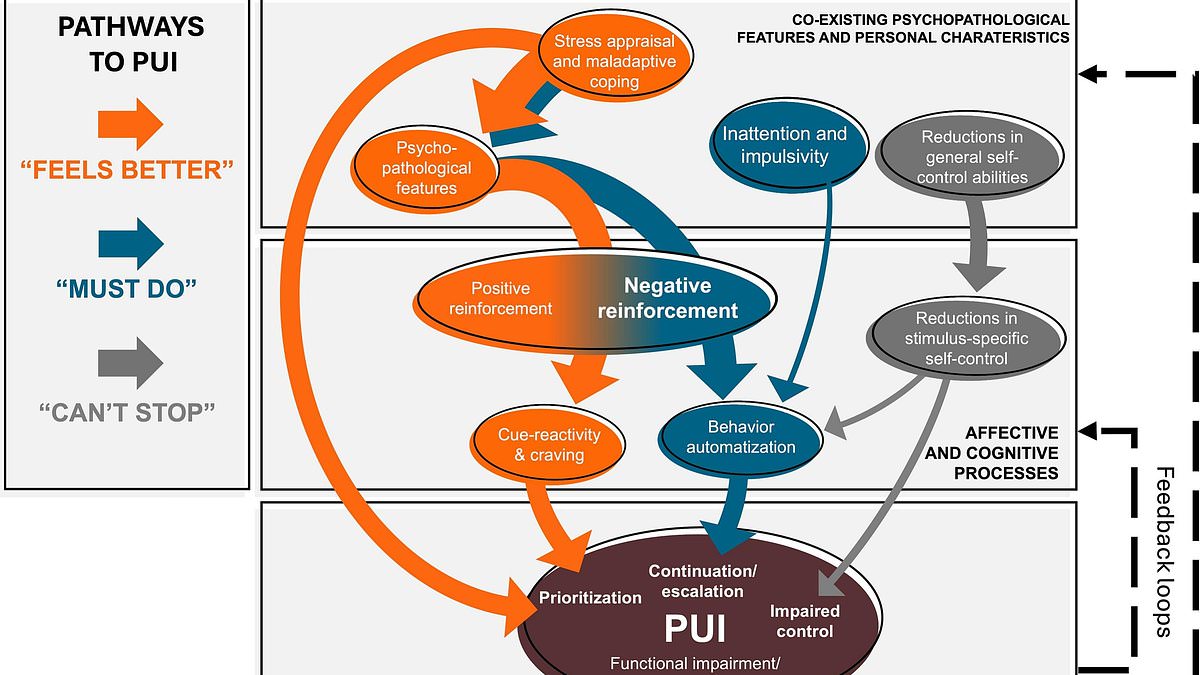
Do you feel lost without your smartphone in your hand? If so, your internet use might be spiralling out of control. Scientists from the University of Duisburg–Essen have pinpointed the three key drivers of problematic internet use. First is the desire to feel better or less bad – for instance through reward or distraction. Second is a growing inner compulsion to go online, which the researchers dub 'must do'. Finally, many people are driven by 'can't do' – a diminished ability to stop the behaviour. 'Problematic usage of the internet (PUI) is a steadily growing public health concern,' the researchers explained. 'With prevalence rates of approximately 7% for unspecified PUI across the globe, there is a need for improvements of prevention and intervention to protect individuals from PUI. 'If left unaddressed, PUI may progress to a clinically relevant mental health problem.' Scientists from the University of Duisburg–Essen have pinpointed the three key drivers of problematic internet use, which they've called 'Feels Better', 'Must Do', and 'Can't Stop'To understand what drives problematic internet use, the researchers enlisted 819 participants, with an average age of 27. The participants' internet use was examined extensively in a lab setting, using clinical interviews, questionnaires and computer–based tests. The results uncovered three key drivers of problematic internet use. The first pathway, called 'Feels better', tends to start with altered stress appraisal and a maladaptive coping style for dealing with stress in daily life.The second pathway, 'Must do' is linked to compulsivity.'Behavior automatization (i.e., using games or social media automatically and 'without thinking') is also linked to attentional impulsivity, which is a specific predisposing variable for the second, the compulsivity–related 'Must do' pathway,' the researchers explained in their study, published in Comprehensive Psychiatry.Finally, the third pathway, 'Can't stop', is related to reductions of cognitive behavior control. However, the researchers point out that many problematic internet users will be driven by a combination of these drivers. Do you feel lost without your smartphone in your hand? If so, you might your internet use might be spiralling out of control (stock image) The 3 key drivers of problematic internet use Feels better: Starts with altered stress appraisal and a maladaptive coping style for dealing with stress in daily lifeMust do: Using games or social media automatically and 'without thinking'Can't stop: Related to reductions of cognitive behavior control They added: 'The holistic picture of PUI mechanisms involves not only three distinct pathways but also includes conjunctions and interconnections between affective and cognitive processes acting in concert.' If any of these drivers sound familiar to you, don't panic. Dr Craig Sawchuk, a psychologist at the Mayo Clinic in Rochester, has shared tips to stop the scroll. Firstly, while you're on your phone, check in with your mood every five to 10 minutes. 'If you feel worse, pay attention to that,' Dr Sawchuk says. 'It doesn't mean you have to stop scrolling right away. You might scroll another five or 10 minutes and do another check–in. If you feel even worse, that's telling you something.'The psychologist also advises setting a time limit. He said: 'Decide how much time you will spend online. For example, you might agree to limit your scrolling to 15 to 20 minutes twice daily and set a timer.' A bizarre new trend has emerged on TikTok, in which Gen Z put themselves in timeout to try to fix their attention spansFinally, try to replace doomscrolling with healthy activities, such as socialising, exercising, or sleeping. The news comes shortly after a bizarre trend emerged on TikTok in which Gen Z 'rawdog boredom' to fix their attention spans.'Rules: no music, no TV, no drink, no phone,' one user explained in their TikTok video.This sounds fairly straightforward – and perhaps even a treat for busy people who rarely get a break. However, many participants have struggled, with one calling it the 'hardest thing I've done in a while.'According to Dr Sandi Mann, a senior psychology lecturer at the University of Central Lancashire, rawdogging boredom actually has many benefits – from sparking creativity to lowering anxiety. '[It] might seem like a humorous and slightly bizarre trend. However, there are some real mental–health benefits to gain from it,' she previously told the Daily Mail.