Will council shake up and possible devolution boost Norfolk business?
The government has confirmed that Norfolk’s eight councils will be abolished and replaced with three new unitary councils - Greater Norwich, West Norfolk and East Norfolk - from April 2028.
Business leaders say the move to fewer, larger councils goes “hand-in-hand” with devolution and the creation of a Mayoral Combined County Authority for Norfolk and Suffolk.
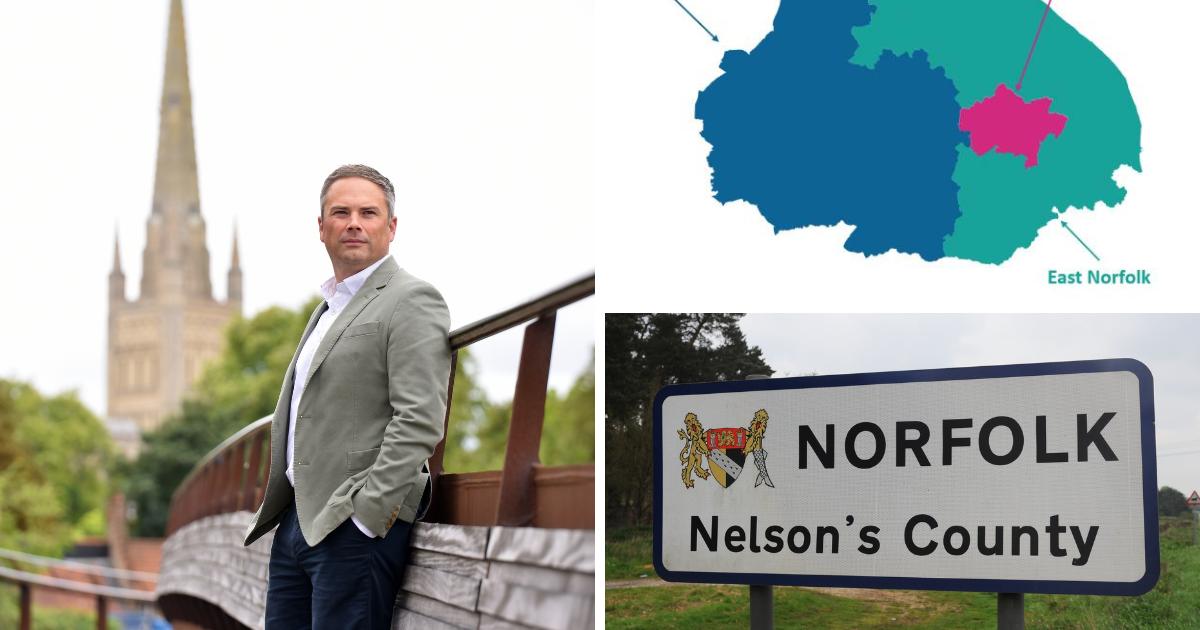
Norfolk's three new unitary councils, Greater Norwich, West Norfolk and East Norfolk (Image: Future Norfolk)
Devolution would see powers and budgets for transport, housing, jobs and skills transferred from central government to a Norfolk-Suffolk combined authority, controlled by an elected cross-county mayor.
The Norfolk Business Board is a partnership between business leaders, education providers and policy makers representing the county’s £20 billion economy.
The Board says the proposed devolution deal promises a long-term investment fund to support infrastructure, innovation and growth - as well as greater local influence over skills and transport, and a stronger regional voice in national decision-making.
“This is an opportunity we must grasp,” said Nick Steven-Jones, chairman of the Norfolk Business Board and Jarrolds chief executive.
Nick Steven-Jones, chairman of the Norfolk Business Board and Jarrolds chief executive (Image: Denise Bradley)
“From an economic standpoint, the underlying case for devolution has not changed. Norfolk continues to face long-standing challenges around productivity, east–west connectivity, skills alignment and access to long-term investment.
“These challenges are particularly acute in our rural and coastal communities. Greater local control over funding and decision-making is widely regarded by employers as a practical route to addressing these issues.”
He said devolution would increase the availability of skilled labour, the pace of infrastructure delivery and the confidence of inward investors.
“Recent uncertainty has affected business confidence and external perceptions of the region,” he added.
“From a business perspective, the priority is securing the long-term investment and meaningful local influence necessary to strengthen productivity, support high-quality employment and deliver long-term prosperity across Norfolk.”
Nick Steven-Jones, chairman of the Norfolk Business Board (Image: Denise Bradley)
The creation of Norfolk’s three new unitary councils, confirmed by the government last Wednesday (March 25), is a form of local government reorganisation - which is separate from devolution.
It will mean the abolition of Norfolk County Council, Norwich City Council, South Norfolk Council, Broadland District Council, Breckland District Council, North Norfolk Council, Great Yarmouth Borough Council and West Norfolk Council.
They will be replaced by Greater Norwich, West Norfolk and East Norfolk, which will provide all of the services in the area they cover.
This is in contrast to the current set-up where some services - such as roads, adult social care and children's services - are the responsibility of County Hall, while the district, borough and city council handle others, such as recycling, environmental health and planning.
Greater Norwich (Image: Future Norfolk)
Each new council will handle everything from business rates billing and collection, planning, licensing and trading standards, to roads, waste and skills‑related services.
Boundaries are set to shift so some firms will find themselves in a different ‘patch’ politically, dealing with a new set of councillors and senior officers.
A single planning authority in each council should give more consistent policies and decisions across each area.
East Norfolk (Image: Future Norfolk)
West Norfolk (Image: Future Norfolk)
Candy Richards, who represents East Anglia at the Federation of Small Businesses (FSB), said fewer councils could help eliminate the “postcode lottery” that firms face when applying for support and funding.
She said it could also speed up decision-making, planning and the delivery of infrastructure and investment.
“With the Government now confirming which model has been chosen for local government reform, it gives some certainty and clarity to residents and businesses about how future services and business support will be delivered,” she said.
Candy Richards, East Anglia regional business and stakeholder engagement manager at the Federation of Small Businesses (Image: Supplied)
“During this transition period, it is vital that councils do not lose focus on ensuring that small businesses receive the support they need, and that time and money is not diverted away from front-line service delivery.
“With both consumer and business confidence at record lows, our small businesses need their councils to be responsive and attuned to their needs whilst whole-scale reform takes place in the background.”