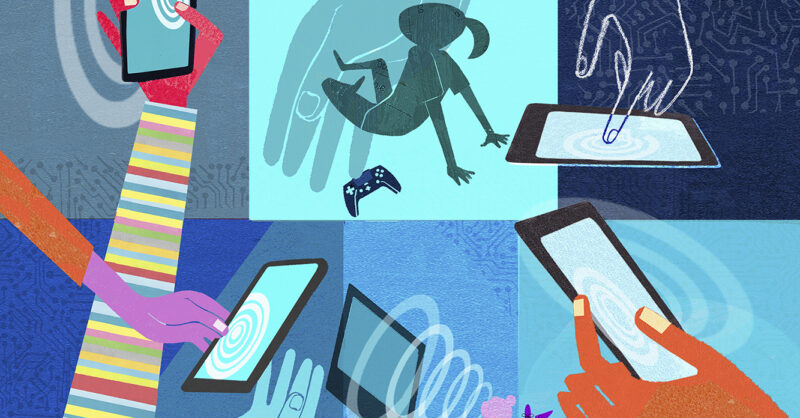
Parents must also take responsibility for online safety
“We need to do more to protect children,” the Prime Minister has said, responding to yesterday’s (25 March) decision by a Los Angeles jury which found tech giants Meta and Google liable for harming a 20-year-old’s mental health. The plaintiff, known only by her first name, Kaley, was awarded $6m in damages ($3m in compensatory damages and an additional $3m in punitive damages). Jurors agreed that Meta – which owns Instagram, Facebook and WhatsApp – and Google, the owner of YouTube, had intentionally built and designed their social media platforms to be addictive.
Campaigners for a social media ban for under-16s have welcomed the case, arguing that it has confirmed their worst fears. Social media is harmful to children, and they need to be shielded from it. Jonathan Haidt, the highly respected social psychologist whose book The Anxious Generation has been so influential in this debate, responded to the court’s decision, saying: “Social media is a defective, hazardous product, and states have the right to act to protect their children from dangerous products.”
Maybe. I am no expert in US law. But if states have the responsibility to protect children from dangerous products, surely so do parents. And this case has some worrying features which should prompt discussion over where responsibility lies when it comes to children and social media. Kaley told the court that she started using YouTube when she was six years old. She downloaded the app onto her iPod Touch to “watch videos about lip gloss and an online kids game”, the Mail has reported. Kaley joined Instagram three years later, when she was nine. By 10, the court heard, Kaley began experiencing anxiety and depression, both of which she later received therapy for.
I do not question the difficulties that this young woman has been through. How could I? I have the utmost sympathy. But as a mother of two children, I find some of these details hard to comprehend. Why was no one aware that these platforms were being accessed at such a young age? How could that be? My nine-year-old does not have a device to put Instagram on. We have no intention of changing that any time soon. But if she did, I am pretty sure I would know what she was doing and would put the necessary parental controls in place. At one point during her testimony, Kaley told the court: “I stopped engaging with family because I was spending all my time on social media.” It is unclear from media write-ups how old she was at this point. But I cannot help thinking why no one stepped in. Take the phone, the iPod Touch, the tablet – whatever it was – away.
Subscribe to the New Statesman today and save 75%
I am no apologist for Meta or Google (nor Snap and TikTok, which settled with Kaley before the case went to court). These companies undoubtedly could and should do more to keep children safe online, whether through far more robust age verification systems or by disabling certain features. The Los Angeles court ruled the companies “negligent”. Features like “infinite” scrolling and autoplay were designed to “hook” young children, the jury agreed, and did not adequately warn them of the dangers. Only a day earlier, a court in New Mexico ordered Meta to pay $375m. It found serious fault with the tech giant over the safety of its platforms, saying that it exposed children to sexually explicit material. This is both abhorrent and deeply worrying to me as a parent.
But much of the discussion about social media harm seems to centre on the software – the apps and the content within them – rather than the hardware necessary to view them: the smartphones, the tablets, the (now rather old-school) iPod Touches. Parents have some responsibility here, too. The picture is more complicated, more nuanced, than some campaigners portray.
In January, more than 60 Labour MPs signed an open letter calling for a social media ban for under-16s. It is what many believe led to the government’s decision to launch a consultation on the issue. The man behind the letter, Plymouth Moor View MP Fred Thomas, made his case in the Telegraph a month earlier. “The average 12-year-old spends 29 hours each week on their smartphone,” he wrote. “In the past three years, the likelihood of young people having mental health problems has increased by an astonishing 50 per cent,” he asserted, and “teachers and students consistently tell me about the pressures of the online world.”
Yet there is clearly far more going on in these statements than would be solved by simply enacting a ban. Putting aside whether the first statistic is true, what about not giving 12-year-olds a smartphone, or placing limits on it? The “online world” is not restricted to social media, something the government’s adviser on suicide prevention and mental health, Professor Louis Appleby, has pointed out. With more than a quarter of a century of suicide and mental health research behind him, Appleby is worth listening to. “There is undeniable suicide risk from social media,” he has written on social media, “but it is only part of a wider internet risk that includes the information available there.” Does that matter? he asked. “It does, if a social media ban distracts from tackling the full problem.”
Lawyers and campaigners alike have heralded yesterday’s decision in the US as a major turning point in the battle against social media. There are hundreds of similar cases now winding their way through US courts. There is widespread agreement that social media can be damaging for children. The debate is over how best to deal with it.
Two studies are planned for the UK to look at what approach might work best. One, involving 300 teenagers, will compare four different groups. One quarter of participants will have no access to the most popular social media apps (mimicking a ban). Another quarter will have no restrictions placed upon them, modelling the current arrangement. But two other groups will also be studied: one which has social media usage capped at 60 minutes per day, and one where young people will not be able to access social media between 21:00 and 07:00. A second, larger study is taking place of 4,000 12-15 year olds in Bradford, which has a similar design. The results won’t be available until 2027.
Whether the case of Kaley, or any other individual, proves that a social media ban is the only way forward, I am not yet convinced. I think the UK government is right to take its time to study the LA ruling “very carefully”, but not leap to action. Things will change, the Prime Minister said today. “The question is how much, and what are we going to do?” Consultations cannot go on forever. Decisions must be made. But we should welcome a commitment to looking at the evidence and competing solutions to this most pernicious of problems. For some policies, however well intentioned, may have inadvertent consequences.
[Further reading: Of course police could find Morgan McSweeney’s phone]
Content from our partners
Related