From the archive: Where to from Aldermaston?
After the anti-nuclear march from Aldermaston to London on Easter Monday 1962, the New Statesman’s then editor, Kingsley Martin, reflected on the future of the peace movement.
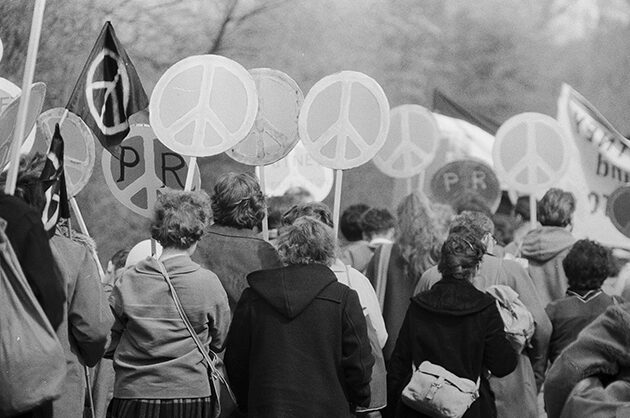
US tests; the fact that CND delegations were leaving to carry the protest to New York and Geneva; the great, silent demonstration which packed three sides of Grosvenor Square; the news that 30,000 marched in Copenhagen, that there were a dozen marches in various parts of the US, others in Canada, Italy, West Germany, Holland, Norway and New Zealand; the moving statements of survivors from the first nuclear explosions in Japan 17 years ago – these were new features of this year’s Aldermaston March. It was a sensible, serious and gay affair. Those who put about stories that the marchers were beatniks and juvenile delinquents may perhaps feel ashamed of themselves; in fact they were admirably disciplined, in spite of some trivial incidents which The Times reported as if they were significant. Those who organized the petty obstruction in Reading can have found little satisfaction, while the effect of noisy patriots occupying a corner of Trafalgar Square was merely to enable a larger and more impressive gathering to congregate in Hyde Park. No one can tell with accuracy how many reached the final rally – the most conservative estimate is 40,000; but it is in any case remarkable that something like one in every thousand of the British population bothered to assemble in one spot in London on Easter Monday. The young people had marched: their parents and older friends came to the final rally. Never, except in India, had I seen so many people gathered together in one place; certainly no such numbers of young people have ever before come together in this country to support a political cause. Their protest is national; their banners bring a demand from every part of this island. They are not a centralized party, but a free and spontaneous association of democratic groups – from all classes and religions – who are linked not by a blind loyalty but by an enthusing common purpose.
Most of the marchers are well aware that ‘Ban the Bomb’ is only a slogan which implies a new foreign policy. Every nuclear disarmer is first and foremost an advocate of multilateral disarmament; he or she supports the first CND policy demand for general disarmament, but adds ‘if necessary, alone,’ states that it intends in any case to begin the disarmament process. ‘If necessary’, because experience of orthodox disarmament conferences has taught us that nothing comes of horse-trading in arms, while it is still possible that the deadlock may be broken if one of the great powers bluntly states that it intends in any case to begin the disarmament process. To this must be added the now supremely important objective of stopping the spread of nuclear arms to other countries which are hesitating to make them. The further, more complex problems which follow – the future of Nato, disengagement, the meaning of positive neutralism and the economic results of a switch in defence expenditure – are of course less clearly understood, but widely discussed.
Until this year, there has never any doubt about where the Aldermaston March was expected to lead. The goal was Westminster, the object was to capture the Labour party, whose leaders seemed (only two years ago before the Scarborough victory) to be opposed to Britain’s possession of a separate national deterrent, as well as securely pledged to opposition to the renewal of all tests. Since Mr Gaitskell’s success at Blackpool in reversing the Scarborough decision, many people fail to see any difference on issues of foreign and defence policy between Tory and Labour leaders. If none of the protests against the renewal of tests has been formally debated in the House of Commons, that, as Michael Foot told the Hyde Park rally, is because on this issue ‘Mr Gaitskell is dumb.’ If the leader of the Labour party agreed with President Kennedy last September that ‘Soviet testing has shown complete disregard for the welfare of mankind’, what makes him believe that America’s decision to poison the atmosphere today is any less reckless? Inevitably the CND movement asks whether the Labour party under such leadership can be the instrument of a sane policy.
Subscribe to the New Statesman today and save 75%
In 1960 Lord Russell’s Committee of 100 initiated a policy of direct pressure by non-violent disobedience. I have never believed that this would promote disarmament, because in a country where legal means of protest are available little public sympathy can be aroused by sit-down obstruction and the like. Illegal action can succeed in building support for a repressed minority or for a national movement in a country which, like India, was under foreign domination. Many groups from the Quakers downwards, have won the right to hold and express their opinions by civil disobedience. But no government with a majority at its back is likely to abandon its defence policy and discard its weapons because some hundreds or thousands of citizens disobey the law. There is of course far more to be said for such methods as secret, and therefore technically illegal, broadcasting. The arguments in favour of nuclear disarmament are advanced by such broadcasts; here it is the arguments and not the illegality which attract attention.
The Committee of 100 has won much publicity, but if its enthusiasts are not to tire, it must find new methods of agitation which do not divide, but strengthen and unite the anti-nuclear movement. Despairing of winning their way within the Labour party, a number of keen and energetic nuclear disarmers have advanced a proposal to set up independent CND candidates at by-elections. The idea is superficially attractive, but I believe that the advantages are easily outweighed by the disadvantages. It is true that, if a CND candidate stands for election, the issue of nuclear disarmament is forced into the centre of the campaign and that those who believe this to be the most important of political issues have the chance of voting for a candidate who genuinely represents them. In some cases, this might mean that the Labour or Liberal party would select a candidate who was also a nuclear disarmer or at any rate one who so represented himself to be during the election. But it is clear that the Labour party executive would expel any CND supporters who worked for any candidate who opposed the official Labour candidate. This would mean that all the prominent Labour supporters of CND would be compelled to dissociate themselves from a unilateralist candidate. Nothing would better suit Mr Gaitskell and Mr George Brown.
Whether or not the official CND leadership is thus seriously embarrassed, the logic of separate candidatures is the formation of something like a new ILP. It is far from clear what advantages, apart from a short-lived emotional satisfaction, such a policy would have. If support for separate candidates can be, as at present intended, confined to by-elections without involving the official CND, no great harm might follow. The chances are, however, that very few, if any, candidates standing on a purely unilateral platform would be elected; even in by-elections, comparatively few voters care to give their support to a candidate who at best can only be a lonely voice of protest. The likely result would be a derisory vote, not because the number of CND supporters is derisory – indeed, they might be a majority in some areas – but because people are not normally prepared to vote on a single issue where the choice before them is broadly between socialist and conservative policy.
To expose the objection to new policies is easy. The retort, which the CND itself must be able to meet, is that to march once a year from Aldermaston to London, to demonstrate and to organize public meetings and discussions all over the country, is not in itself sufficient. Some other method of persuasion must be discovered if the CND argument and attitude to life is to grow and conquer within the present political system. Aldermaston may too easily become a spring festival, splendid but politically atrophied. An annual demonstration is valuable because it consolidates support and generates enthusiasm. Mr Frank Cousins, in an eloquent speech at Monday’s rally, reached the kernel of the problem when he pointed out that, if all the supporters of CND were prepared to enter local and trade union politics with their Aldermaston enthusiasm, they would inevitably transform the Labour party. There are already areas where each Labour party municipal candidate is a CND supporter. CND in fact has reached the point at which to be effective its public demonstrations are less important than its solid political work. If it throws its energies into each council election, if it agitates within each trade union, if it organizes on a mass scale in each by-election, few Labour or Liberal candidates will reach the House of Commons who repudiate its principles.
[Further reading: From the archive: Requiem for Harold Wilson]
Content from our partners
Related
This article appears in the 25 Mar 2026 issue of the New Statesman, Easter Special