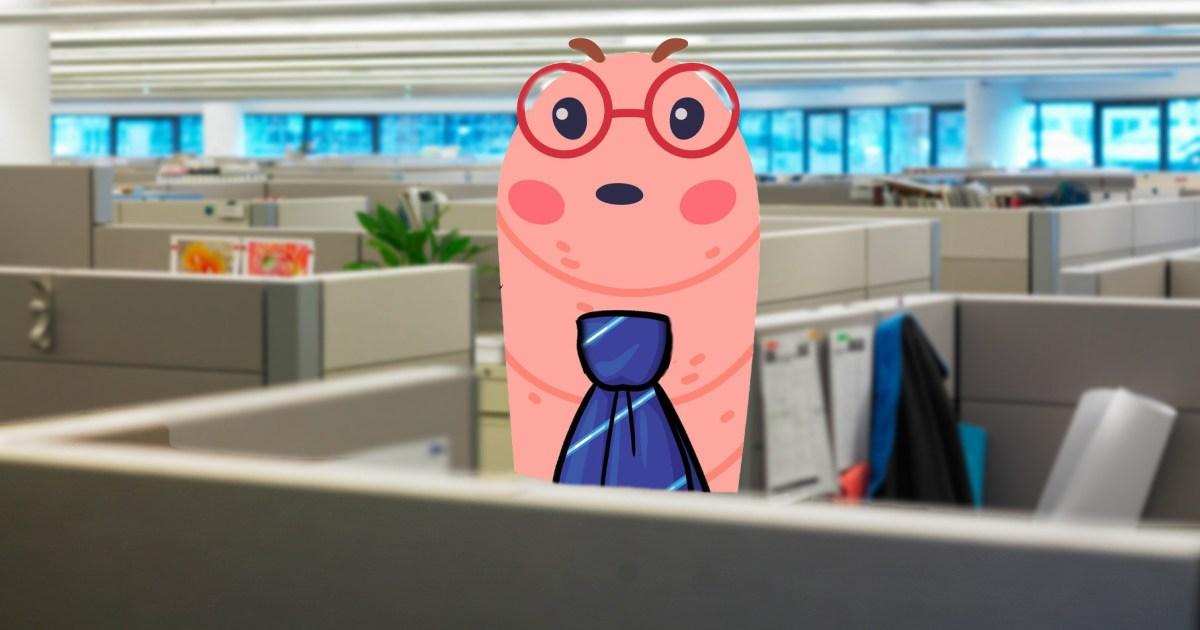
Hookworms are plaguing UK offices and bosses haven’t even noticed
This subtle work personality is going unnoticed (Picture: Getty/Makin)
Hookworms are some of the most unpleasant, vicious creatures on earth.
These are the words of Susie Ashfield, a UK leading speech coach, who’s new book Just F**king Say It provides a handy guide to dealing with ‘difficult creatures’ in workplace settings.
Now, if you’re unsure what a hookworm is, its a parasite which enters the body through the foot, using its sharp mouth to penetrate the skin, before settling in your body and moving all the way up to your throat. Yikes.
‘A hookworm’s ability to lie undetected for so long means that by the time you’re aware you have one, it becomes extremely difficult to get rid of,’ Susie explains.
‘They’re ambitious, successful, and have a serious long-term plan to get to the top.’
It may sound alarmingly similar to a certain type of personality that is common in UK offices. You know, that person with a maddening tendency to suck up to the right people (like your impressionable boss, for instance) while simultaneously bringing those around them down.
With 85% of Brits claiming they have an annoying work colleague, according to Kickresume, it’s likely there are some pesky hookworms in the mix.
Identifying a hookworm
‘We’ve all encountered a “hookworm” at some point in our careers, and they’re usually the people we avoid like the plague at the Christmas party,’ Jim Moore, employee relations expert at HR consultants Hamilton Nash, tells Metro.
Office hookworms can be very passive aggressive (Picture: Getty Images)
‘These employees might be great at toadying up to senior management, but they’re toxic to peers and subordinates, and can cause real damage to team morale and productivity.’
But what exploits might cause you this undue stress? ‘Classic behaviours include taking credit for others’ work, flattering senior leaders while criticising peers and subtly sabotaging colleagues through gossip,’ Jim explains.
Susie adds they may take credit for something they didn’t do, and this type of person is disliked by 33% of Brits in the office.
They may also make snide comments, give backhanded compliments, or undermine the work of others around them. An example Susie gives in her book is being told by said hookworm: ‘I was surprised that your report came back to me ahead of the deadline.’
‘Some of their tricks might sound petty, but they can have a real effect on people’s careers and prospects,’ says Jim.
How to deal with the hookworm
It might seem like your boss loves them, but that doesn’t mean your hookworm is untouchable.
Jim explains that if you’ve been affected by this type of colleague, you need to make sure you document specific incidents, including times, dates and who it was witnessed by.
‘You also need to build your own relationships through the workplace, so their narrative isn’t the only one that’s being heard,’ he says. ‘If the behaviour involves bullying or taking credit for your work, raise it with your line manager or HR team.’
Making strong workplace relationships means people will hear your side of the story (Picture: Getty Images)
Just 12% of people dealing with a colleague like this reported it to HR, according to Kickresume, despite 58% of people admitting annoying colleagues deeply impact their productivity at work.
‘Being a hookworm isn’t a reportable offence in itself,’ Jim clarifies, ‘but when it crosses the line into bullying, sabotage and creating a toxic work environment, it’s time to speak to HR.’
Gently ask them why
Susie’s advice for dealing with someone who communicates in a passive-aggressive way is to bring what they’re actually saying to the surface (in a professional manner).
If we go back to the example phrase from a hookworm ‘I was surprised that your report came back to me ahead of the deadline’, simply ask them to clarify why they were surprised, in a very neutral tone, says Susie.
If they shrug the question off, simply ask again, the speech expert adds, and if they do tell you why they were surprised, then you can address the root of the problem.
I ditched bleak Britain and moved to a country I'd never visited before
'Soft off days' might be an elite corporate hack — but they could get you sacked
'Key jammers' are the thorn in the side of UK HR departments
‘They’re much less likely to throw passive-aggressive comments your way now because they know you’re happy to call them out and deal with them,’ Susie says.
The expert adds that if they’re always stealing credit, be quick to shout out your colleagues for work they’ve done well, to make sure the hookworm doesn’t get the praise if it’s not due.
‘Ultimately,’ Jim says, ‘hookworms can prosper through their behaviour in the short term, with their antics often resulting in promotions and career opportunities.
‘The good news is these people are usually found out, especially when colleagues speak up, or when they’re promoted to a position where they become exposed.’
Do you have a story to share?
Get in touch by emailing MetroLifestyleTeam@Metro.co.uk.
Arrow
MORE: UK’s remotest island with population of 50 seeks ‘resourceful’ new residents
Arrow
MORE: ‘Soft off days’ might be an elite corporate hack — but they could get you sacked
Arrow
MORE: I ditched bleak Britain and moved to a country I’d never visited before
Comment now
Comments
Add Metro as a Preferred Source on Google
Add as preferred source