Stream It Or Skip It: ‘The Testament of Ann Lee’ on VOD, an Over-the-Top Musical Biopic in Which Amanda Seyfried Blows us Away Playing a Christian Cult Leader
Is The Testament of Ann Lee (now streaming on VOD platforms like Amazon Prime Video) the grimmest musical ever put on film? Credit director Mona Fastvold – who co-wrote The Brutalist with Brady Corbet, who in turn co-wrote Ann Lee – for blurring the lines between the period piece, biopic and musical genres by dramatizing the story of the leader of the Shaker movement, an offshoot of the Quaker sect whose members incorporated peculiar dancing and singing into their worship. Is what we’re seeing an authentic portrayal of such expressiveness, or is it just a Hollywood production? It’s kind of hard to tell, and all the more fascinating for it, especially as it’s led by Amanda Seyfried, who shows the type of commitment and intensity that has us puzzling over the lack of a 2026 Best Actress Oscar nomination.
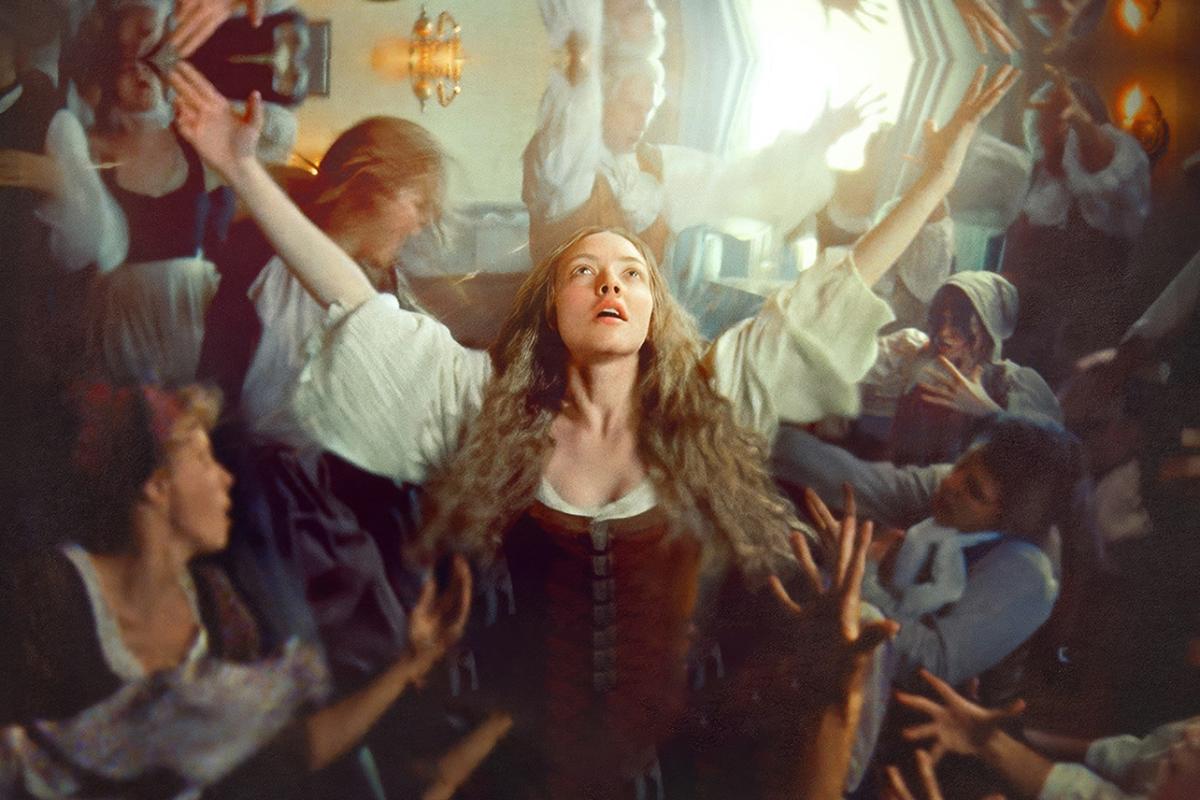
The Gist: The opening sequence in which a gaggle of women in bonnets thrash and dance in Michael Jackson’s Thriller-meets-The Robot style choreography threw me off and kept me there, unbalanced, for more than two hours. Led by Mary (Thomasin McKenzie), our narrator with one mottled-cloudy eye, these dancers sing of the woman who led them, “clothed by the sun,” with the “moon under her feet.” That would be Ann Lee, born in Manchester, England in 1736 to a family we see teaching their soft-skulled babies how to clasp their hands in prayer at the dinner table. She has a brother, William, and as children they tied handkerchiefs around their mouths so they wouldn’t inhale fluffs of cotton as they toiled in the textile mill. Those are the mundane details; we watch as young Ann Lee’s eyes widen in horror to see her parents engage in sexual intercourse under cloak of darkness.
The adult Ann Lee (Seyfried) works outside her core community as a cook at an infirmary. She walks into a revival meeting held by the “Shaking Quakers,” a spinoff denomination that engages in rapturous, chaotic musical expression that resembles speaking in tongues if it was (almost) set to a beat, with moans and thrusts that remind those of us with normal dirty minds of something rather unreligious. They became known as Shakers, and they would counterbalance their physical and vocal craziness with an assertion that God was both male and female, therefore landing on the logic of gender equality (and by that token, racial equality too). As Ann Lee became acclimated to the ways of the Shakers, she grew less comfortable with her own life, as her husband Abraham (Christopher Abbott) liked to spank her bare behind and read scripture just prior to the physical communion that Ann Lee found so repulsive. Her relationship with sex grew even thornier with the result of it: She had four children, all of whom died within their first year on this planet, here dramatized in a musical montage unlike any you’ve ever seen or ever likely will see.
We learn that Ann Lee’s brother William (Lewis Pullman) is secretly gay, although that soon won’t matter much. The Shakers’ loud and disruptive evangelism results in Ann Lee’s arrest and imprisonment, during which she levitates and has visions, and whether that’s the result of divine intervention or the fact that she starved herself for two weeks depends on how much logic you want to apply to the situation. Her release from jail was her rolling-the-boulder-from-the-mouth-of-the-cave moment. She declares herself the second coming of Christ, and, not at all apropos of nothing, just ask her therapist, proclaims fornication to be the ultimate sin. As the Shakers proclaim her their messiah-leader, they wear out their welcome in England, and Ann Lee leads a small faction to America, in the soon-to-be-state of New York to be precise, where the pending Declaration will deem their religion legal, and where they can find a patch of land in the woods out of earshot so the rest of the population doesn’t have to hear the constant stomping, moaning, screaming, gibbering, yelping, grunting and singing. Or maybe that’s just the movie staging a musical sequence?
Photo: ©Searchlight Pictures/Courtesy Everett Collection
What Movies Will It Remind You Of? For thematic and creative reasons, Ann Lee absolutely shakes hands with The Brutalist. It also finds Fastvold to a degree borrowing some of the visual language from thrillers and horror films, whether it’s the unsettling vibes of Ari Aster’s Midsommar or the starkness of Michael Haneke’s Cache or The White Ribbon.
Performance Worth Watching: I’m just confirming that yes, indeed, the reports of a Seyfried tour-de-force are true.
Sex And Skin: Graphic nudity, some S&M and moments of sweaty rutting illustrate the stark difference between “depicting sex” and “sexy.” Note, there are scenes of sexual violence and graphic childbirth, if you’re sensitive to any of that.
Photo: Everett Collection
Our Take: The Testament of Ann Lee is a difficult watch, unruly, creative and intense, fascinating and perplexing in equal measure, its extreme imagery presented within a robust visual palette, its song-and-dance choreography, part of the lifestyle and philosophy of its characters, seamlessly integrated into the narrative, which focuses tightly on an unforgettable central performance. It’s overwhelming. A bit much, perhaps. But it’s also a shame that larger audiences aren’t likely to see Seyfried lose herself within this character and production, giving an emotionally raw and physically grueling performance that in a just world would place her among the elite talents of film (and here I’ll note that her performance, as huge as it can be, is rooted in more naturalism than current Oscar favorite Jessie Buckley (Hamnet), who, despite the lack of singing required for her role, is ultimately more performative and self-conscious).
Also, here’s hoping Seyfried’s next film is a featherweight rom-com, not because we necessarily need one (note: we probably do!), but to balance out the energy in the room here a bit.
I watched Ann Lee with eyes wide (often growing wider) and fingers scratching my head, basking in a confusion as to what I was seeing, and why. Fastvold has a way of challenging us in the neutral zone between fact-based “reality” and fiction, incorporating musical numbers as diegetic within the context of the narrative. It’s a thoroughly inspired way to tell this story about what’s essentially a cult and its messiah-complex leader, who’s enlightened when it comes to human equality and notions of nonviolence, but a tad shortsighted in the means of growing the faith movement, since no members can reproduce without being expelled.
I wish the film wrestled with this irony more, and was more invested in the details of the growth of the Shaker movement – most fascinating is a sequence in which lead evangelist William swoops in to assimilate a faction of Christians ready to abandon their apocalypse-predicting pastor (Tim Blake Nelson) after a solar eclipse fails to rend the Earth asunder. And Ann Lee is never quite a character with a full inner life, as Seyfried portrays her as someone who keeps her whole self bare to the elements at all times, a reflection of the Shaker tenet in which members must openly confess their sins to the congregation, in a display of stomping, moaning, screaming, gibbering, etc. It’s no wonder that we – and perhaps Fastvold – are distracted from Ann Lee’s mercurial themes and tone, repelled and activated and puzzled by this maximalist expression of religious devotion as we inevitably are. We may walk away from the film with only the broadest psychology of its bizarrely charismatic protagonist, but there’s no doubt whatsoever that Ann Lee took no half-measures in life.
Our Call: Ann Lee goes whole-hog and you can’t help but be admired by her dedication – and hypnotized by this most singular of musicals. STREAM IT.
John Serba is a freelance film critic from Grand Rapids, Michigan. Werner Herzog hugged him once.