Owen Doyle: Hollie Davidson was picked on merit, but Ireland v Italy wasn’t her best work
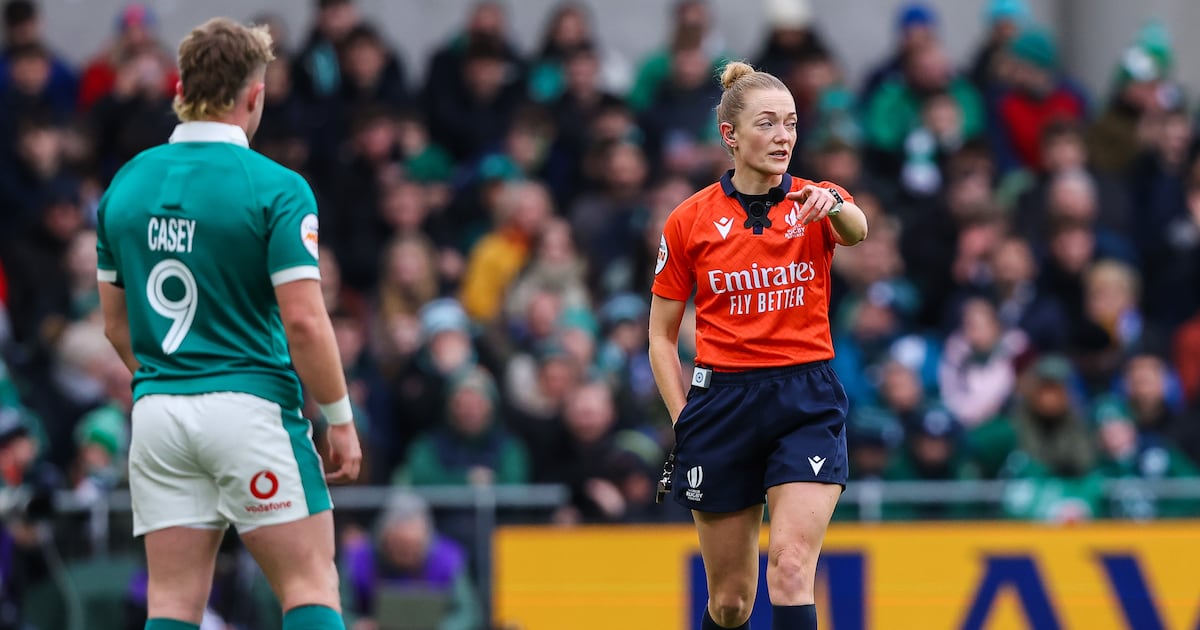
It may have been Valentine’s Day at the Aviva, but there was no love lost in this battle. That’s Amore echoed around the stadium, but its calming influence proved minimal. Ireland were put to the pin of their collar on their way to forging a much-needed victory, although something tells me the better team lost.The previous week’s results – a win for Italy and a defeat for Ireland – greatly increased the challenge for Hollie Davidson. Becoming the first woman to referee in the men’s Six Nations is a truly brilliant achievement. It was a merit-based appointment and we will see more of her at this level.The first half was, by any metric, a very good performance by Davidson. Italy’s Louis Lynagh was rightly binned for a deliberate knock-on as he had no chance of catching the ball. Craig Casey was also yellow-carded for an upright attempted tackle. While it might have looked a harsh call and the degree of danger was not high, Casey needed to make some effort to position himself for a legal tackle.As we got into the second half, the temperature rose and tempers frayed. In this respect, James Ryan may well be heading for trouble as his attempts to provoke the opposition were totally out of order. With the intensity ratcheting up, we saw a few incorrect and questionable decisions. Two or three breakdown calls perplexed Irish captain Caelan Doris. He had a point.READ MOREThe Counter Ruck: the rugby newsletter from The Irish TimesJamie Osborne’s timely return fills Ireland’s injury void in Six NationsIreland must keep guard raised against wounded beast at TwickenhamDid Ireland restore confidence ahead of Twickenham showdown?The scoring pass from the superb Tommaso Menoncello to Lynagh was called forward, ruling out the try. It was an unnecessary intrusion by TMO Ian Tempest, who should have stayed silent. The passed ball crossed the 22-metre line, making it appear as being forward. But, as Isaac Newton’s law of momentum tells us, that has nothing to do with it. Nor did we see evidence of the ball being delivered forward out of Menoncello’s hands. Italy clearly have a very genuine gripe on this one – it goes into the poor-decision category.The last-minute penalty against Edwin Edogbo was also in that category. Or was it? Edogbo seemed to do as he was told, but was pinged anyway. If Davidson considered that he had slowed down Italian possession, then she probably felt a penalty was necessary. It was all very debatable and therefore, the wise course of action was to play on. Potentially result-altering decisions need to be crystal clear and this one was not.Referee Nika Amashukeli shows a red card to England's Henry Arundell (not pictured) during last Saturday's Six Nations match between England and Scotland at Twickenham. Photograph: David Rogers/Getty Images Scotland against England in the Calcutta Cup has seen many famous contests. The famous trophy, on the line since 1879, adds enormous additional bite to this annual joust. Six Nations apart, this is a separate, private battle.On Saturday, Scotland confirmed that pre-match form is meaningless as they fairly sliced and diced England. It was a terrific victory, forecast by precisely nobody. Steve Borthwick’s army was “sent homeward tae think again”. Nika Amashukeli, probably the best referee in the world, was in charge – and it needed someone of his stature. But even Amashukeli found it necessary to tell the captains only they could talk to him. That really should be established before kick-off.When the Calcutta Cup match came my way, it was postponed due to awful January weather, so we all set off for Twickenham in early April. Scotland were firm favourites and the win would give them the Triple Crown. England were very much in the doldrums, illustrated by their position at the bottom of the table on zero points. But again, the tables were turned in a noteworthy match.It was the legendary Brian Moore’s first cap – he would eventually retire with 64, plus another five for the Lions across two tours. We would see quite a bit of each other over the next six years or so. He could be tricky enough on the pitch, but good company once hostilities had ceased.In this, their last match, the crucial penalty try awarded by this Irish referee was, incredibly, England’s first try of the Five Nations. The decision wasn’t difficult and received the approval of the try-starved home crowd. The palindromic scoreline of 21-12 went in England’s favour. They had unexpectedly bagged the prized trophy. Most unusually, it was also accompanied by the not-quite-so-prized wooden spoon.After the match, the urbane Dudley Wood, long-time secretary of the RFU, sought me out. “There’s a former referee who’d like to meet you.” It was Denis Thatcher. Yes, that’s the one. He was not at all like the man persistently ridiculed at the hands of Private Eye. Thatcher was charming, smart, amusing and definitely knew his rugby. He had indeed been a very respected referee in his day. We chatted for nearly an hour over a glass or two of the black stuff. He insisted that it was the most appropriate beverage to celebrate the victory, and, as he said, the penalty try.Ireland, in the unfamiliar territory of fifth place in the table, now travel to London. They will face a wounded England, who will be all the more dangerous for it. Italian referee Andrea Piardi is likely to be busy. It won’t be easy, but it will be completely compelling, adding to the thrilling rugby the Six Nations is delivering once again. It’s a wonderful tournament, proof that there isn’t really much wrong with the laws of the game.Those who wish to tinker with them must be resisted. Rugby union is not and must not become an all-singing, all-dancing game. Even if that means disobliging the new World Rugby chair, Brett Robinson, who seems to be in an almighty hurry to change things. World Rugby’s constituent unions should not follow suit – there is absolutely no need.