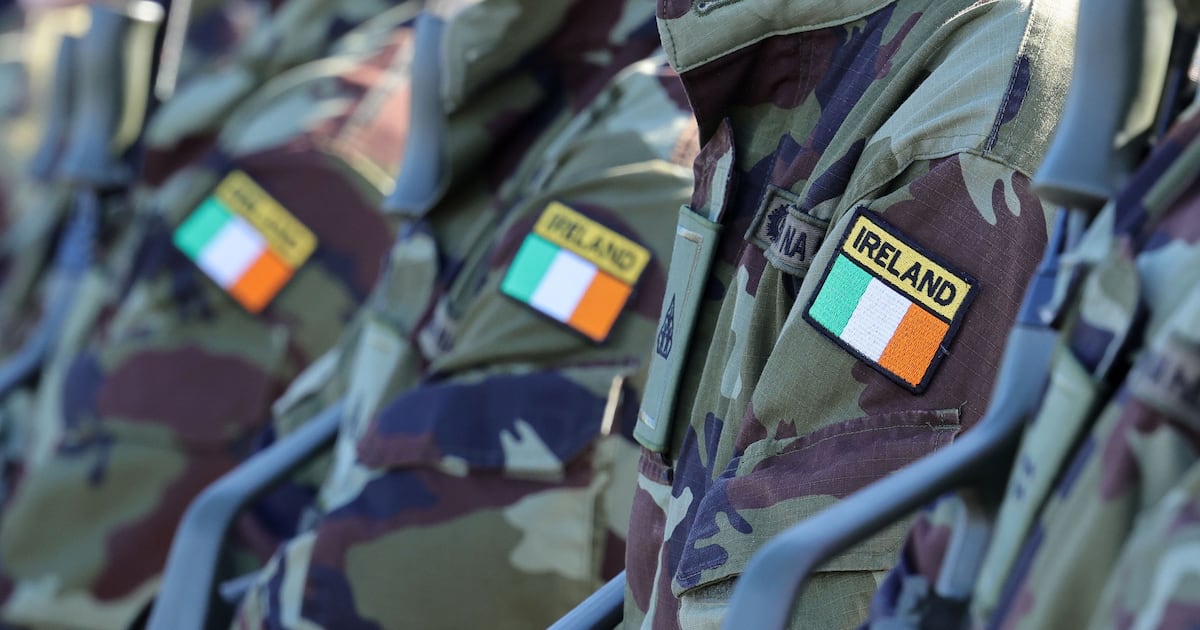
‘A bunch of freeloaders’: Increasing UK pressure on Ireland to invest in defence
In 1990, Northern Ireland secretary Peter Brooke announced, in what became known as the Whitbread speech, that Britain held “no selfish strategic or economic interest in Northern Ireland”. It was a landmark moment in the embryonic peace process, one which introduced the principle of consent; that the future of Northern Ireland would only be decided by the people of Northern Ireland. This would form part of the bedrock of the Belfast Agreement eight years later. At the time, less attention was paid to the part of the speech which made clear that Northern Ireland – and by extension the island of Ireland – was no longer strategically relevant when it came to defending the UK from foreign threats. It was in stark contrast to the period following the War of Independence, during which British negotiators insisted on control of the Treaty ports to protect their shipping lanes. It was also unlike the darkest days of the second World War, when Winston Churchill gave consideration to invading the south. READ MOREDancing with the Stars review: The latest celeb exits, but the real losers are the viewers Dan Sheehan enjoys bus trip before Rob Kearney, Conor Murray and Peter O’Mahony jump ship It was an era of body-moralising in Ireland, when obesity was a personal failureThroughout the 1990s, British forces in the North were drawn down. This was partly a result of the peace process and partly due to the end of the Cold War. Thousands of British troops were brought home, Naval Service and RAF assets were withdrawn, and radar bases were shuttered. Today, just over 1,500 troops are stationed in Northern Ireland. However, since Russia’s full-scale invasion of Ukraine, Brooke’s assertion that Ireland is no longer of any strategic importance is being re-examined in London’s political and security circles. The result is a subtle, and sometimes not-so-subtle, pressure campaign by British officials and prominent commentators for Ireland to step up its military capacity, particularly regarding naval and air defence. In public, British politicians and diplomats praise Ireland’s cooperation on security matters. In private conversations, they question how the Government has let the Defence Forces deteriorate to a point where it can often only put one ship to sea at a time. “Ireland’s position in the Atlantic has always made it pretty critical to British defence,” said Ed Arnold, a senior research fellow at Britain’s Royal United Services Institute. “Today it’s about information and the subsea cables that effectively connect the US to a large part of Europe.” Ireland lacks the ability to protect these cables even though, as a major data hub, it benefits from them economically, Arnold said. “So there’s an annoyance in Westminster now where they’re saying, ‘Well, we’re basically covering Irish waters as well, because we have a critical dependency there, but Ireland is not doing it themselves’.” Britain increasingly views these failures in defence as a risk to its own national security, particularly from Russian naval vessels operating off the Irish west coast. The result has been a series of think-tank reports, Westminster debates and opinion articles, as well at a lot of behind-the-scenes lobbying, imploring Ireland to start taking defence seriously. Russia’s increasing use of hybrid warfare and sabotage operations is focusing minds in London about Ireland’s lack of defence, according to Steve Aiken, a Northern Ireland MLA and member of the Ulster Unionist Party. Aiken, a former nuclear submarine commander in the Royal Navy who also sits on the British-Irish Parliamentary Assembly, said British aircraft are increasingly being sent to the Baltic to carry out Nato air patrols to deter Russian aggression. “That does not leave any spare air-capacity to be going out to defend a bunch of freeloaders,” he told The Irish Times. “Anybody who has served in the UK armed forces and has served alongside the Defence Forces anywhere has the utmost respect for your professionalism. “But you cannot be given missions to do for which you have no equipment, no training, no support and above all, politicians who haven’t got a bloody clue.” Similar sentiments have been increasingly expressed in Westminster in recent months. Last October, Jock Stirrup, a member of the House of Lords and once the UK’s most senior military officer, said Ireland “lacks the capabilities to defend against” attacks on its expanding maritime infrastructure. He also suggested the election of Catherine Connolly as President might lessen Irish co-operation with Nato – though the role of Irish president has no control over foreign policy. Stirrup asked Vernon Coaker, a minister of state in the UK ministry of defence, what assessment had been made of the UK’s “vulnerabilities to Ireland’s position”. In response, Coaker said Stirrup had raised an important point and confirmed that the UK government “talks with our Irish colleagues about some of these threats”. A month previously, Kate Hoey, the often-outspoken peer from Northern Ireland, asked in the House of Lords how Ireland can “keep their neutrality without having to pay any contributions”. She asked Coaker to tell Dublin “that co-operation is a two-way process”. One figure who has voiced concerns about Irish defence capabilities in the UK parliament is Chris Parry, a retired Royal Navy admiral and a member of Nigel Farage’s Reform party. Parry caused a minor political storm last year when, while appearing before a briefing in Westminster, said Nato should conduct naval exercises in Irish-controlled waters, whether Dublin agreed or not. “If anyone attacks Britain, they will attack Ireland. It is as simple as that,” he said. “If you are part of the free world, you have to be prepared to defend it. The Republic needs to reduce its vulnerabilities.” The Irish question is coming up “more and more” in the UK, Parry told The Irish Times last week. “There’s a big gap where Ireland’s contribution should be, both in practical terms and also in military terms.” “You can’t just sit on the border between Lebanon and Israel and do nothing,” the retired officer said in reference to Ireland’s UN peacekeeping commitments. “Your country is better than that. It really is. I’ve served on operations and combat tours with Irish people and they’re great. We just need them contributing.” Parry and Aiken, both former naval officers, specifically raised the nightmare scenario of Russia using Irish waters to launch a missile attack on the UK, with the Irish military unable to intervene. Russian ships could use the waters off the Irish west coast to target Europe and Britain, “possibly with hypersonic and certainly with cruise missiles”, said Parry. “Can you imagine how Britain’s going to feel about Ireland just watching these things fly over as they hit Liverpool, Manchester and London?” As it stands, the Irish Naval Service “is basically tied up”, Aiken said. The prospect of Irish reunification and with it, the possibility of Northern Ireland leaving Nato, is a particular cause of concern in some sectors, especially in conservative circles. Last year, Policy Exchange, an influential think tank founded by Conservative MPs, published Closing the Back Door, a lengthy report on the security risks posed by Ireland’s underinvestment in defence. “The unavoidable fact is that the ROI grounded its security upon the transatlantic-European economic and security order, whilst freeloading off the significant investment of others in protecting it, absent any Irish desire to play a constructive part in the broader Atlantic security system,” the authors stated. The solution, the report concluded, is to reinforce the UK’s military commitment to Northern Ireland and take any prospect of reunification off the table when dealing with the Republic. It also recommended encouraging other countries to make clear to Ireland that its “disregard for collective security will no longer be accepted”. The right to station military assets in Northern Ireland is essential for Britain in the event of war, said Parry. In a conflict with Russia, shipping lanes around Ireland will again become vital for the UK’s survival, just as they were in the world wars, he said. “You’d see a repeat of the problems of actually getting any merchant ships through the [English] Channel, so the north channel becomes incredibly important in those situations.” Being able to deploy combat interceptor aircraft from the island of Ireland would also dramatically increase response times during a war situation, he added. Various solutions have been put forward to the issue by UK commentators, including Ireland joining Nato or entering a bilateral collective security arrangement with the UK. “Of course you’re halfway there anyway, because Britain provides the air and sea security for Ireland,” said Parry. Others have suggested Ireland starts paying the UK for this defence. “Is it not time we made it clear to the Irish that, in this globally dangerous world, they have to make an appropriate contribution to defence?”, former UK admiral Alan West said in the House of Lords last year. “You put up two [Royal Air Force] Typhoon fighters with a tanker, you’re burning through close on €1.5 million worth of fuel and airframe hours every hour," said Aiken last week. “I want to see how Ireland is going to pay for its air defence, because it doesn’t come cheap.” The prospect of Ireland making defence payments to the UK is an unlikely one, as is a bilateral Nato-style agreement. The approach of the current Labour government and its diplomats is to gradually and politely move Irish thinking in the desired direction, UK sources said. A spokesman for the British Embassy said “both governments are committed to strengthening our cooperation in security and defence on everything from subsea infrastructure and cyber to implementing our existing Memorandum of Understanding on Defence”. The direction of travel has been “positive”, according to a diplomatic source. “Has it been happening as quick as one would expect post Russia’s invasion of Ukraine? No.”