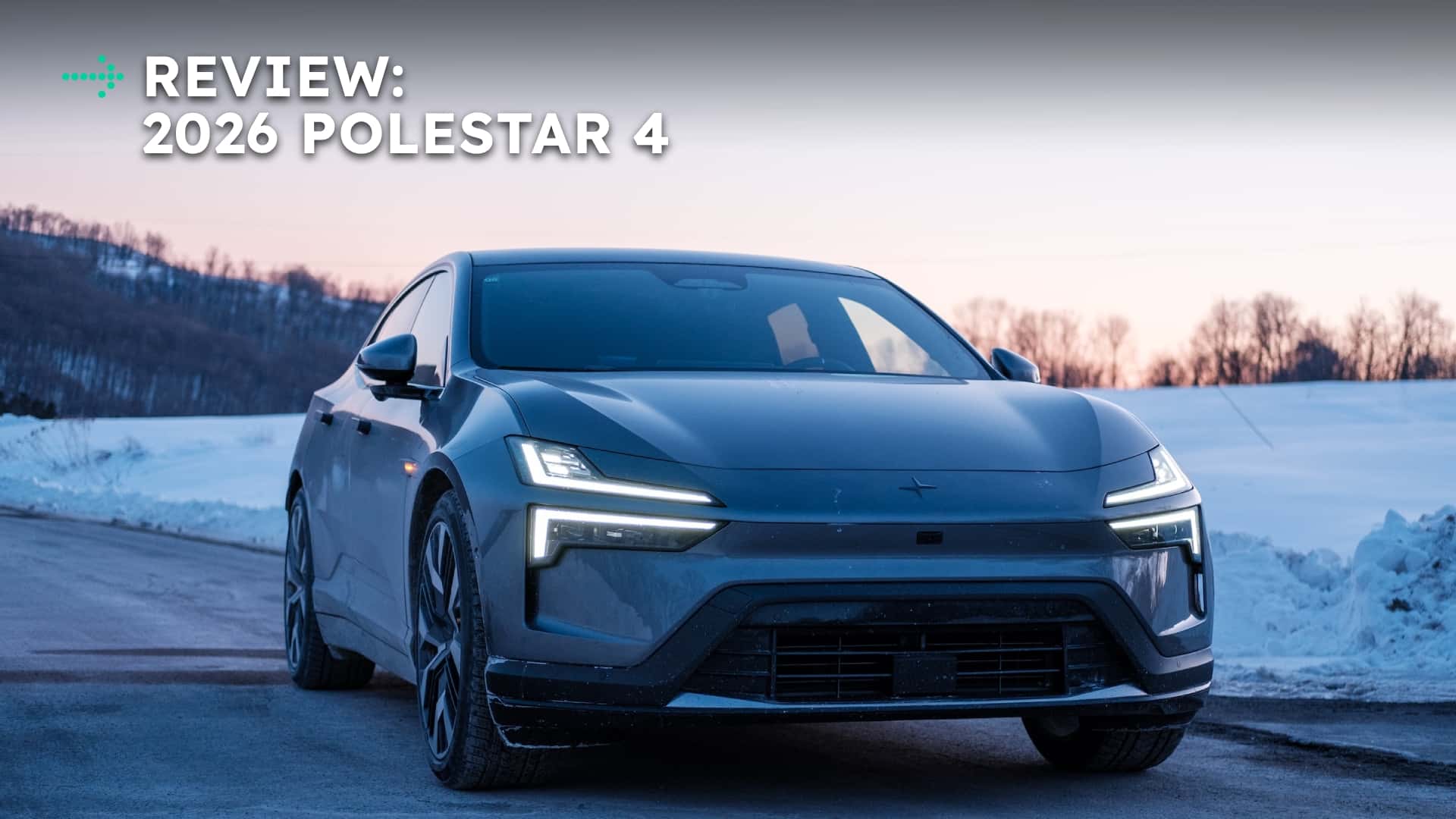
I Drove The 2026 Polestar 4. It May Be America's Weirdest EV
At the risk of sounding biased, I’ve always been rooting for Polestar. The brand made one of the earliest credible Tesla challengers with the Polestar 2, an electric sport sedan that remains an InsideEVs reader favorite—and has been known to win over gas-car fans, too. For a minute, it seemed like the Volvo spinoff was really onto something.
Problem is, Polestar took too long to capitalize on that early success. The Chinese-made Polestar 2 held things down for years while tariffs, price hikes, delays to key new models, financial upheaval and executive turnover took their toll.
At long last, Polestar is in comeback mode with two new models. The first is the Polestar 3, a premium electric crossover related to the Volvo EX90 and positioned as an upmarket alternative to the Tesla Model Y. Crossovers sell, making it an obvious move—but software bugs at launch have undercut its momentum.
Photo by: Patrick George
This brings us to the Polestar 4, and it is something truly different.
It’s billed as an “SUV coupe,” but it’s really just a tall sedan with a hatchback trunk. It gives you a lot of performance and respectable range. It does not, however, give you a rear window. You get a roof-mounted camera instead of a traditional rearview mirror.
The Polestar 4 is an incredibly odd swing for a brand finally attempting to go mainstream. For a bunch of reasons, it is not for everyone. But that’s why I like it so much.
Photo by: Patrick George
(Full Disclosure: Polestar loaned me a Polestar 4 for a week of testing.)
2026 Polestar 4
Base Price
$56,400 (Single-Motor RWD)
As-Tested Price
$80,800 (Dual-Motor AWD Performance Pack)
Battery
100 kWh
EV Range
280 miles EPA-rated (Dual-Motor AWD)
Efficiency
2.2 miles per kWh (in extreme cold)
Charge Time
10% to 80% in 30 min. (Manufacturer estimate)
Output
544 hp, 506 lb-ft
Drive Type
Dual-Motor AWD as tested
2026 Polestar 4: Specs And Features
Polestar’s naming convention goes in order of release date. The Polestar 1 was a six-figure, hybrid sport coupe (and a barely disguised Volvo) that didn’t last very long. The Polestar 5 is a high-performance, Porsche Taycan-fighting grand tourer. The Polestar 6 will be a two-door convertible. And the Polestar 7 will be a more mainstream-priced Tesla Model Y competitor. Frankly, that’s probably the car it should’ve made before all those others.
Photo by: Patrick George
But those cars have analogues and competitors in the market, electric or otherwise. The P4 is harder to figure out. It’s nine inches longer, six inches wider and a little taller than the Polestar 2. Maybe that shape draws comparisons to the Kia EV6, but it’s bigger than that car in certain dimensions, and somehow feels and drives smaller overall.
Adding to the P4’s oddness, it is designed and engineered by Swedes, made by a brand with a Chinese parent company, and built at the former Renault Samsung plant in South Korea. A truly international machine, and finally one without a Volvo equivalent.
No wonder it’s a weird animal that defies traditional automotive segments. But its specs are solid. A 100-kilowatt-hour (usable) battery is standard across the lineup. Unlike the updated P3, the P4 still makes do with a 400-volt electrical architecture, however.
Photo by: Patrick George
The Polestar 4 comes in single-motor rear-wheel-drive and dual-motor all-wheel-drive configurations, good for 310 and 280 miles of EPA-rated range, respectively. You get a decent 272 horsepower on the single-motor car and a zero-to-60 mph time of 6.9 seconds. I’d spring for the dual motor version, though, which offers 544 hp and a 3.7-second dash to highway speeds.
2026 Polestar 4: Driving Experience
I don’t care what Polestar says. The P4 is a tall-ish sedan, not an SUV. It's 3.5 inches shorter than a Model Y. Look at this thing: If that’s an SUV, then I am 27-time Grammy Award-winning hip-hop artist Kendrick Lamar. Words mean nothing, and reality is whatever you want it to be.
Photo by: Patrick George
Regardless, I like the size and shape of the 4 in the real world. It’s refreshing because it feels and drives like a sedan. It’s relatively low and wide, which gives it an aggressive stance without totally eliminating visibility. The American EV market is oversaturated with crossovers. It’s nice to drive something different.
I love the design. Maybe the new Polestar 5 grand tourer nails the brief a bit better, but the sleek silhouette, the double-stacked headlamps, the long hood and the shark-like nose all give this car a very unique vibe.
Photo by: Patrick George
Vibes are one thing, but P4 is also genuinely fun to drive. At 5,192 pounds, it’s no lightweight, just on par with EV competitors. But it’s stable, controlled and direct in the corners with very little body roll. You get the good stuff here, including continuously controlled active dampers and Brembo brakes on the Performance Pack, like my tester.
For all the good qualities that EVs have, not many of them have me searching for a good, twisty back road; the P4 did. It puts all that power down in a way that’s smooth and linear, never violent or sudden. It carries on the mission of the P2, which always felt to me like a car for reformed Subaru WRX bros with climate guilt. (I mean that in a good way.) You also get adjustable one-pedal driving settings and an option to toggle creeping on or off.
Photo by: Patrick George
The major downside is that, at least with the Performance Pack’s 22-inch wheels and Pirelli P-Zero tires—ride quality suffers. The suspension is adjustable (from the screen this time, thankfully, unlike the physical adjustments on the Polestar 2), but even the softest settings don’t help much. The P4 joins a great tradition of European performance cars made by people who truly don’t understand how bad Americans are at maintaining their roads. It’s not as brutal as BMW’s M cars, but you will feel the seams and potholes in the road.
Photo by: Patrick George
Otherwise, it’s quite comfortable with the kinds of cushy seats Volvo does better than pretty much everyone. It’s astoundingly quiet and insulated from road noise as well. The Polestar 5 may be the one laying down lap times, but the Polestar 4 is what you want on your cross-country drive.
Photo by: Patrick George
The interior materials are solid and high-quality, and it carries the Scandinavian minimalist vibe without feeling cheap. Oh, and the tester’s optional 16-speaker Harman Kardon surround-sound system makes for a wonderful soundtrack.
I’ll cover the lack of a rear window and the digital camera for a rearview mirror in a longer breakout. Polestar argues it gives you a better field of vision than a mirror would. I think it’s wholly unnecessary. But you get used to it and barely notice it.
Photo by: Patrick George
Photo by: Patrick George
Photo by: Patrick George
Photos by: Patrick George
I also never felt claustrophobic in the cabin without the back window, but I did occasionally turn around to look behind me when backing up, out of habit. It’s merely a unique style and technology choice, nothing more.
2026 Polestar 4: Tech
Here’s where Polestar is clearly trying to run the Tesla playbook, for better or worse. If you’re a big fan of physical buttons, this is not the EV for you. Save for a semi-useful volume knob that doubles as a play/pause button and some familiar steering wheel controls, everything is routed through that 15.4-inch landscape touchscreen.
Photo by: Patrick George
Some controls could be easier to use. Want to change your headlight settings? Hit the car icon, then Exterior Lights, then select what you want, and confirm with a button on the steering wheel. Or the climate and airflow settings, which are also operated via a screen cursor; I hate this on Teslas and Rivians, and I hate it here too. It is unnecessarily irritating to operate at speed.
Still, it’s a pretty robust software suite, and thankfully pretty dialed-in. Polestar shoppers may be wary after the P3’s bugs, but the P4 runs a completely different software stack—for me, it proved stable and robust, albeit somewhat quirky.
Photo by: Patrick George
Photo by: Patrick George
Photo by: Patrick George
Photos by: Patrick George
I found the menu layouts mostly easy to figure out; any driver can get used to things quickly. It has its quirks, however. The Polestar smartphone app often failed to respond to climate-start or remote-lock commands, even sitting a few dozen feet away in my driveway. The screen never seemed to give an accurate temperature reading; one morning, the car said it was 35 degrees out.
Photo by: Patrick George
Thirty-five! Reader, it’s been in the single digits and low teens in upstate New York since about Thanksgiving. I’d kill for 35 right now. I almost broke out my swim trunks and started making margaritas when I saw that.
2026 Polestar 4: Range And Charging
Thankfully, the P4 feels like it was made by people who have been deploying countermeasures against freezing weather since the dawn of humanity. The car handles itself well in the winter. The heated seats and steering wheel have multiple settings, and the P4’s heat pump puts in the work: the cabin warms up very quickly, more so than other EVs I’ve tested.
Photo by: Patrick George
For the performance you get, the 280 miles of EPA-rated range is quite respectable. I also managed about 2.2 miles per kWh in this freezing weather—about average, maybe even a little better than my EV6 has been doing lately. The P4 also offers dynamic (real-world) or certified range estimates based on the EPA figure, and I preferred the former. Let’s just say I didn’t encounter any surprises.
I wish the P4 came with a native Tesla-style North American Charging Standard port, but with an adapter and access to the Tesla Supercharger network, it doesn’t matter much. My performance at the Supecharger was odd, however.
Photo by: Patrick George
The P4’s max charging speed is up to 200 kilowatts—a bit underwhelming for its price class, I’d say—and my speeds on the Tesla plug were all over the place, frequently bouncing between 89 kW and 125 kW at most, even with the battery preconditioned. I’d like to test it further, but my P4 tester took almost 40 minutes to go from 14% to 75% at a Tesla plug. Polestar claims a nominal time of 10–80% in 30 minutes, so maybe it does better in other settings. Even still, that’s far from the front of the pack these days.
2026 Polestar 4: Price And Verdict
Photo by: Patrick George
The single-motor P4 starts at $56,400. The dual-motor version brings things up to $62,900. My car, loaded as press testers tend to be, came with the electrochromatic glass roof ($1,500), Nappa leather ($3,700), the Plus Pack with the aforementioned stereo option ($5,500), the Performance Pack ($4,500) and metallic paint ($1,300). The grand total: $80,800.
It’s not cheap. But I think it’s a very credible alternative to the BMW i4 or i5, and in most ways that count, I like this better. It also reminds me of the Volkswagen ID.7 the U.S. won’t get, but with more athleticism. The downsides are a few tech hangups, which seem fixable with software updates, and potentially inconsistent DC fast charging performance, at least in my brief experience.
Photo by: Patrick George
But I think it’s a winner, and probably Polestar’s best car yet—and the one that feels the least like a unique product and not a re-badged Volvo.
The P4 seems to be selling well in Europe. Can it deliver the same results in the sedan-skeptical and truck-loving U.S.? I wouldn’t put money on that. Maybe the safer plan would’ve been another $50,000 Model Y competitor, like every other brand is putting out.
88
Source: Patrick George
The market didn't ask for a $60,000-$80,000 electric sport sedan posing as an SUV that's a lot of fun to hustle through the corners and doesn't have a rear window. But that's what Polestar gave us. It's something weirder and more special than what we've been conditioned to expect.
It's an EV for oddballs, in the best sense of that word. It's for people who love design, who love the tech-forward approach to cars, who still want to have fun when they get behind the wheel. It's for people who like to talk about film photography, rare jazz vinyl and the intricacies of the Universal Century timeline in Mobile Suit Gundam when they hang with their pals. You meet somebody who drives a Polestar 4, and I bet that person has something interesting to say.
I'll take that over something boring any day of the week.
Contact the author: patrick.george@insideevs.com
We want your opinion!
What would you like to see on Insideevs.com?
Take our 3 minute survey.
- The InsideEVs team