'I told the Queen my bath at Windsor castle was too cold': A riotously entertaining interview with Lech Walesa, who cheerfully admits he's such a male chauvanist he didn't even think Mrs T should have been PM!
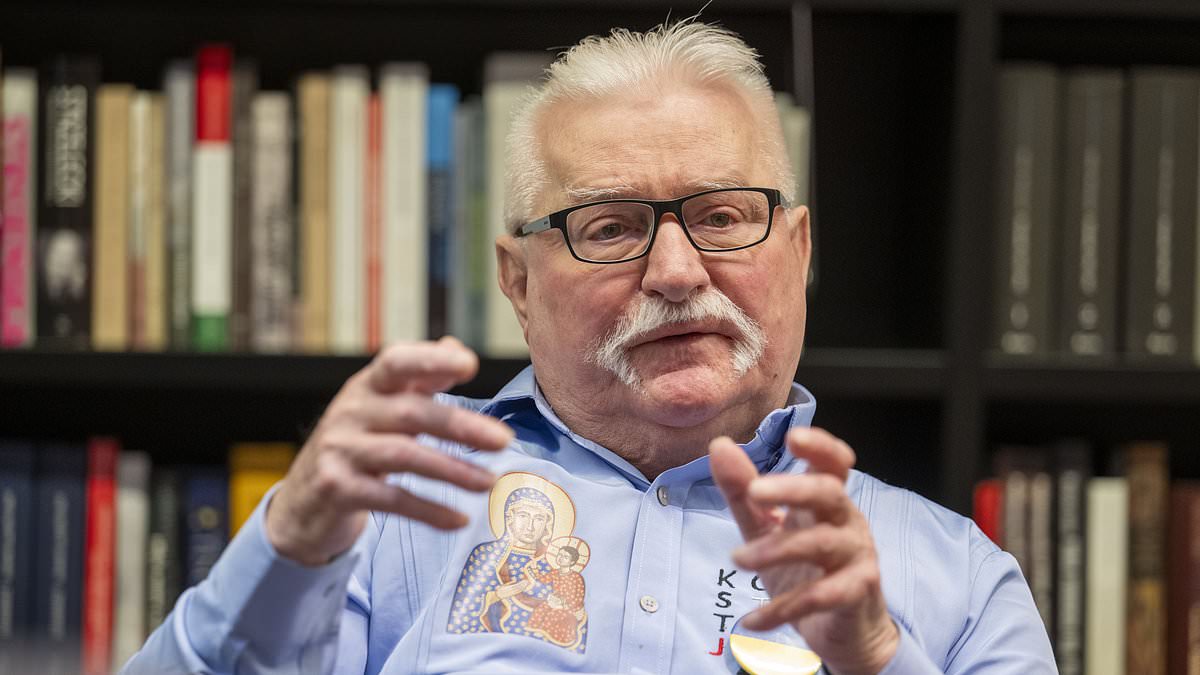
Lech Walesa, the living legend who freed Poland (and, he would claim, the entire world) from communism, was raised in a poor farming family, received only a basic education and worked as a shipyard electrician.In April 1991, therefore, when Queen Elizabeth invited him and his wife Danuta, a former flower shop assistant, to stay with her for three days at Windsor Castle, social commentators feared the couple would be horribly out of their depth.As a plumed horse carriage carried them to their first engagement, a banquet in St George's Hall attended by the royals and Prime Minister John Major, snooty 'experts' envisaged them making faux pas such as mistaking their finger bowls for cabbage soup.Yet as Walesa tells me in a rare personal interview – later described by his personal assistant as the most revealing he has given – he and the Queen became such great 'mates' that he felt able to complain to her that his stone–built bath in the castle was too cold and tell her he'd have been 'more comfortable in a hotel'.He also claims to have delivered her a stark warning based on his electrical know–how. Had she heeded it, he says, one of the worst royal catastrophes of recent times might have been averted.As he and Danuta settled into their superficially opulent quarters, Walesa tells me, he was alarmed to find bare wires protruding from the wall and realised that the centuries–old castle had fallen so far into disrepair that it was in a 'dangerous' condition.After fearlessly leading the mass 'Solidarity' trade union strikes that began the Eastern Bloc's collapse, he was by then Poland's first democratically elected president.Pragmatic as always, however, Walesa – named by Time magazine as one of the most significant figures of the 20th century – reverted into sparky mode. Lech Walesa, the living legend who freed Poland (and, he would claim, the entire world) from communism, has given a rare personal interview to the Daily Mail Walesa with Queen Elizabeth II in 1991. When the late Queen invited him and his wife Danuta, a former flower shop assistant, to stay with her for three days at Windsor Castle, social commentators feared the couple would be horribly out of their depth'I had a look at the wires and thought, this place needs repairing. It was in a terrible state,' he tells me, chuckling so hard that the points of his trademark moustache begin to twitch. 'Some of them were hanging down, so I fixed those myself.'Then I warned Elizabeth what would happen. I said I'd looked at the electrical fixtures, and I told her straight, 'This castle will catch fire soon' – and within a few weeks it did just that!'Walesa's timing is somewhat awry. In fact, the huge fire that raged through Windsor Castle, destroying priceless antiquities and causing £35million of structural damage, came 19 months later, in 1992 – a year the Queen memorably described as her 'annus horribilis'.And while faulty electrics were initially thought to have started the blaze, it was later attributed to a workman's spotlight, which had been left too close to some curtains and set them alight.Given that Walesa's epoch–making life is entering its 83rd year, however, perhaps we shouldn't expect pinpoint accuracy in his entertaining reminiscences.Before we move on from the Queen, I ask him in jest whether he and Danuta had taken a crash–course in etiquette before his state visit. Were their calloused hands trembling as they lifted the solid silver cutlery? He leans back on his chair and lets out another throaty laugh. 'No, not at all! Do you know what? In a way, I felt superior to Elizabeth, and that's why she admired me.'She was probably thinking, 'How is this possible? He is showing me no special respect. Nothing at all.' I just treated her as though she was my mate, which was unthinkable for her.'She was really amazed by my attitude, that's why she liked meeting me and we met on a few more occasions. No–one else treated her like that. But I'm different from other guys. I don't behave according to the official guidelines.' Walesa shakes hands with Margaret Thatcher in 1989. While Walesa forged a close bond with the Queen Thatcher's admiration for him, frequently expressed during her time as prime minister, was not requited The trade union activist is reportedly recovering from cancer and his paunch strains the buttons of a dated, grey shirt sporting a Ukraine badge and an image of the Black Madonna of Czestochowa, Poland's patron saintEvidently not. While Walesa forged a close bond with the Queen, it's jarring to hear that Margaret Thatcher's admiration for him, frequently expressed during her time as prime minister, was not requited.For as he startlingly admits, when it comes to politics, he is an unreconstructed sexist.'I'm old school. I treat women a little differently than men,' he says with an unapologetic shrug. 'I'm a male chauvinist, women in politics don't suit me very well. I was respectful to her – it was all very appropriate – but still I knew she was a woman.'I assume he's jesting again, but no. 'We got on quite well, but her style of politics was very different to mine. She always asked everyone for advice before making decisions... I never ask.' From the moment we meet – in a cavernous new museum beside the Gdansk shipyard that stands testimony to Solidarity's victory – Walesa leaves no doubt that he feels assured of his place in history.The trade union activist is reportedly recovering from cancer and his paunch strains the buttons of a dated, grey shirt sporting a Ukraine badge and an image of the Black Madonna of Czestochowa, Poland's patron saint.But he is not slowing down. Indeed, the young man in a hurry has simply morphed into an old, and frequently irascible, man in an even greater hurry.'Bring it on, man! I want difficult questions! Easy ones make me sleepy,' he barks, waving away my interpreter's opening pleasantries. 'I've got no time, I'm 83! I only have a few more hours left to live!'We open with Poland's economic resurgence (made possible, he suggests, because he removed its 'shackles') and, with impatient claps of his hands, race on to the power struggle between Donald Trump, Vladimir Putin and China's leader Xi Jinping, which, he avers, poses a greater threat to humankind than the Cold War. Walesa told the Mail: 'Some people don't like me because I speak my mind. They will be more appreciative of me [when] I'm harmless and resting dead. I achieved wonderful, just unbelievable things. I walked a straight and just path, and I never gave up on my goals'More of that later. However, it's when I steer the conversation on to personal matters that Walesa stops grandstanding and bares his soul.While he was being lauded for facing down the forces of communism, he confesses, his wife and eight children paid a heavy price. For many years, he was at pains to present them as a strong family unit. In his 1992 autobiography he recalls how Danuta, whom he fell for in her teens when she served him flowers in her shop, was the 'rock' upon whom he relied as the authorities tried to break him.When heavies from the SB, Poland's secret service, raided their house and planted bugging devices, she would mock them fearlessly. And in 1981, when they arrested him for a year's internment, she tried to break their car window with her shoe.Since he feared being banned from re–entering Poland if he went to Oslo to receive his Nobel Peace Prize, in 1993, Danuta collected it for him.However, in 2011, when she released her own bombshell memoir (without warning Walesa what it would contain) it became clear there was not always solidarity in their marriage.She depicted Walesa as an egocentric and overbearing husband who made major family decisions without consulting her, and consigned her to the role of cleaning lady, cook and nursemaid.Meanwhile, 'crowds of labour union members, advisers, politicians, journalists and lunatics [were] pouring into our apartment from dawn until late at night. 'When Solidarity was born, the father and the husband were gone. With that bloody politics he was less and less involved with the children and with me... there was no formal divorce but there were two separate worlds in our family.'Though Walesa affects another little joke about Danuta's book – 'sometimes I regret that she learned to write' – her revelations clearly still rankle. 'I was brought up to believe that one doesn't tell everyone what is happening at home, and she revealed everything, just like women do,' he says. Thatcher with Walesa in Gdansk. When it comes to politics, the former president admits he is an unreconstructed sexist Walesa speaks at a rally in Poland in 2018. While he has been lauded for facing down the forces of communism, he confesses, his wife and eight children paid a heavy priceA few years after the memoir was published, tragedy struck the family. In 2017, his third child, Przemyslaw, was found dead at his Gdansk apartment, aged 43. Suicide and foul play were ruled out but he had struggled with depression and alcoholism.Then, last year, his second child, Slawomir, who had suffered similar problems, also died suddenly, aged 52. Again, the cause was not suspicious but remains a mystery, for Poland does not hold public inquests. 'They were burdened by their parents' struggle,' Walesa replies balefully, striving to explain why they found life so painful. 'They were obviously raised differently from other kids.'Read More Why we've left the UK...and won't be coming back Does he feel guilty? For once he pauses before answering bleakly: '[Their deaths] are the proof that they were not properly raised because there was no father at home. They weren't looked after at the right time.'But that is the cost one had to pay. I destroyed the old order. I freed the world from... communism. I paid for it with the loss of my family, and my children not being brought up as well as they should have been. But serious politics is like this. Once you are in, there is no way out.' What of Danuta? They still share the same sprawling house in the Gdansk suburbs, which he bought cheaply in 1988 when it was in need of renovation, but are they fully reconciled?He gives me a saucy wink and responds obliquely. 'Yes, as far as my age allows, but of all my masculine activities, all I have left these days is shaving. And even that doesn't go very well – my hand shakes.'Along with his six surviving children, Walesa has 'about 20 grandchildren' and a great–grandchild. His oldest son, Bogdan, works for him, but otherwise there is 'no strong connection' between them.Back on more comfortable ground, I wonder what he makes of the increasingly erratic Trump presidency. He bids his aide to show me a photo of himself with The Donald and makes another extraordinary claim. Walesa faced allegations he was a communist spy during the Cold War to which he responds: 'What kind of communist agent would I be, if I was the one who destroyed communism?'It was taken in 2011, Walesa says, when Trump was beginning to set his sights on the White House but worried about his lack of political experience, and invited him to Mar–a–Lago to give him some 'advice'. Walesa says he encouraged him to stand, for if a simple workman like him could become the leader of his nation, so could a billionaire businessman.Today, appalled by Trump's belligerence, the man who overthrew Poland's communist regime without resorting to violence deeply regrets those words.'He's either a Soviet agent or an enormously talented politician who sees the world needs to be reformed but tries to reform it by force,' Walesa surmises. 'He's right about the reforms but totally wrong about the methods.' So how would he have handled Putin, particularly over Ukraine? After all, he negotiated with the peaceable, West–friendly Mikhail Gorbachev and vodka–sodden Boris Yeltsin, not a power–crazed dictator who threatened to start a nuclear war.Had Solidarity been up against Putin, I venture, the Iron Curtain might still be intact. Walesa gasps incredulously: 'With Putin, it would have been even easier! When the war [in Ukraine] started, I announced publicly, 'Get Putin over here, I want to talk to him.' And I'd have said to him, I'll sit opposite you and you'll listen to what I have to say.'I'd have said, 'What do you want? You want a fight? All your weapons are rubbish! Out of date. You'd have no chance. Come on, I'll show you! Don't annoy me or I'll bloody well slap you!''I don't want to fight [but] that's the way to talk to him. Whenever I spoke with Yeltsin, our talks were very manly. You had to be straight forward, not play the diplomacy game.'By now I've kept Walesa in his seat for over an hour and he's checking his watch. It's time to broach a matter that could see me shown the door. In his younger days, was he really a communist spy?When this accusation first surfaced, more than 25 years ago, it seemed preposterous, but opinions changed in 2016 when the widow of Poland's communist–era interior minister released a cache of documents her husband had stashed away. Though some Gen–Z Poles are sceptical about Walesa, to most in Poland he remains a paragonPurportedly signed by Walesa using the alias 'Bolek', the papers – later authenticated by handwriting experts – appear to prove the security service paid him hundreds of pounds in the early 1970s to snoop on his shipyard comrades. He has always insisted the 'evidence' was concocted to smear him and repeats his denial to me – albeit with an intriguing new caveat.'What kind of communist agent would I be, if I was the one who destroyed communism?' he asks, not unreasonably. 'When I was young and silly, I was tempted to become a member [of the secret service]. It was my idea to become a part of the system and dismantle it from within.'However, realising he was secretly planning to sabotage their operations as a double agent, he claims, the SB refused to accept him into their ranks.'The only mistake I made was trying to explain myself later. The outcome of my struggle was such that I shouldn't have need to justify myself, but I got into explaining and it ruined me.'Judging by my conversations in Gdansk, the notion that he is in any way 'ruined' is far–fetched. Though some Gen–Z Poles are sceptical about him, to most he remains a paragon. It is not customary here to erect statues to living heroes, and he feigns not to care whether his moustached features will one day gaze down on town squares across the land.But he says: 'Some people don't like me because I speak my mind. They will be more appreciative of me [when] I'm harmless and resting dead. I achieved wonderful, just unbelievable things. I walked a straight and just path, and I never gave up on my goals.'For all his directness and his monumental sense of self–importance, the shipyard spark's old 'mate' Elizabeth would surely have agreed with that.Additional reporting by Szymon Gontarski