The only conspiracy at the Fabian Society conference
Depending whom you ask, the Fabian Society is either an association of progressive, left-wing thinkers – a cross between a think-tank and a member’s club, the Wine Society for fans of centre-left politics – or a cabal that secretly runs Britain and the world. It would be really surprising if the latter were true. It would be like finding out that the world is secretly run by the John Lewis Partnership, or Halfords.
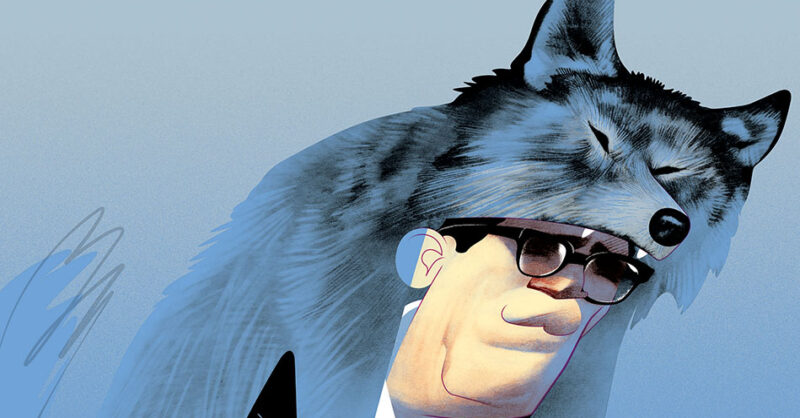
Nevertheless the conspiracy theory is out there, hanging around like a bored teenager. And to be fair, when the Fabian Society was founded at the end of the 19th century, they chose a coat of arms that depicts a wolf dressed in the skin of a sheep, a motif that doesn’t exactly scream “no conspiracy here”. Nor did their decision to name it after a Roman general (the cautiously pronounced Fabius Cunctator), who specialised in stealthy attrition and surprise attack.
At the Fabian Society’s yearly conference on Saturday, however, a more immediate and credible conspiracy was in the air: the plot to remove Keir Starmer. The Fabians had gathered in London’s Guildhall (again, meeting in a medieval crypt is something a secret society would never do) to hear from some of Labour’s biggest names, including Lucy Powell, Wes Streeting, Sadiq Khan and Ed Miliband, but also for a front-row seat at this week’s political drama. Andy Burnham had until 5pm to declare his intention to run in the Gorton and Denton by-election, and therefore his intention to become at least one combination of the letters M and P.
The chandeliers in the Guildhall’s great hall are terrifying. Each one is the size of a Fiat 500, sharply embellished with metal foliage. These hulking Damoclean presences hung in the air between us and the vaulted ceiling, 85 feet above our heads, as the society’s chair, Sara Hyde, introduced the day: “As you would expect from the Fabians”, she beamed, we were to expect “a range of pamphlets”. To the right of the stage stood Pitt the Younger; to the left, further back, the Duke of Wellington. In an alcove near the doors sits a bronze Churchill, slumped angrily in his chair. Hyde introduced Lucy Powell, who got spontaneous applause for her condemnation of the idea of “trying to out-Reform Reform”. She deplored the way Reform sees the country: “This debate about how broken Britain is”, Powell says, “it does make me laugh, it must make you laugh as well” (it did not make anyone laugh).
New year, new read. Save 40% off an annual subscription this January.
It would become apparent that Powell and a number of her colleagues had somehow all come up with the same idea. Asked if Andy Burnham should be allowed to run in the by-election (and by implication, to challenge Starmer for the leadership), she said: “I want to make sure we’re putting the best team on the pitch… I don’t want to see Haaland [a famous footballer] on the bench”. Sadiq Khan would later tell the audience that he is “a firm believer in the best teams having all the talent playing for them”. Elsewhere in the country, at another conference, Angela Rayner was coincidentally of the opinion that “we should put our best players on the pitch”, while Labour MP Andy Macdonald would also (what are the odds!) tell the BBC that Labour needed “the best players out there on the pitch”. It’s almost as if they’d all been in the same meeting, talking to the same ambitious Everton supporter.
In the Guildhall’s art gallery there is a small painting called, unimprovably, The Huff (John Phillip, 1859). In it a young Spanish woman meets the viewer’s eye with disdain, eyebrows aloft, arms crossed, fuming. The picture asks the same question with which the Fabians wrestle today: where did this anger come from? Why are the British public so annoyed? In speeches and panel discussions, Labour politicians and Fabian members wrestled with the problem of “telling the story” of Labour’s success. “We can’t count on ten years”, warned a woman in her 60s during a Q&A; other Fabians nodded at her sagacity. Lucy Powell said “the single biggest thing” she is asked at her “Lucy listens” sessions with Labour members is why they can’t convince people that they’re smashing it, and that it’s the Tories’ fault for having been awful. Stephen Timms added it takes time for people to notice what a great job Labour is doing, and that it’s the Tories’ fault for having been awful.
Sadiq Khan had another explanation: it’s the voters’ fault, for failing to understand “the enormous benefits of immigration”. London, the “magical city”, has been “shaped and reshaped” for the better by migration. Khan’s team have calculated that Labour’s change to permanent settlement rights (heads shake in the crowd) will affect “half a million Londoners, who contribute £50bn to our economy every year”. To me this sounds, at an implied salary of £100,000 per migrant, a little generous (it’s almost triple the median income), but that’s because I’m a brainwashed rustic simpleton. Such people, Khan explained, “prejudge. I’m not saying they’re prejudiced, but they prejudge” (were I only clever enough to grasp the difference!) “because they rely upon their news from social media, or certain types of news”. As soon as the country understands that, they’ll definitely stop being annoyed.
Like a freeform jazz concert, or a football match, a political conference is an event at which people gather to test their shared capacity for tedium. As I sat among the Fabians, a young woman in a row ahead leaned into the young man sitting to her left. She placed her head on his shoulder and he rested his cheek on the crown of her head. Clearly, I had underestimated the romantic potential of Miattah Fanbulleh’s opinions on devolution policy.
Wes Streeting, the other pretender to Keir’s crown, took the stage, and still there was no word from Burnham. The Fabians fidgeted, hungry for internecine drama. They knew Wes had something written for this, perhaps a statesmanly observation, hopefully a waspish joke, but it went unused. Wes left, and in the last few minutes before five o’clock you could almost hear the Burnham window closing. Across the audience people looked up from their phones and found themselves sitting in a hall, listening to Ed Miliband talking about how he went to a factory in Stafford that makes high-voltage transformers.
Then, at the final pip of 5pm, at the last possible moment – it’s the Fabian strategy! Cunctator surgit! – Burnham struck, declaring his desire to run.
His letter was one we’ve all written. “In my current job…” and all those familiar cover-letter notes: you have to pretend you’ve not been scouring LinkedIn for a way out. You’re so happy and successful in your position that you plan not only to expire in your office chair, but to be preserved in it for perpetuity, like Jeremy Bentham. But then this role came up and you realised it’s time to grasp the nettle of career advancement. Not for yourself! It’s simply that you’re such a great fit for the role that it would be irresponsible not to apply. And in conclusion, Andy wrote, that’s why the best place to continue the fight for the Manchester Way is from a seat in the House of Commons. And with that, the news was back. Burnham would shortly find himself blocked from returning to parliament. Labour’s manifesto promise to “end the Conservative chaos” was fulfilled; the chaos in the Labour Party would now be the main drama. It was dark outside, a light cold rain wafting in the streetlights. Wellington looked coldly down on the remaining Fabians, waiting for them to leave, that he might stand on his plinth in the Guildhall’s medieval gloom and observe nothing less dignified than the silent passing of time.
[Further reading: Labour should fear a Green surge]
Content from our partners
Related