As the Gulf of St. Lawrence warms, whales are switching up the menu and may be sharing lunch
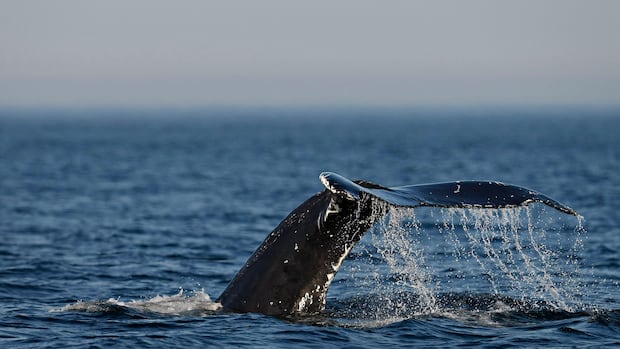
Listen to this articleEstimated 5 minutesThe audio version of this article is generated by AI-based technology. Mispronunciations can occur. We are working with our partners to continually review and improve the results.As the waters of the Gulf of St. Lawrence warm up, new Canadian research suggests the diets of some baleen whales are shifting. And that's because the menu is changing, too.There's been a lack of Arctic krill, "which was a particularly important prey for fin whales in the 1990s," said lead author Charlotte Tessier-Larivière, with Université du Québec à Rimouski.Fin and minke whales, her new research suggests, have shifted to eating more forage fish such as capelin, mackerel and herring — the primary diet of humpbacks in the area."Our study shows that whale species are able to adjust their diet to varying availability of preferred prey," Tessier-Larivière explained to CBC News via email. "This is positive as it shows a certain capacity to adapt — but we don't know the full extent of their adaptive capacity."And it raises a question: If they're all eating the same kinds of fish, is there enough to go around? And what happens if these prey species decline? Hanna Vatcher, campaigner at advocacy group Oceana, says that while she finds it encouraging that the study shows certain whale species appear to be adapting, the results are also "distressing.""I think that this confirms what scientists have been observing for a while now in the Gulf, and that is that the ocean is changing, climate change is having a real impact on our oceans, and a slew of ocean life from large whales all the way down to small forage fish are responding to those changes in real time."A minke whale. (Fisheries and Oceans Canada)You are what you eat The study took samples from the tissues of each whale species, as well as the tissues of their prey, during the summer months for 28 years. Those samples were analyzed for carbon and nitrogen isotopes, which are telling signatures of diet.Tessier-Larivière says that as the whales feed, the "composition of the prey will be metabolized and incorporated into the tissues," allowing researchers to get some sense of who's eating how much of what.In the later years of study, more forage fish signatures were found in the tissues of all three whale species.What the whales are eating is "really important in the food web," Vatcher explained, calling those forage fish the backbone of these ecosystems.Smart sharingBut the study also found that despite signals that fin, minke and humpback whales were eating the same food, they weren't stealing from each other. Instead, there were signs of "resource partitioning," which happens when there's a limited supply. The whales were eating from the same pool of fish, but the study indicated less food overlap between the whales in recent years, indicating that they could be targeting different species of fish, possibly at different times or places."They are highly intelligent beings," says Janie Wray, CEO of BC Whales and North Coast Cetacean Society. "Even from year to year, there can be upswings and downswings in regards to prey availability for them. So they do need to adapt." A humpback whale breathes through its blowhole while swimming in the St. Lawrence River. (Mathieu Belanger/Reuters)Wray led a recent paper focused on the practice of bubble net feeding by humpback whales — a complex technique where the whales emit air bubbles in the water that they can then use as a net or curtain to concentrate their prey, making hunting easier.And she's seen co-operation between humpbacks and fin whales when it comes to food on the West Coast, too. "We've definitely noticed that they will be foraging in the same area, somewhat spread out from each other, but they could very well be feeding at different depths," Wray told CBC News from Alert Bay, B.C. LISTEN | How whales use bubbles to corral their food:Quirks and Quarks9:02Whales use underwater bubble blowing in sophisticated ways to trap preyWray says whales will try to adapt to changing conditions — learning new hunting techniques, as her team saw. She points to the recovery and survival of humpback whales in the Pacific after commercial whaling decimated their numbers in the 20th century.She says it's important to study their habits and use that information to correctly identify which marine areas need to protected."There do seem to be certain areas where you see large congregations of whales more so than other areas. So there's something very valuable about that area," Wray said. Once they know an area is a whale hotspot, she says, they can work to protect it. "Because the whales themselves are telling us, 'This is home, this place is important to us.' "The area studied in the St. Lawrence whale paper was not in a marine protected area, although there are existing protected areas deeper into the St. Lawrence. There are also plans to expand the current areas.Vatcher says Canada has to be "dynamic" when it comes to protected areas, given that the whales themselves are adapting their habits."Protecting whales and protecting marine habitat in the future is going to depend on climate informed adaptive management that looks at not just where whales have been historically, but where their food is going, based on models and climate predictions," she said.