Court reserves judgment in Kenilworth Square residents’ action over rugby pitch plan
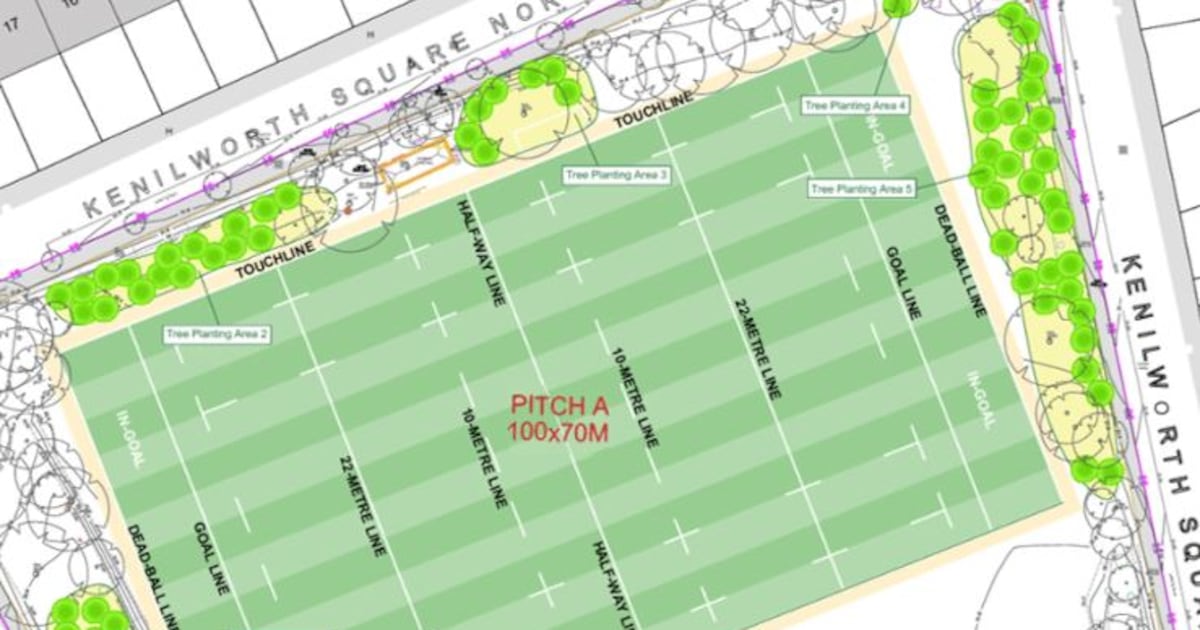
The High Court has reserved its judgment in an action brought by residents of Rathmines challenging Dublin City Council’s finding that a local boys’ school does not need planning permission to make changes to its rugby pitch.In August 2024, the local authority granted St Mary’s College a planning exemption for its proposed redevelopment of pitches at the Victorian-era Kenilworth Square. The proposed redevelopment involves changing the existing grass surface to an artificial all-weather surface, changing the orientation of existing pitches and installing a fence around the reconfigured pitch. Following the council’s decision, local campaign group Protect Kenilworth Square and Kenilworth Square resident Martin Joyce initiated judicial review proceedings seeking to overturn the decision. READ MOREVerdict of medical misadventure in death of woman who died after home birthLimerick woman jailed for life for murder of boyfriend’s four-year-old sonEnoch Burke leaves Mountjoy Prison after High Court orders release to prepare for hearing Feeder Schools: Six take-aways from this year’s listingsThe residents’ case is against Dublin City Council. The congregation behind St Mary’s College and the school’s board of management are notice parties to the action.It is the residents’ case that the proposed redevelopment at Kenilworth Square should not be exempt from planning permission. They also claim that the council’s decision should be overturned because it failed to adequately consider the environmental impact of the development. The council and the school deny these claims.Opening the residents’ case before Mr Justice David Nolan on Wednesday, Tom Flynn SC, appearing with barristers John Kenny and Molly Higgins, and instructed by FP Logue, said the proposed development represents a “very, very large intervention into the existing environment”. One feature of the development is the necessity of “major” excavation works at the square using heavy plant machinery, Mr Flynn submitted. The court heard that the depth of the proposed excavation is about 430mm. Mr Flynn submitted that a key matter in the case is the interpretation of exempted development regulations, as set out in the Planning and Development Regulations, 2001. Specifically, the school relies on an exemption for developments “consisting of the laying out and use of land ... for athletics or sports”.Mr Flynn submitted that the planning exemptions were intended for developments of a minor or insignificant nature. Mr Flynn said that the breadth, volume and scope of works necessitated by the complete replacement of the grass pitch takes the development beyond the scope envisioned by the planning exemption regulations.Mr Flynn also submitted it was “quite extraordinary” that a development of such magnitude could occur in the immediate proximity of several protected structures, and have no environmental impact assessment carried out in advance of the development. Mr Flynn noted the historic and architectural significance of Kenilworth Square, and the fact that 86 of the 88 houses on the square are protected structures.[ Kenilworth Square residents ‘outraged’ at planning exemptions granted to St Mary’s CollegeOpens in new window ]He submitted that the council unlawfully provided no reason for its conclusion that the development would not result in a significant impact on the environment. Stephen Dodd SC, appearing for the council with barrister Christopher Hughes, described the residents’ claims that the development would involve large interventions as “speculative ... and utterly irrelevant”. Mr Dodd said that the key issue is whether the development falls within the exemption regulations, which, he said, it “squarely” does. Mr Dodd said there was “an air of unreality” to some of the arguments advanced by the residents. Counsel said that the residents’ case involved interpreting limitations within the exemption regulations that “are not there”. Jarlath Fitzsimons SC, appearing for the school with barrister Eoghan Foley, and instructed by Arthur Cox, echoed this submission, stating that the residents succeeding in their argument would require reading into the regulations “wording that simply is not there”.It is the council’s case that the proposed development involves a change to existing school facilities, and does not fall within the definition of an “urban development” – a development that requires an environmental-impact statement. On the conclusion of submissions, Mr Justice Nolan thanked the parties and said he was reserving his judgment.