The latest wave of architecture films explores overlooked histories
Architectural documentaries are hybrids, neither essential design tools nor pure entertainment. It is possible to spend a career in architecture and never watch any, though many architects find themselves intrigued when they do. The genre encompasses glibly narrated didactic monstrosities, tedious compilations of badly lit buildings and wooden interviews, plus shameless hagiographies intended to consolidate reputations. Finely conceived and professionally crafted films do exist, but they are the exception rather than the rule. At their best, the strongest architectural documentaries contribute to knowledge of the built environment and confirm moving images deserve a seat at the table next to traditional media—plans, renderings, photographs, and documents—employed in making and understanding buildings.
Within the ecology of non-fiction films about architecture, which are typically a challenge to finance, make, publicize, and exhibit, film festivals play a key role and are often the only theatrical exhibition venue before documentaries enter the Bermuda Triangle of films without distributors or, in our now incontrovertibly post-DVD age, turn up on streaming services such as Kanopy, Vimeo, YouTube, or Shelter.
Watching Architecture Films
The Architecture Film Festival Rotterdam (AFFR), founded 25 years ago by architect, filmmaker, and curator Jord den Hollander, is the Cannes of architecture documentary festivals, a genre it invented whole cloth. It is the subsequent model for all architecture film festivals and the coveted top rung of the festival food chain for ambitious filmmakers seeking to place their films. For five days in October, architects, critics, scholars, and cinephiles gather for screenings, conversations, and debates at the Lantaren Venster cinema in the base of the New Orleans tower designed by Álvaro Siza. These events provide a forum for robust public exchanges of the kind that seldom occur in American architecture, where professional, academic, journalistic, and public discussions tend to be siloed. After the lights go down and the pleasures of being in the dark with strangers begin to work their magic, even the rivalries and turf wars that pervade architecture sometimes temporarily go on hold.
That the festival programs films about architects and topics that are hardly household names alongside those more likely to be crowd pleasers is a testament to its commitment and idealism. At a time when free content oozes from the internet, enticing young viewers to buy movie tickets and concentrate on a screen other than their phone can be challenging. One strategy is to include short films, as AFFR’s head of programming, Christina Ampatzidou noted in an email: “Our proximity and sustained collaboration with two educational institutions, the Architecture Faculty at TU Delft and the Rotterdam Academy of Architecture, combined with younger volunteers who invite their networks of friends and peers, have been crucial. We are learning from our audience behavior too: Short films programs consistently attract younger visitors so we offer more each year. I assume this has something to do with contemporary media habits: Shorts programs provide a diversity of stories, perspectives, or cinematic approaches while also catering to shorter attention spans.”
The Architecture and Design Film Festival (ADFF), based in New York and founded by architect Kyle Bergmann screens its programs at the Village East by Angelika on Second Avenue and today organizes festivals in Chicago, Toronto, Vancouver, Los Angeles, and Mumbai. While its Dutch counterpart is largely funded by government coffers, ADFF survives in the increasingly tough U.S. theatrical exhibition environment through ticket sales, advertisements, and donations. (Note: AN is a media partner for ADFF.)
Whereas shorts made by first-time filmmakers play a key role at AFFR, ADFF emphasizes feature-length films. Although I have seen architects and “design-adjacent” moviegoers fill New York screenings to capacity, I also have sat in theaters in its Los Angeles iteration with intimate audiences small enough to fit around a dinner table.
What follows are some of the stand-out offerings from last fall’s festival season.
Ryan Mah and Danny Berish’s Arthur Erickson: Beauty Between the Lines includes dramatic recreations of key turning points in the architect’s life. (Ryan Mah and Danny Berish/Courtesy ADFF)
Arthur Erickson: Beauty Between the Lines
Films about architects outnumber all other types of architectural documentaries combined. Inevitably, they emphasize a career or a body of work and few succeed on both fronts. Shown this year in both Rotterdam and New York, Ryan Mah and Danny Berish’s Arthur Erickson: Beauty Between the Lines narrates the life of the figure still regarded as the finest Canadian architect of his generation, if not ever. Today revered for worldclass Vancouver buildings like Robson Square, Simon Fraser University, and the Museum of Anthropology at the University of British Columbia, Erickson ended his career bankrupt and stripped of his license.
Though his homosexuality was never a secret (but rather acknowledged sotto voce during the 1970s when being out could prove professionally risky), the film explores the public presentation of self this required, as well as his dysfunctional relationship with Francisco Kripacz and the financial extravagance ($50,000 spent on floral displays at a party!) his younger lover encouraged. Its major novelty is to include dramatic recreations of key turning points in the architect’s life. Riveting (and depressing) as it is to watch Erickson’s character flaws unravel his brilliant career, the ultimate effect of the film is to siphon attention away from his built work, which remains underappreciated, particularly his lesser-known buildings such as the University of Lethbridge.
Miralles centers Spanish architect Enric Miralles in a series of cinematographic explorations of major works. (Maria Mauti/Courtesy ADFF)
Miralles
Miralles by Maria Mauti tacks to the opposite extreme when presenting the architecture of Spanish architect Enric Miralles in a series of cinematographic explorations of major works, such as the Scottish National Parliament in Edinburgh, the Barcelona Santa Caterina Market, and Igualada Cemetery. (The last project is where the architect was buried after dying of a brain tumor in 2000 at the age of 45.) The documentary rejects the long-dominant convention of filming architecture devoid of people as when it memorably presents children occupying the boarding school in Morella, Spain Miralles designed with his first wife, Carme Pinós.
Yet the architect’s second wife, Benedetta Tagliabue, was no less important a collaborator. Both the architect’s complicated personal life spent with his two spouses and creative/partners and his intellectual and creative formation receive short shrift in a film that places a premium on the experience of architecture at the expense of presenting a rich account of its creators. After revealing deep dives into stunning buildings followed by too many self-indulgent sequences in the architect’s understated and thus even-more-dazzling home, I found myself yearning for an old-fashioned talking heads approach and greater historical context. To be fair, the film also left me wanting to visit all of the architect’s works it presented and to learn about others. Perhaps it is unreasonable to expect more than whetting a viewer’s curiosity and interest.
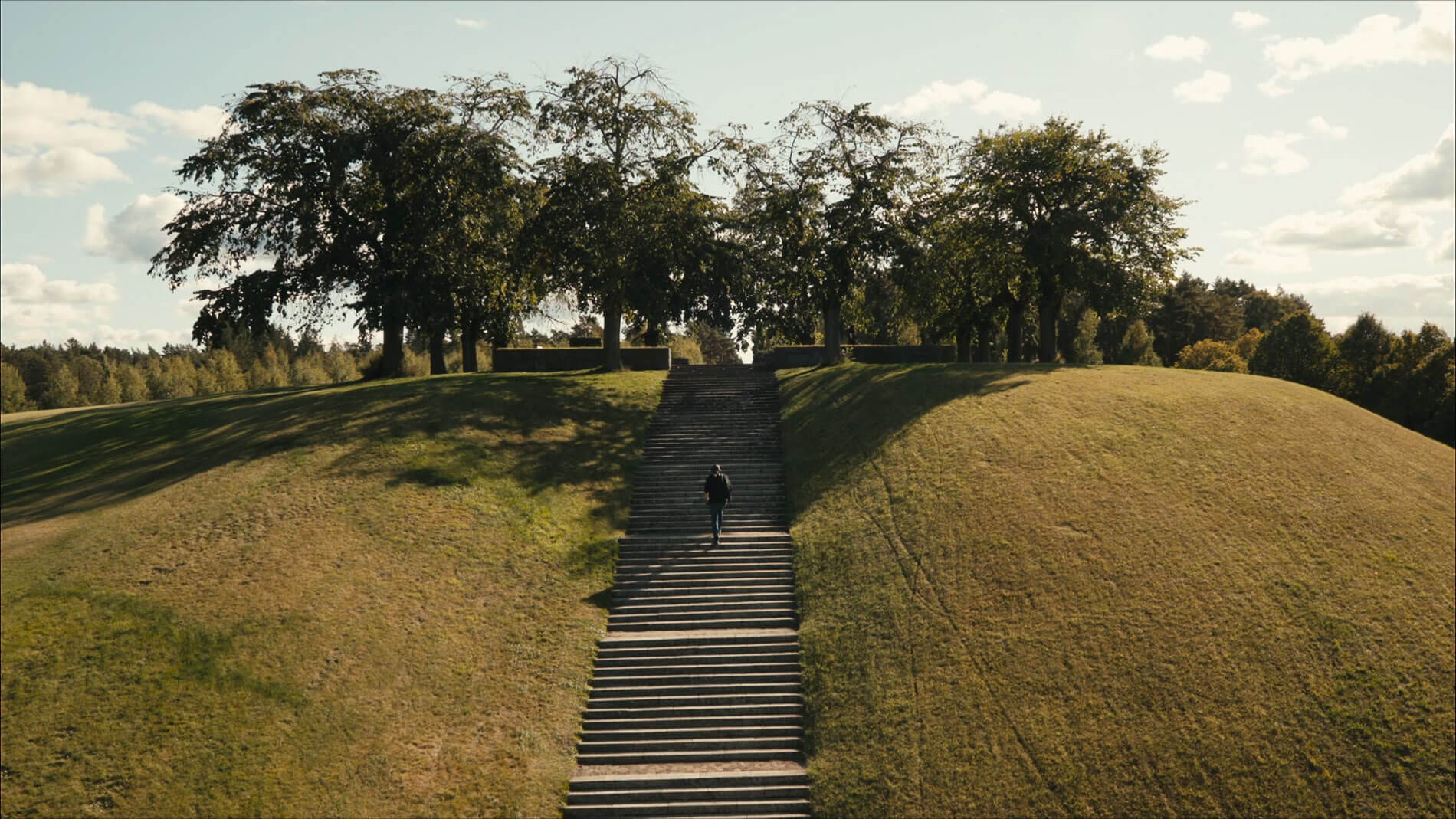
In his documentary, Sven Blume traces Sigurd Lewerentz’s evolution from neoclassicism to functionalism, as seen in the architect’s National Insurance Institute. (Sven Blume)
Lewerentz: Divine Darkness
A film that strikes an exemplary balance between life and work is Sven Blume’s Lewerentz: Divine Darkness. Though no longer the insider tip he was a decade ago and today the beneficiary of growing scholarly investigation, Swedish architect Sigurd Lewerentz (1885–1975) was a notorious recluse who refused to grant interviews and wrote little about his work. A trove of recorded interviews and movie footage filmed by his protégé Bernt Nyberg, discovered in a basement in Lund, provided Blume with unrivaled documentation from which he constructed a portrait of a finicky perfectionist obsessed with materials but also a sensitive man traumatized by his being fired from the Woodland Cemetery on which he collaborated with Gunnar Asplund.
It also furnishes an elegant narrative structure: As the recordings are playing, scenes are recounted by Marianna Manner, Nyberg’s partner. Tracing Lewerentz’s evolution from neoclassicism to functionalism to the brick churches widely regarded as his masterpieces, St. Marks in Björkhagen and St. Peters in Klippan, Blum skillfully intercalates documentary footage of their construction and interviews with family members, friends, colleagues, and collaborators. His film’s exquisite cinematography bears out the suggestion in its title that Lewerentz built with darkness no less than light. Historian Caroline Constant declares that his works manifest a singular grasp of mortality and the human condition that warrants his recognition as a major modern architect. Although the devices and conventions in Blume’s film are familiar ones, he deploys them with uncommon deftness and skill. See his film at upcoming U.S. screenings, in Chicago, New York, and Boston.
Prickly Mountain/My Design Build Life is the debut film of Allie Rood, a filmmaker and creative director. (Allie Rood/Courtesy ADFF)
Prickly Mountain and My Design Build Life
In the hands of a passionate director, often with a personal connection to the history recounted, polemics and politics can replace careers and biographies as organizing principles. Prickly Mountain and My Design Build Life, the debut film from Allie Rood, explores the community of architects who worked during the 1960s in Vermont’s Mad River Valley. After studying at Yale with Paul Rudolph, James Stirling, and Henning Larsen, David Sellers spurned what he perceived as elitism and formalism of the mainstream architectural profession and built the wooden clad pyramidal Sibley and Tack houses in the town of Warren. His work and that of other local architects such as William Reineke, Bill Maclay, Jim Sanford, and Richard Travers, culminated in the Dimetrodon multiunit housing and the still-active Yester Morrow Design Build School. After her film’s world premiere in New York, Rood joined AN’s Jack Murphy for a Q&A session.
Rood grew up in Warren, where her parents and students in the school constructed the first house in the Waitsfield 10 development. It is hard not to admire the creativity, improvisation, and communitarian ethos that suffused the work of these activists. Yet I found it more difficult to become excited about some of their houses with awkward spaces, energy-inefficient designs, and extensive glazed surfaces that make them a nightmare to heat and cool. If the rigid academicism of the establishment can breed dogmatism, the unbridled imagination exercised by its self-proclaimed opponents who sometimes appear in the film to be reinventing the wheel can lead to different problems.
Six decades later, the challenges of wresting the architectural profession away from conformism, to paraphrase Walter Benjamin, and formulating desperately needed alternative modes of thinking and building and identifying the optimal balance between tradition and innovation are more urgent than ever.
Danae Elon’s Rule of Stone is a troubling and meticulous exploration of the law adopted during the British Mandate in Palestine requiring all buildings in Jerusalem be constructed using the local pale limestone. (Danae Elon)
Rule of Stone
Yet the stakes of hippie construction in Vermont pale beside those presented in Danae Elon’s Rule of Stone, a troubling and meticulous exploration of the law adopted during the British Mandate in Palestine (1922–48) requiring all buildings in Jerusalem be constructed using the local pale limestone. The aesthetic homogeneity this instituted (which to contemporary viewers might recall the replacement of the pluralistic GSA Design Excellence program by a new set of guidelines requiring government buildings to be designed in classical architectural styles) is scarcely as disturbing as the human costs accompanying the forced dislocation of 300,000 Palestinians after 1967. Architecture—expressed here through the building material stone—provided a key armature for constructing a coherent Israeli national identity from which Palestinians were to be expunged. A scene in which a Palestinian man describes being compelled to destroy the home he built is lacerating and unforgettable.
It is a testament to the film’s scrupulous commitment to presenting multiple perspectives that it has been shown in Jewish film festivals and praised by Palestinian activists. At no point does Elon, the daughter of a distinguished journalist and historian, take the easy way out. A zionist city planner explains how the history and destiny of the Jewish people is embodied in the stone city of Jerusalem. An anti-zionist Israeli activist laments that the national association of architects never once criticized the demolition of over 400 Palestinian settlements. And Moshe Safdie, who worked in post-1967 Jerusalem, observes that clients hire architects and voters elect governments that pass laws. To deem architects more capable of resolving political conflicts than other citizens, he suggests, is to misconstrue their agency.
As an exploration of the politics of materials and the social responsibility of architects, Rule of Stone is an instant classic. The discomforting questions it raises about architecture as profession find ready analogues in other national settings and leave viewers wondering about the environments in which they live and practice and how they might be different.
Edward Dimendberg is Professor of Humanities at the University of California, Irvine. His most recent book is Richard Neutra and the Making of the Lovell Health House 1925–35. He is currently writing a book on documentary films about architecture.