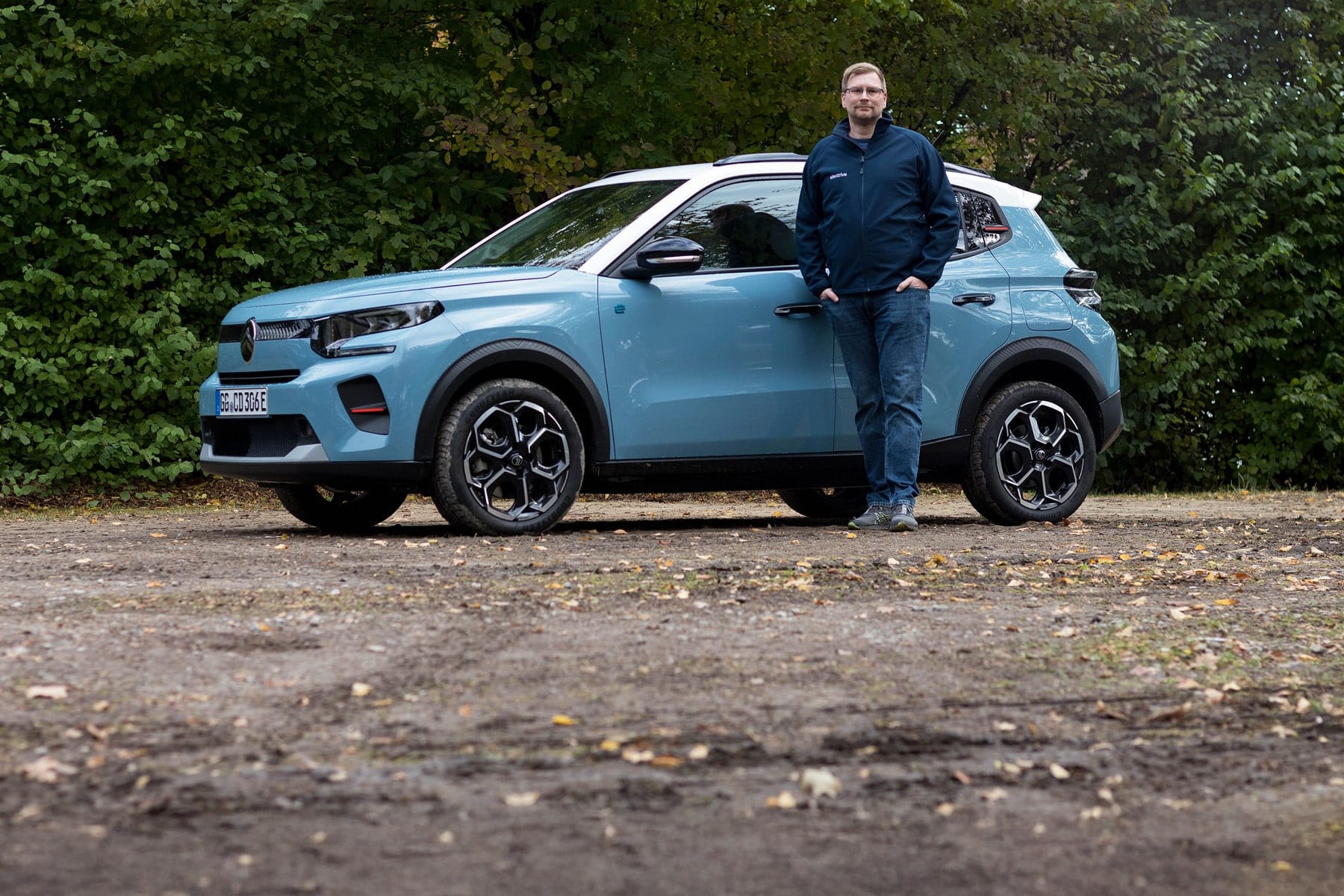
Citroën ë-C3 review: a small and affordable battery-electric car with limitations
For a long time, affordable electric vehicles were scarce, particularly in the battery-electric small car segment. Many manufacturers initially focused on larger, higher-margin models, primarily to offset the development and battery costs associated with electric mobility. As a result, offerings were largely aimed at less price-sensitive customers, including fleet operators.However, with falling battery prices, increasing economies of scale, and growing market pressure, other segments are regaining focus. The number of small battery-electric cars is noticeably increasing. That said, it will still be some time before Volkswagen introduces its ID. Polo. For now, the compact electric vehicle segment remains open to other manufacturers, including Citroën.In autumn 2023, the Stellantis brand caused a stir with the unveiling of the ë-C3, quickly positioning the model as a “major contender for affordable e-mobility with everyday practicality.” At the time, a battery-electric car in this segment offering around 320 kilometres of WLTP range in the combined cycle—not just in urban driving—and starting at €23,300 was remarkable. Since September, Citroën has even offered the ë-C3 from €19,990. However, buyers opting for this version must accept significant compromises in range and equipment. The test vehicle was the version equipped with the 44 kWh battery in the “Max” trim, which has a starting price of €27,800.The ë-C3 is not yet based on the upcoming STLA Small small car platform but on the architecture referred to by Stellantis as “CMP Smart Car.” This is not a completely new development but rather an evolved version of the familiar “Common Modular Platform” (CMP or eCMP). The technical specifications of small electric vehicles are expected to improve further with the introduction of the STLA Small platform.
Image: Daniel Bönnighausen
Image: Daniel Bönnighausen
Image: Daniel Bönnighausen
Image: Daniel Bönnighausen
Image: Daniel Bönnighausen
Image: Daniel Bönnighausen
Image: Daniel BönnighausenProven foundation with a new designCompared to its predecessor, the new C3 is only marginally larger: at 4,015 millimetres in length, it has grown by just 19 millimetres, while its width (1,813 mm) has increased by only six millimetres. The most noticeable change is its height: at 1,577 millimetres, the ë-C3 has grown significantly, visually aligning it more closely with an SUV-style body. Ground clearance has increased from 135 to 163 millimetres. Inside, the new design is intended to provide more space throughout.This follows a trend that has seen the small car segment become larger and taller in recent years—an impression the vehicle conveys not just on paper.Decent space – with rear-seat limitationsFrom the moment you get in, it is clear that the Citroën ë-C3 offers a generous amount of space for a small car, thanks to its new dimensions. This is particularly true for the driver and front passenger areas, which benefit from ample legroom and headroom. The so-called “Advanced Comfort” seats are designed for comfort and provide sufficient support.Before driving off, however, the seat position and mirrors must be adjusted. The driver’s seat is height-adjustable, but only from the mid-range “Plus” trim level upwards—a detail that should not be overlooked. In my view, this adjustment is essential for finding a comfortable seating position, which is generally achievable even for taller drivers like myself (1.90 metres). In practice, however, a detail that becomes particularly noticeable at my height is the interior mirror: it cannot be adjusted sufficiently to provide a full view of the rear window. Instead, the rear seats dominate the field of vision, leaving only a partial view of the rear window.
Image: Daniel Bönnighausen
Image: Daniel Bönnighausen
Image: Daniel Bönnighausen
Image: Daniel Bönnighausen
Image: Daniel Bönnighausen
Image: Daniel Bönnighausen
Image: Daniel Bönnighausen
Image: Daniel Bönnighausen
Image: Daniel Bönnighausen
Image: Daniel Bönnighausen
Image: Daniel Bönnighausen
Image: Daniel Bönnighausen
Image: Daniel BönnighausenSpace in the rear is significantly more limited. Both headroom and legroom are tight, especially if taller occupants are seated in the front. This is acceptable for short to medium distances, but longer journeys with four adults may quickly become uncomfortable.The ë-C3’s boot space remains average for its class. With 310 litres of luggage capacity, it offers sufficient storage but does not set any benchmarks. For comparison, the significantly shorter Hyundai Inster provides 351 litres. However, the Citroën scores points in other practical areas: a roof load capacity of 75 kilograms, a tow ball load of 61 kilograms, and a braked trailer load of 550 kilograms are far from standard in this segment.Focus on comfort meets cost-cutting measuresI appreciate the interior design, which creates a generally cosy atmosphere. While the pressure to cut costs is evident in the choice of materials, the predominantly hard plastics are well-finished. The modern dashboard design stands out positively. The grey fabric trim, which is also used on the seats and door panels, effectively conceals the hard plastic and lightens the otherwise dark interior. Less convincing is the extensive use of high-gloss piano-black surfaces, which are prone to fingerprints and scratches in everyday use.Citroën has dispensed with a traditional instrument cluster in the ë-C3. Instead, it introduces a “Citroën Head-Up Display” for the first time, projecting essential vehicle information onto a glossy black area between the top of the dashboard and the bottom of the windscreen. The display remains clearly legible even in direct sunlight and presents information with sharp contrast. The compact new multifunction steering wheel is adjustable for height and reach, ensuring the head-up display remains in view at all times. I welcome the physical controls on the steering wheel.In the centre console, the mid-range and top trims feature a 10.25-inch touchscreen. The base “You” trim does without a conventional display, instead offering a “smartphone station.” Citroën retains physical controls for the climate system across all trim levels. However, automatic air conditioning is only available from the “Plus” trim upwards; in the base version, the air conditioning must be adjusted manually.Comfort overdDynamicsOverall, while the visual impression initially masks the cost-cutting measures, these become apparent in the details—including when starting the journey. Instead of a keyless system, Citroën opts for a traditional ignition key, which must be inserted and turned to make the ë-C3 ready to drive—a functional but clearly cost-driven solution.Within the first few metres, one aspect stands out negatively: something I have observed in several test vehicles. The ë-C3 starts with regeneration activated as standard, and there is no option to adjust the regeneration strength. Those who prefer coasting must switch to Comfort mode via the “C” button on the gear selector at the start of every journey. A permanent preset is not possible.Both the small and large battery versions feature an 84 kW electric motor on the front axle. This provides sufficient propulsion for urban and rural roads but does not inspire any sporting ambitions. With an acceleration time of 11 seconds from 0 to 100 km/h, the ë-C3 falls short of the typical instant acceleration associated with electric vehicles.Citroën has prioritised comfort over achieving top performance scores. All versions of the C3 are equipped with “Citroën Advanced Comfort” suspension, which uses two progressive hydraulic dampers instead of mechanical stops in conjunction with the shock absorbers and springs. In practice, the ë-C3 absorbs bumps well, the steering is precise, and it provides adequate feedback. Whether in the Hamburg area or during my stay in the Harz region with its winding roads, the electric vehicle performed reliably. For its class, the ë-C3 offers an above-average level of comfort.However, the limitations of the segment become evident on the motorway. The top speed is limited to 132 km/h (125 km/h in the smaller battery version), underscoring that the ë-C3 is not designed for long-distance high-speed travel. During testing, overtaking manoeuvres proved cumbersome with these performance figures. While the vehicle is adequate for occasional motorway trips, it is not intended to be a long-distance cruiser.Citroën states that the 44 kWh battery in the ë-C3 delivers a combined WLTP range of up to 325 kilometres. However, translating this into real-world range is difficult in the vehicle. A conventional energy consumption display—often referred to as an estimate—is missing. As a result, conclusions about achievable range can only be drawn indirectly, such as by comparing the distance travelled relative to the battery’s state of charge. In autumn conditions with temperatures between 10 and 15 degrees Celsius and rain, mixed driving (urban and rural roads) yielded ranges of between 250 and 280 kilometres. For those primarily driving on motorways, however, significantly lower figures must be expected: in testing, ranges of between 190 and 230 kilometres were achieved. This places the electric C3 within the industry average.Practical ranges, limited charging performanceThe ë-C3 is primarily designed for short to medium distances. Longer journeys can quickly become tedious, not least due to its “charging performance.” Citroën specifies a maximum DC charging power of up to 100 kW for the ë-C3. Under ideal conditions, charging from 20 to 80 percent should take around 26 minutes.In practice, however, the ë-C3 falls short of these figures. While Hyundai’s Inster uses NMC cell chemistry and offers optional active battery preconditioning, Citroën equips the ë-C3 with an LFP battery, which is more sensitive to low temperatures. There is no preconditioning option— not even as a paid extra. As a result, the promised 100 kW was never achieved during testing; the highest measured charging power was 88 kW.This directly impacted charging times: charging from 20 to 80 per cent took around 29 minutes, while charging from 10 to 80 per cent took approximately 32 minutes. These figures are acceptable for a battery-electric small car but highlight where costs have been cut. The cost-saving measures are even more apparent in the smaller battery version. Here, Citroën specifies a maximum DC charging power of only up to 30 kW. Additionally, DC fast charging is not standard in this version: those wishing to use fast chargers must pay an extra €500. With this option, the battery can be charged from 20 to 80 per cent in around 36 minutes, provided it has reached its optimal temperature.When charging with AC, both battery sizes can lead to an unpleasant surprise if the optional 11 kW onboard charger, available for €400, has not been ordered. As standard, the ë-C3 charges single-phase at up to 7.4 kW. However, this charging power is only available if the wall box provides 32 amperes single-phase, which is typically only the case with 22 kW charging stations. At many private wall boxes designed for 11 kW and delivering only 16 amperes per phase, the charging power is significantly reduced. In this case, the ë-C3 will only charge at a maximum of 3.7 kW.Instead of around 1 hour 55 minutes or 2 hours 50 minutes with the optional 11 kW charger, the charging time is almost tripled. The recommendation is therefore clearly in favour of the more powerful onboard charger – to significantly increase the everyday usability of both range variants of the ë-C3.Connectivity and equipment: functional but limitedFrom a practical perspective, the 3D navigation system available only in the top “Max” trim can be dispensed with. While it allows route planning, it does not incorporate live traffic data or other real-time information. During testing, charging stations within a 20-kilometre radius could be displayed, but the database appeared outdated. Some charging points that no longer existed were shown, while newer locations were missing. Route planning with integrated charging stops is not provided in any case.For enhanced navigation features, paid connected services are required. Only with these are real-time traffic data, car park searches, or weather information available. Additionally, the “e-Routes” app offers features such as battery level forecasts upon arrival or information on charging station availability. However, these functions could not be tested.From a practical standpoint, the “Plus” trim therefore appears to be the more sensible choice. It includes a 10.25-inch touchscreen with Apple CarPlay and Android Auto as standard. Google or Apple’s navigation solutions are free to use, and the market offers numerous reliable alternatives for route planning with charging stops.Those who prefer to do without an integrated display entirely can opt for the base “You” trim, which features only a “smartphone station.” This allows the use of navigation services via the user’s smartphone, and some functions can also be controlled via the steering wheel buttons.It is worth examining the trim levels closely. For example, a rain sensor for the windscreen wipers is only available from the mid-range trim upwards. Also tied to the larger battery in this line are features such as front seat heating, fog lights, and electric windows front and rear. Parking sensors with a rear-view camera, an auto-dimming interior mirror, or a heated steering wheel are exclusive to the top “Max” trim.Citroën does not differentiate between trims when it comes to driver assistance systems. All versions come with a speed limiter, active emergency braking assist, lane-keeping assist, traffic sign recognition, and an attention assist system as standard. Overall, these systems performed reliably during testing. However, the traffic sign recognition repeatedly identified incorrect speed limits. To deactivate the legally required warning tone when exceeding the detected speed limit, a button to the left of the steering wheel on the dashboard must be held down for several seconds—and this must be repeated at the start of every journey.ConclusionAll in all, it is clear that the base variant, priced at €19,990 (small battery) or €23,300 (large battery), is likely to appeal particularly to fleet customers such as care services or delivery operators. However, even beyond the base model, the ë-C3 remains competitively priced. The better-equipped “You” variant, starting at €23,300 (small battery) or €25,500 (large battery), continues to hold its own in the growing segment. Opting for the highest trim level is not necessary.Despite its limitations—such as in charging or connectivity—Citroën has succeeded in creating an affordable and practical entry into electromobility with the ë-C3. This provides not only private customers but also more price-sensitive fleet operators with another battery-electric vehicle to choose from.