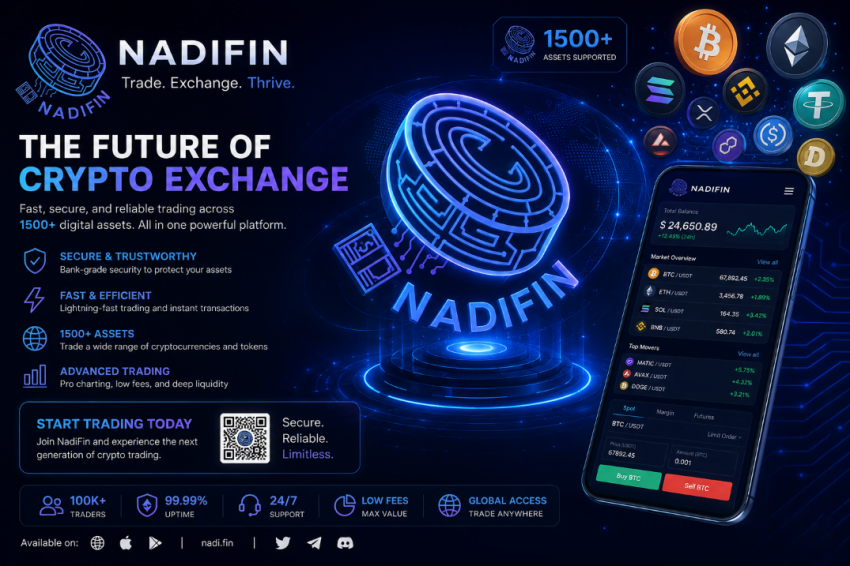
NadiFin— Non-Custodial Crypto Exchange for Wallet-to-Wallet Swaps Across 1,500+ Crypto and Network Combinations
NadiFin is a non-custodial cryptocurrency exchange service designed to simplify wallet-to-wallet crypto swaps without requiring users to maintain custodial balances on a centralized platform.
Supporting more than 1,500 cryptocurrency and network combinations, NadiFin focuses on straightforward exchanges, live transaction estimates, dashboard-based tracking, and API access for develop... moreNadiFin— Non-Custodial Crypto Exchange for Wallet-to-Wallet Swaps Across 1,500+ Crypto and Network Combinations
NadiFin is a non-custodial cryptocurrency exchange service designed to simplify wallet-to-wallet crypto swaps without requiring users to maintain custodial balances on a centralized platform.
Supporting more than 1,500 cryptocurrency and network combinations, NadiFin focuses on straightforward exchanges, live transaction estimates, dashboard-based tracking, and API access for developers who want to integrate crypto swap functionality into their applications.
Cryptocurrency users have more choices than ever when it comes to digital currencies and blockchain networks. However, exchanging one cryptocurrency for another can still involve unnecessary complexity.
Users may need to navigate multiple exchange interfaces, manage accounts across different platforms, compare exchange rates manually, or transfer funds through an intermediary before reaching their intended destination.
For users who prefer maintaining control of their own wallets, these additional steps can introduce friction and increase dependence on third-party custodial services.
NadiFin takes a different approach by focusing on non-custodial, wallet-to-wallet cryptocurrency exchanges. Rather than positioning itself as a traditional custodial exchange where users maintain balances on the platform, NadiFin is designed to facilitate crypto swaps while supporting a more direct wallet-based workflow.
Why Non-Custodial Crypto Exchanges Matter
Cryptocurrency was built around the idea that individuals can hold and transfer value without necessarily relying on a central institution to control their funds. Yet many exchange services still require users to deposit cryptocurrency into accounts controlled by the platform before trading or withdrawing their holdings.
Custodial exchanges can provide useful services, including order books, liquidity, and trading tools. However, custody introduces a separate set of considerations. Users must trust the provider to safeguard their balances, process withdrawals, maintain account access, and operate its infrastructure reliably.
A non-custodial crypto exchange model offers a different arrangement.
Reduced dependence on custodial balances: Users can pursue wallet-to-wallet swaps without relying on a conventional exchange account to store their cryptocurrency between transactions.
A more direct exchange workflow: Instead of depositing funds into a centralized trading balance and later initiating a withdrawal, users can follow an exchange process designed around sending one cryptocurrency and receiving another at a designated destination wallet.
Greater alignment with self-custody: Users who already manage their own wallets may prefer an exchange service that fits into their existing approach to cryptocurrency ownership and security.
Support for diverse cryptocurrencies and networks: As the cryptocurrency ecosystem expands, users increasingly need ways to exchange between different assets and blockchain networks without manually coordinating every step.
Non-custodial does not mean risk-free. Users still need to understand transaction requirements, verify destination addresses, account for exchange-rate changes, and consider the security and reliability of the service facilitating the swap.
What Makes NadiFin Stand Out?
1. Non-custodial wallet-to-wallet crypto swaps
NadiFin focuses on cryptocurrency exchanges that take place through a wallet-to-wallet workflow rather than a conventional custodial balance model.
This can be useful for users who want to exchange cryptocurrency without maintaining funds in a centralized exchange account. The service is designed around facilitating the swap, allowing users to work with their own wallets instead of treating the exchange platform as a long-term storage destination.
For example, a user who holds one cryptocurrency but needs another for a blockchain transaction may want to exchange the funds before interacting with a decentralized application, paying a crypto-denominated expense, or managing a portfolio across networks.
A wallet-to-wallet exchange service can simplify this process by bringing the exchange steps together in one workflow.
Users should always confirm the supported currency pair, the destination network, the estimated amount to receive, and the transaction status before proceeding.
2. More than 1,500 cryptocurrency and network combinations
Cryptocurrency interoperability remains an important challenge. Different users hold different coins, and the same cryptocurrency may be available across multiple blockchain networks.
NadiFin supports more than 1,500 cryptocurrency and network combinations, providing a broad range of potential exchange routes for users seeking to move between supported cryptocurrencies and networks.
This breadth matters because crypto exchange requirements are rarely identical for every user. Someone exchanging one asset for another on the same network may have different requirements from a user moving between assets associated with separate blockchain ecosystems.
A wide selection of combinations can help users find exchange routes that better fit their needs.
However, the number of combinations should not be confused with a guarantee that every possible cryptocurrency pair is available at every moment. Availability, minimum exchange amounts, liquidity, rates, and network conditions may vary by route.
Before initiating a transaction, users should check the current availability of the exact cryptocurrency and network combination they intend to use.
3. Live exchange estimates
Exchange rates can change as market prices and liquidity conditions move. The amount a user expects to receive may differ from the final amount if the rate changes during the exchange process.
NadiFin provides live exchange estimates to help users understand the expected conversion before initiating a swap.
This is useful for comparing available exchange options, assessing whether a proposed transaction meets a minimum amount requirement, and deciding whether to proceed under the displayed conditions.
An estimate should not automatically be interpreted as a guaranteed final rate. Users should review the rate conditions, applicable fees, and any time limits or transaction requirements shown during the exchange process.
Clear exchange estimates are particularly valuable when swapping volatile cryptocurrencies or exchanging between assets operating on different networks.
4. Dashboard-based transaction tracking
A crypto exchange involves more than calculating a conversion rate. Users also need to understand what happens after a transaction begins.
NadiFin provides dashboard-based transaction tracking, giving users a place to monitor their exchange activity and review transaction progress.
This can make it easier to follow a swap without repeatedly navigating different blockchain explorers or manually organizing transaction information.
Transaction tracking is especially useful when network confirmation times vary or when an exchange requires several steps before the receiving wallet is credited.
Users should still rely on the transaction details and relevant blockchain records when investigating a delayed or incomplete swap. A dashboard can help organize the process, but blockchain confirmation and the service's exchange status remain important considerations.
5. API access for developers
Developers building cryptocurrency-related products often need exchange functionality without wanting to construct an entire swap infrastructure independently.
NadiFin offers API access for developers who want to integrate supported crypto exchange functionality into their applications.
Depending on the available endpoints and integration requirements, API-based workflows can support activities such as retrieving exchange estimates, initiating supported exchanges, and monitoring transaction status.
This can be relevant to portfolio tools, crypto applications, wallet-related services, and platforms that need to incorporate cryptocurrency exchange functionality into a larger user experience.
Developers should review the current API documentation before implementation to confirm supported operations, authentication requirements, rate limits, error handling, and transaction lifecycle behavior.
API credentials should be stored securely, and exchange completion should be validated through trusted server-side mechanisms where appropriate.
How Wallet-to-Wallet Crypto Exchanges Fit Into Everyday Use
The practical value of a non-custodial exchange service depends on how well it fits the user's existing cryptocurrency activities.
Exchanging cryptocurrency for another asset
A user may hold a cryptocurrency that is not accepted by a particular application or service. Exchanging it for a supported alternative can make the funds more useful for the intended transaction.
NadiFin's wallet-to-wallet approach is designed to support this type of exchange workflow without requiring the user to rely on a conventional custodial trading balance.
Moving between supported blockchain networks
Users may need cryptocurrency on a particular network to interact with a decentralized application, pay network fees, or use a blockchain-specific service.
Because cryptocurrency availability and network compatibility are separate considerations, users should select the exact supported asset and network combination rather than assuming that every version of a coin is interchangeable.
NadiFin's range of supported combinations provides users with options to explore when planning these exchanges.
Managing a multi-crypto portfolio
People who hold several cryptocurrencies may occasionally need to rebalance their holdings or exchange one asset for another.
A service offering live exchange estimates and transaction tracking can make it easier to assess the expected result and follow each swap.
Users should consider price volatility, exchange fees, liquidity, and tax obligations that may arise from cryptocurrency disposals or exchanges in their jurisdiction.
Supporting crypto-native applications
Developers building crypto-native products may need to offer exchange functionality as part of a broader application.
NadiFin's API access provides a potential integration path for projects that want to connect their applications with supported exchange workflows rather than independently building and maintaining every component.
The precise implementation depends on the API capabilities and supported cryptocurrency routes available at the time of integration.
Security Considerations for Non-Custodial Crypto Swaps
Non-custodial exchange services can reduce dependence on a provider holding user balances, but users must still exercise appropriate care when transacting with cryptocurrency.
Verify destination addresses. Cryptocurrency transfers can be difficult or impossible to reverse. Users should carefully confirm the receiving address and the intended network before submitting a transaction.
Check the selected network. A cryptocurrency may exist on several blockchains, but an address or transaction intended for one network should not automatically be assumed to work on another.
Review the estimated output. Before starting a swap, check the expected receiving amount, applicable fees, exchange-rate conditions, minimum transaction requirements, and any displayed expiration time.
Understand the transaction lifecycle. Sending funds, receiving blockchain confirmations, completing an exchange, and delivering the output cryptocurrency are distinct stages. Users should understand the service's status indicators and what to do if a transaction is delayed.
Protect wallet credentials. Private keys and recovery phrases should never be disclosed to an exchange service or entered into an untrusted website. Users should verify that they are interacting with the legitimate service and should use appropriate wallet security practices.
Account for network conditions. Blockchain congestion, transaction fees, liquidity, and the availability of supported exchange routes can affect the time and cost of completing a swap.
These precautions are relevant to every cryptocurrency exchange service, regardless of whether the workflow is custodial or non-custodial.
Non-Custodial Does Not Mean No Risk
The distinction between custody and exchange execution is important.
A non-custodial model can reduce the need to entrust an exchange platform with a long-term cryptocurrency balance. It does not eliminate counterparty risk, technical failures, market volatility, liquidity limitations, incorrect transactions, or the possibility of delays.
Users should understand how an exchange is executed, how the service handles unsuccessful transactions, what happens if the amount received differs from the estimate, and which support channels are available when a swap requires investigation.
Developers integrating an exchange API should also test error handling, transaction status updates, network-specific requirements, and recovery procedures before making the integration available to customers.
The objective is not simply to choose a service described as non-custodial. It is to understand the complete transaction workflow and determine whether its controls and operating model meet the user's requirements.
Who Can Benefit From NadiFin?
NadiFin's approach can be relevant to several groups within the cryptocurrency ecosystem.
Individual crypto users: People who exchange cryptocurrencies occasionally may appreciate a wallet-based workflow, live exchange estimates, and a dashboard for monitoring transactions.
Self-custody users: Users who prefer managing cryptocurrency through their own wallets may find a non-custodial exchange model more compatible with their approach than maintaining balances on a conventional centralized exchange.
Multi-crypto holders: People working with multiple cryptocurrencies and networks can benefit from access to a broad range of exchange combinations, subject to current availability.
Crypto application developers: Developers can investigate the available API to determine whether NadiFin's exchange functionality fits their application requirements.
Businesses operating with cryptocurrency: Crypto-native businesses may need to exchange one supported cryptocurrency for another to manage operational funds or interact with different blockchain ecosystems.
The suitability of the service depends on the supported currencies, networks, rates, fees, transaction requirements, and the user's specific objectives.
Evaluating the Exchange Experience
Choosing a cryptocurrency exchange service involves more than counting supported assets.
The number of available combinations is useful, but the quality of the exchange experience also depends on the accuracy of estimates, clarity of transaction instructions, reliability of status tracking, and how the service handles unexpected outcomes.
Users evaluating NadiFin should consider the following:
• Whether the required cryptocurrency and network combination is currently supported.
• Whether the displayed exchange estimate meets their needs.
• Which fees and minimum transaction requirements apply.
• How the exchange progresses from initial submission to completion.
• How the service handles delayed, failed, or incomplete transactions.
• Whether the available API documentation supports the intended integration.
• What security practices and wallet requirements apply to the selected exchange route.
These checks help users determine whether a particular exchange service fits their requirements before committing funds.
Final Thoughts
The cryptocurrency ecosystem continues to expand across assets, blockchain networks, and decentralized applications. As this diversity grows, users need practical ways to exchange cryptocurrency without adding unnecessary steps to their existing wallet workflows.
NadiFin focuses on non-custodial wallet-to-wallet crypto swaps, support for more than 1,500 cryptocurrency and network combinations, live exchange estimates, dashboard-based transaction tracking, and API access for developers.
Its approach is relevant to users who want to exchange supported cryptocurrencies while maintaining a wallet-oriented workflow instead of relying on a conventional custodial balance.
As with any exchange service, users should verify the exact currency pair, destination network, exchange terms, fees, and transaction status before proceeding. Developers should also review the current API documentation and test the intended integration thoroughly.
For people seeking a non-custodial approach to cryptocurrency exchange, NadiFin is a service worth exploring.
About NadiFin
NadiFin is a non-custodial cryptocurrency exchange service focused on wallet-to-wallet swaps. The service supports more than 1,500 cryptocurrency and network combinations and provides live exchange estimates, dashboard-based transaction tracking, and API access for developers. Its approach is designed for users seeking a practical way to exchange supported cryptocurrencies while maintaining a wallet-oriented workflow.
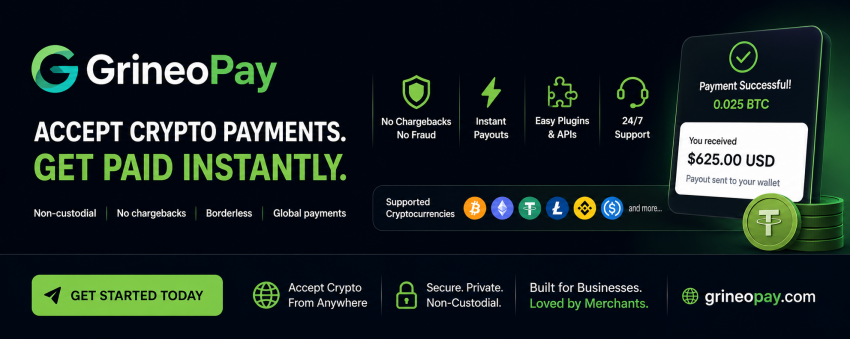
GrineoPay— Non-Custodial Crypto Payment Gateway With 0.5% Fees, Instant Payouts, and Multi-Network Support
GrineoPay is a non-custodial cryptocurrency payment gateway designed to help businesses accept crypto payments while retaining control over their funds.
With an advertised transaction fee of 0.5%, instant merchant approval, instant payouts, no KYC/KYB requirements, and integrations through payment links, QR codes, plugins, and APIs, GrineoPay offers an alternative to conventional custodia... moreGrineoPay— Non-Custodial Crypto Payment Gateway With 0.5% Fees, Instant Payouts, and Multi-Network Support
GrineoPay is a non-custodial cryptocurrency payment gateway designed to help businesses accept crypto payments while retaining control over their funds.
With an advertised transaction fee of 0.5%, instant merchant approval, instant payouts, no KYC/KYB requirements, and integrations through payment links, QR codes, plugins, and APIs, GrineoPay offers an alternative to conventional custodial payment processing.
Cryptocurrency has made borderless payments possible without requiring every transaction to pass through traditional banking infrastructure. However, accepting crypto commercially involves more than generating a wallet address.
Merchants need dependable payment tracking, transaction verification, order management, network compatibility, and a checkout experience that customers can use without unnecessary complications.
At the same time, businesses want to avoid excessive processing fees, lengthy onboarding procedures, and payment arrangements that require them to leave their cryptocurrency in a third-party custodial account.
GrineoPay addresses these requirements with a crypto-native payment infrastructure built around non-custodial settlement and practical integration for online businesses.
Why Crypto Payments Need Better Infrastructure
Cryptocurrency adoption among online businesses continues to create opportunities for merchants serving international customers. Software providers, VPN services, digital product sellers, online stores,
and Web3 businesses can all benefit from offering customers a way to pay with crypto.
However, several challenges remain.
Custodial payment arrangements: Some payment providers hold incoming cryptocurrency in platform-controlled balances before permitting withdrawals.
Depending on the service, merchants may encounter withdrawal delays, account restrictions, or additional verification requirements.
High processing costs: Gateway fees can significantly affect profitability, particularly for businesses processing large volumes of transactions.
A merchant processing thousands of crypto payments needs a predictable fee structure that does not unnecessarily reduce revenue.
Blockchain and network complexity: Cryptocurrencies operate across different blockchain networks, each with its own transaction requirements, confirmation behavior, and fee structure.
Supporting customers who use different coins and networks requires more than displaying a generic crypto payment option.
Complicated integration: Developing a crypto payment system from scratch requires payment creation, transaction monitoring, blockchain verification, order synchronization, and security controls.
Maintaining that infrastructure can be expensive for smaller businesses.
Onboarding delays: Traditional payment providers may require lengthy application reviews and extensive business documentation before merchants can begin processing payments.
GrineoPay approaches these challenges by focusing on non-custodial crypto payment processing, straightforward integration, accessible onboarding, and an advertised gateway fee of 0.5%.
What Makes GrineoPay Different?
1. Non-custodial crypto payment processing
GrineoPay is designed around a non-custodial approach to cryptocurrency payments. Rather than requiring merchants to accumulate their proceeds in a conventional custodial gateway balance,
its model focuses on facilitating crypto payments with settlement to the merchant's designated wallet.
This distinction matters for businesses that prefer to retain control over their cryptocurrency instead of depending on a third party to release accumulated funds.
Non-custodial payment processing can reduce exposure to certain custody-related risks. It does not eliminate every risk associated with cryptocurrency transactions, however.
Merchants remain responsible for protecting their wallets, securing credentials, and verifying incoming payments.
2. Instant merchant approval
Businesses should be able to evaluate and implement a suitable crypto payment solution without unnecessary onboarding friction.
GrineoPay offers instant merchant approval without KYC/KYB requirements as part of its onboarding proposition. This can be attractive to independent developers, online entrepreneurs,
privacy-conscious businesses, and crypto-native companies seeking a more direct route to accepting cryptocurrency.
Merchants should still review the platform's terms, supported industries, and applicable restrictions. The absence of gateway KYC/KYB requirements does not exempt a business from legal obligations that may apply to its operations.
3. Instant payouts
Access to incoming crypto payments is an important consideration for businesses that need to manage liquidity, pay suppliers, or maintain operational reserves.
GrineoPay emphasizes instant payouts through its non-custodial payment model, helping merchants avoid the conventional process of waiting for a provider to release funds from a custodial balance.
Actual transaction completion remains dependent on the relevant blockchain, network conditions, and the payment workflow.
Merchants should distinguish between the gateway's payout process and the time a particular blockchain transaction requires to be confirmed.
4. An advertised 0.5% transaction fee
Processing fees directly affect merchant profitability. GrineoPay advertises a transaction fee of 0.5%, offering a straightforward starting point for businesses calculating the cost of accepting crypto.
For example:
• $1,000 in processed payments corresponds to $5 in gateway fees.
• $10,000 in processed payments corresponds to $50 in gateway fees.
• $100,000 in processed payments corresponds to $500 in gateway fees.
These examples cover the percentage-based gateway fee only. Applicable blockchain network fees or other charges should be considered separately when calculating the total cost of a payment.
5. Payment links, QR codes, plugins, and APIs
GrineoPay provides several ways to integrate cryptocurrency payments into a business.
Payment links allow merchants to request crypto payments without building an entire checkout interface. QR codes simplify payment initiation for customers using compatible wallet applications.
Plugins help merchants connect supported e-commerce platforms to the payment service, while APIs provide developers with greater flexibility to build custom payment workflows.
These options make the gateway relevant to both merchants seeking a simple way to collect cryptocurrency and developers building more complex online services.
Supported Cryptocurrencies and Blockchain Networks
Multi-cryptocurrency support is an important consideration when choosing a payment gateway. Customers do not all hold the same cryptocurrency, use the same wallet, or prefer the same blockchain network.
A merchant may want to accept Bitcoin, while another may prefer stablecoins for pricing digital services. Some customers may use Ethereum-based tokens, whereas others may transact through alternative blockchain ecosystems.
A useful crypto payment gateway must make it clear which currencies and networks are supported, how customers select their preferred payment method, and where the merchant receives the funds.
GrineoPay is positioned as a crypto-only payment gateway. Merchants should consult its current supported-currency and network list to confirm the exact combinations available for their intended checkout.
Cryptocurrency compatibility and network compatibility are not interchangeable. A particular cryptocurrency may exist on more than one blockchain, and a payment intended for one network should not automatically be assumed to work on another.
Before enabling a cryptocurrency at checkout, merchants should verify:
• The exact cryptocurrency and blockchain network combination supported.
• The wallet address or payment destination generated for that combination.
• The required transaction confirmations and payment verification rules.
• The network fee implications for customers and merchants.
• Whether the received cryptocurrency settles directly to the merchant's designated wallet.
• The handling of underpayments, overpayments, expired payment requests, and transactions sent through an unsupported network.
These checks are essential for avoiding payment reconciliation problems and helping customers complete transactions correctly.
For merchants accepting multiple cryptocurrencies, a clearly organized checkout can reduce confusion by presenting supported coins and networks with accurate payment instructions.
Original-Cryptocurrency Settlement and Merchant Control
One important aspect of crypto-native payment processing is what happens after a customer pays.
Some businesses want to receive the cryptocurrency their customers actually send, rather than being required to convert every payment into fiat currency or another cryptocurrency.
GrineoPay emphasizes original-asset wallet settlement, aligning its approach with businesses that prefer to receive crypto in the asset used for payment.
For example, a business operating with a particular cryptocurrency may want to retain incoming payments for its own operational needs.
A Web3 service might prefer cryptocurrency settlement because its expenses are also denominated in crypto. A digital services provider may want to manage its incoming cryptocurrency through its own wallet infrastructure.
In these cases, a non-custodial payment model can fit more naturally into the merchant's existing workflow.
The precise settlement behavior depends on the supported currency, network, and implementation. Merchants should verify the current documentation before deploying a payment flow in production.
Security Considerations for Crypto Payment Processing
Cryptocurrency transactions introduce security responsibilities that merchants need to understand before accepting payments.
Wallet security: Private keys, recovery phrases, signing devices, and wallet credentials must be protected. Non-custodial control is valuable, but it also makes secure wallet management essential.
Transaction verification: A payment should not be treated as complete solely because a customer provides a transaction hash or returns to a checkout success page.
Merchant systems should verify the transaction on the correct blockchain and check the recipient, asset, amount, and relevant payment status.
Network selection: Customers need clear instructions about the correct blockchain network. Sending cryptocurrency through an unsupported network can result in a payment that does not arrive at the expected destination or cannot be recovered through the normal workflow.
API protection: Developers integrating a payment API should secure credentials, validate payment events, and avoid exposing privileged secrets in public-facing applications.
Order reconciliation: Merchants need a reliable way to associate confirmed crypto payments with the correct customer orders, including workflows for incomplete payments, overpayments, and transactions that arrive after a payment request expires.
Non-custodial infrastructure can reduce reliance on a third party holding merchant balances, but it should be combined with proper wallet security and transaction verification.
Where GrineoPay Can Be Used
Online stores and digital products
Businesses selling software, downloadable products, digital subscriptions, and other online services can incorporate crypto payments into their checkout workflows.
Payment links and integrations can simplify collection, while transaction verification helps connect incoming cryptocurrency with the correct order.
VPN and privacy-oriented services
VPN providers and privacy-focused online services may serve customers who prefer paying with cryptocurrency.
A crypto-native checkout gives those customers another payment option without requiring the business to develop a complete blockchain payment system independently.
Web3 and crypto-native businesses
Businesses already operating within the cryptocurrency ecosystem may prefer to accept crypto directly instead of relying on compulsory fiat conversion.
Non-custodial settlement can be relevant to services whose operating expenses, supplier payments, or treasury processes already use cryptocurrency.
International digital businesses
Cryptocurrency can provide an additional way to receive payments from customers in different countries. This can be useful for businesses that sell digital services globally and want an alternative to payment flows dependent on conventional banking infrastructure.
However, cryptocurrency availability does not remove the need to comply with applicable consumer protection, sanctions, tax, and business regulations.
Independent developers and SaaS companies
Developers can use supported plugins or APIs to incorporate crypto payments into their products. Rather than maintaining every part of a blockchain payment system themselves, they can integrate an existing payment workflow and focus their engineering resources on the core product.
Understanding the Economics of a 0.5% Crypto Gateway Fee
A payment gateway should be evaluated based on its total cost, settlement process, supported networks, and operational requirements. At an advertised 0.5% transaction fee, GrineoPay offers a simple baseline for estimating gateway processing costs.
For a business processing a large number of payments, the difference between a high percentage-based gateway fee and a lower one can become meaningful over time.
Nevertheless, the lowest advertised fee is not the only consideration. Merchants should also assess the security of the integration, the cryptocurrencies and networks supported, payment verification, settlement behavior, and the quality of the documentation.
GrineoPay is aimed at businesses seeking crypto-native payment processing with non-custodial settlement, accessible onboarding, and a low advertised gateway fee.
Final Thoughts
Accepting cryptocurrency commercially requires more than a wallet address. Businesses need a reliable process for initiating payments, identifying transactions, confirming the correct amount and network, reconciling orders, and receiving their cryptocurrency.
GrineoPay brings these requirements together through a non-custodial crypto payment gateway focused on original-asset wallet settlement, instant merchant approval, instant payouts, and an advertised 0.5% transaction fee. Its payment links, QR codes, plugins, and APIs provide different ways for businesses to incorporate crypto payments into their operations.
For merchants who want to accept cryptocurrency without depending on a conventional custodial payment balance, GrineoPay offers an alternative worth evaluating.
The most important step before deployment is confirming the supported cryptocurrencies and blockchain networks against the current official documentation, then testing the intended payment flow with the relevant wallets and networks.
About GrineoPay
GrineoPay is a crypto-only, non-custodial payment gateway designed for businesses that want to accept cryptocurrency payments.
Its offering includes original-asset wallet settlement, instant merchant approval, instant payouts, an advertised 0.5% transaction fee, and no KYC/KYB requirements as part of its onboarding proposition.
Payment links, QR codes, plugins, and APIs provide integration options for merchants and developers looking to incorporate cryptocurrency payments into their businesses.
Meet $RECEIPT — a community-driven Solana memecoin and content concept turning bold predictions, deleted takes, and memorable internet moments into entertaining, shareable digital receipts.
Official Contract Address:
3cwsWLmoUw1GDY3... more🧾 The internet forgets. We keep the receipts.
Meet $RECEIPT — a community-driven Solana memecoin and content concept turning bold predictions, deleted takes, and memorable internet moments into entertaining, shareable digital receipts.
Passive Income Using Your Own "Flywheel": How a Structured DeFi Strategy Actually Works
Most people keep their savings in accounts earning close to zero, while the DeFi space keeps growing. But "passive income" is a loaded phrase, and a lot of beginners get burned because nobody explains the structure behind it.
Here is the framework in simple terms:
1️⃣ Start with the foundation
Learn how wallets, exchanges and basic security work before touching any protocol. Most losses come from user err... morePassive Income Using Your Own "Flywheel": How a Structured DeFi Strategy Actually Works
Most people keep their savings in accounts earning close to zero, while the DeFi space keeps growing. But "passive income" is a loaded phrase, and a lot of beginners get burned because nobody explains the structure behind it.
Here is the framework in simple terms:
1️⃣ Start with the foundation
Learn how wallets, exchanges and basic security work before touching any protocol. Most losses come from user error, not bad luck.
2️⃣ Think in layers, not one big bet
- Foundation: a stable base (stablecoin lending, T-bill style products)
- Growth: established pairs like ETH/USDC
- Opportunity: a smaller high-yield rotation layer
- Kicker: a tiny, hard-capped speculative slice you accept you could lose
3️⃣ Harvest on a schedule
Review positions weekly, take profits, and move a portion into safer storage. It is active and disciplined, not set-and-forget.
4️⃣ Know the risks
Smart contract exploits, impermanent loss, liquidation, bridge hacks and rug pulls are real. Only use money you can afford to lose.
If you are a complete beginner, a structured live format helps a lot. The DeFi Protocol is a 10-week program with:
✅ 3 live classes every week
✅ A personal Course Concierge who checks in weekly
✅ A free 20-minute strategy call to see if it is a fit
Crypto is full of projects chasing short-term hype. We want to take a different approach.
$PAWS is about building over time, growing a genuine community and creating more reasons for people to get involved.
Building our presence on X and Telegram.
Developing staking and community rewards.
Introducing quizzes, competitions and gaming ideas.
Working towards greater visibility through marketing and influencer outreach.
... moreMOONPAWS ($PAWS)
BUILT WITH A VISION, GROWING WITH A COMMUNITY.
Crypto is full of projects chasing short-term hype. We want to take a different approach.
$PAWS is about building over time, growing a genuine community and creating more reasons for people to get involved.
Building our presence on X and Telegram.
Developing staking and community rewards.
Introducing quizzes, competitions and gaming ideas.
Working towards greater visibility through marketing and influencer outreach.
Bringing people together around a shared vision.
We know success doesn’t happen overnight. It takes consistency, commitment, and a community willing to grow together.
We’re not here to promise overnight riches or guaranteed returns. We’re here to put in the work, develop the project, and keep moving forward.
Every follower matters. Every community member counts. Every step forward is progress.
The vision is bigger than a chart. The community is stronger when we build together.
Are you ready to become part of the MoonPaws journey?
Has anyone checked out PÆX — new autonomous trading engine?
Found this autonomous trading engine called PÆX — basically a transformer ensemble that trades 1,900+ instruments across 14 venues with 38ms median latency. Interesting angle: they show a live signal wire where every inference is logged in real time. Worth a look if you're into systematic crypto trading.
How CryptoGames Prevents the Escalation of Chasing Losses in Gambling?
Gambling can be an exciting and rewarding experience for many people. But for some, a losing streak can quickly turn into a serious problem. Losing money never feels final to a gambler. It feels like an injustice waiting to be corrected. That mindset is where the real danger begins. Many players believe one more bet will fix everything.
Gambling can be an exciting and rewarding experience for many people. But for some, a losing streak can quickly turn into a serious problem. Losing money never feels final to a gambler. It feels like an injustice waiting to be corrected. That mindset is where the real danger begins. Many players believe one more bet will fix everything.
Genuine Question: How Do You Handle On-Chain Privacy?
I’m curious how this community approaches wallet privacy.
The more I think about it, the more uncomfortable I get with how much is publicly readable on-chain holdings, transaction history, interaction patterns everything. Full transparency may be a core feature of blockchain, but from a personal financial standpoint, it raises real concerns.
I’ve been exploring different privacy solutions, but most seem either: Centralized, Questionable in... moreGenuine Question: How Do You Handle On-Chain Privacy?
I’m curious how this community approaches wallet privacy.
The more I think about it, the more uncomfortable I get with how much is publicly readable on-chain holdings, transaction history, interaction patterns everything. Full transparency may be a core feature of blockchain, but from a personal financial standpoint, it raises real concerns.
I’ve been exploring different privacy solutions, but most seem either: Centralized, Questionable in structure, Or simply forks of older mixer models
Recently came across Kosmyk.app, and it appears to be structured differently more like a complete privacy-focused DeFi platform rather than a single-purpose tool. From what I’ve seen, it offers: Private swaps, Asset shielding, Cross-chain bridging, Yield opportunities all within one ecosystem.
The access layer is powered by KMK (Kosmyk Cash), which is already trading.
I’m not here to shill just genuinely trying to understand how others think about this topic.
Are you actively using privacy tools? Rotating wallets? Avoiding doxxed addresses? Or do you see full transparency as part of the trade-off?
Would love to hear different perspectives.
CMC01 Village — Real-World Smart Community Powered by Web3
The Vision Behind CMC01 Village
Imagine a destination where modern residential living, world-class lifestyle amenities, sustainable outdoor environments, forward-thinking education, and a dynamic commercial district all thrive under one unified vision.
Welcome to CMC01 Village — a bold, community-first development redefining what it means to live, work, and grow together.
CMC01 Village is more than a real estate proje... moreCMC-01 Village
CMC01 Village — Real-World Smart Community Powered by Web3
The Vision Behind CMC01 Village
Imagine a destination where modern residential living, world-class lifestyle amenities, sustainable outdoor environments, forward-thinking education, and a dynamic commercial district all thrive under one unified vision.
Welcome to CMC01 Village — a bold, community-first development redefining what it means to live, work, and grow together.
CMC01 Village is more than a real estate project. It is a blueprint for tomorrow’s communities — thoughtfully designed to harmonize human connection, environmental responsibility, and technological innovation.
A Community Built on Seven Strategic Pillars
Residential — Community Living, Harmonious Homes
Designed to foster meaningful connections, belonging, and truly livable spaces.
Lifestyle — Well-Being Oasis, Vibrant Living
Premium wellness facilities that nurture the body, calm the mind, and uplift the spirit.
Outdoor — Nature’s Haven, Community Outdoor
Sustainable green spaces that keep residents connected to nature.
Education — Reimagining Tomorrow’s Leaders
Innovative infrastructure and programs dedicated to cultivating future changemakers.
Commercial District — Thriving Commerce, Sustainable Growth
A vibrant business hub built to empower entrepreneurs and support long-term economic vitality.
System Contributors — In Touch with Tomorrow
The technological backbone powering the village’s smart ecosystem.
System Operators — Smart Living, Sustainable Future
Ensuring seamless operations and an elevated experience for every resident.
The CMC01 Token — Investing in a Living Ecosystem
The CMC01 Token is now actively trading on Pump.fun and trackable live via DEX Screener.
It represents participation in a real-world community vision as the village evolves and expands.
CMC01 Token is now officially live on MEXC DEX+, making trading more accessible and seamless for the community.
This milestone significantly expands our market reach as we continue progressing toward regulatory readiness and advancing our long-term smart city vision.
Why Community-Driven Crypto Casinos Are Gaining Momentum in 2026
In a traditional casino, the house always has the edge. Players bet, and operators profit. But a new model is changing that dynamic. Community-driven crypto casinos are turning players into active participants. Ethereum L2 casinos recorded 320% year-over-year volume growth in Q4 2025. That is not a small shift. It is a signal that something fundamentally different is happening.
In a traditional casino, the house always has the edge. Players bet, and operators profit. But a new model is changing that dynamic. Community-driven crypto casinos are turning players into active participants. Ethereum L2 casinos recorded 320% year-over-year volume growth in Q4 2025. That is not a small shift. It is a signal that something fundamentally different is happening.
In 2021, an underdog named Roaring Kitty took on Wall Street giants and led the masses to a short squeeze of GameStop, which made him a legend among men.
5 years later, this narrative kicks off again. Except a new champion is rising...his brother, Barking Puppy.
Soon, the Wild Card will be played, and these heroes will unite to once again take down the Wall Street giants and squeeze GameStop to new heights never before imagined.
There is one meme coin that repres... moreBarking Puppy Roaring Kitty
In 2021, an underdog named Roaring Kitty took on Wall Street giants and led the masses to a short squeeze of GameStop, which made him a legend among men.
5 years later, this narrative kicks off again. Except a new champion is rising...his brother, Barking Puppy.
Soon, the Wild Card will be played, and these heroes will unite to once again take down the Wall Street giants and squeeze GameStop to new heights never before imagined.
There is one meme coin that represents this legendary union:
Barking Puppy Roaring Kitty ($BPRK)
Join the community.
Work for your bag.
Position yourself for Gillions as this narrative unfolds in the months ahead.
Join us in celebrating the innovative Barking Puppy Roaring Kitty crypto meme coin, inspired by the GameStop short squeeze.
Together, we're igniting a new chapter in crypto history!
BitGW Details Revenue Structure Centered on Transaction Services and Long-Term Operational Stability
As the digital asset industry continues to mature and move toward greater regulatory clarity, cryptocurrency trading platforms are increasingly shifting away from short-term incentive-driven models toward revenue structures anchored in ongoing transaction services, liquidity provision, and risk management.
As the digital asset industry continues to mature and move toward greater regulatory clarity, cryptocurrency trading platforms are increasingly shifting away from short-term incentive-driven models toward revenue structures anchored in ongoing transaction services, liquidity provision, and risk management.