There are eight million stories you could tell about Stiff Records, the label which flung itself into the world’s face on 14 August 1976, with the release of ‘So It Goes’/’Heart Of The City’ by Nick Lowe. That single itself tells three of the stories: Stiff Records was where pub rockers went when the majors dropped them; Stiff Records was the stethoscope that picked up on punk before any other label; Stiff Records was the independent label that always made the loudest bang.
There are other stories of Stiff, too. The label that was perpetually on the brink of bankruptcy and found it hard to back the bands it needed to – not least because it was always blowing money on hairbrained promotions that went badly wrong. The label that, for all its apparent blokeishness, also propelled unconventional women – Lene Lovich, Kirsty MacColl, The Belle Stars – into the charts.
Stiff is best thought of as a singles label. It released albums – some great ones – but the full scope of its brilliance and its ridiculousness was apparent in its singles discography, where novelty rubbed sleeves with masterpiece and the notion of what a Stiff act might be became apparent: it was recorded and released quickly; it was melodic, whether it was stupid or sincere; it had a sense of humour; and it was first.
When you look down the discography, it’s startling how much canny decision making went on: rushing out ‘Watching The Detectives’ by Elvis Costello, nurturing and promoting Ian Dury; licensing the first music from Richard Hell, Devo and The Feelies to release in the UK. Dave Robinson, who founded the label with Jake Riviera, may have given the impression that the label was run from the pub and the accounts kept on the back of a beermat – which might well have been the case – but he kept signing unique artists and letting them make the records they wanted, by and large (tales of his attempts to interfere in mixing are legion, but he seldom got his way).
What’s strange is that Stiff ended up being a quintessentially English a label, in both its sense of humour and in its defining records, though one might say the very greatest of its singles were not about England, but about London, which even 40 or 50 years ago was a very different place from the rest of England around it. Robinson was Irish, and the absolute musical heart of the label was American: away from the Madness and Ian Dury and Pogues singles was a solid core of musicians who sounded as though they would have been more comfortable in Asbury Park than Westbourne Park. I am not sure it was ever said out loud but I am certain Bruce Springsteen was a defining influence on the Stiff crowd: that loose, Jersey Shore R&B sound runs through Stiff like the writing in a stick of rock
And it’s a fascinating counterfactual: what if Robinson and Riviera had set up Stiff in New Jersey? I can imagine a brief explosion in which Springsteen, Southside Johnny, Little Steven and half a dozen others are all thrown at the wall at the same time, and none of them become more than beloved cults after each making two great records.
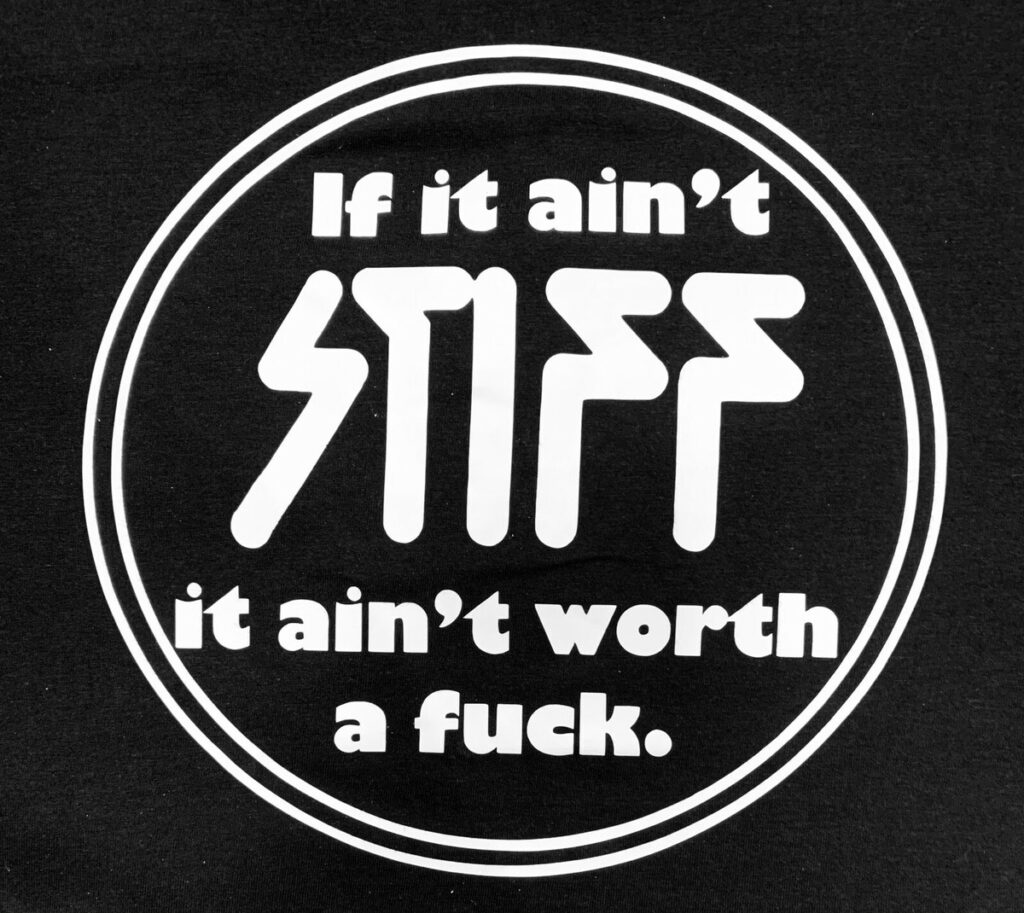
Stiff’s heyday lasted little more than a decade: by the end of 1987 it had folded, though it had saved Island Records in the process: Robinson ended up running both labels, and took his eyes off Stiff to save the major, which he did by creating the modern notion of Bob Marley and compiling the Legend album. I think the right thing happened: Stiff, from its name down, was not a label for the shiny world to come, of labels merging together into giant corporate monoliths in which imprint identity was subsumed into bland algorithmic schedules. That wouldn’t have been Stiff, and if ain’t Stiff, it ain’t worth a fuck. So this is the true story of Stiff, told in seven-inch singles: not a pub rock label, not a punk label, not a bloke’s label, but a pop label – one that saw pop in its widest sense, something that could be silly and joyful and angry, and sometimes all at the same time.
Nick Lowe – ‘Heart Of The City’ (1978)
Stiff single’s first single put two defining songs on either side of a 45, and I can’t think of another label whose first release acts as such a perfect introduction. It’s as if Creation had begun with ‘Upside Down’, backed with ‘Supersonic’. It came from the old guard. Lowe had been bashing around in Brinsley Schwarz for years, and the A-side, ‘So It Goes’, borrowed very explicitly from the distinctly un-punk ‘Reelin’ In The Years’ by Steely Dan and ‘The Boys Are Back In Town’ by Thin Lizzy. But it was new, too: the first record of the impending indie revolution, made cheaply and quickly, and in ‘Heart Of The City’ it had the first UK release that truly captured the amphetamine energy of punk, even if it was not itself punk. Better records would come, by great songwriters, but none had the effortless energy and promise of this one.
The Damned – ‘New Rose’ (1976)
Having got almost-punk out of the door, Stiff turned to actual punk. Lowe had been followed by four more pub circuit regulars, but the sixth Stiff single turned the world on its head: “Is she really going out with him?” asked Dave Vanian, as Rat Scabies summoned galloping hordes on his toms. Like tech bros decades later, Stiff moved fast and broke things, getting this out while the Pistols and the Clash were still doing their dances with major labels. What Stiff couldn’t do, though, was plot courses for its artists, and The Damned – ungovernable to start with – probably suffered from Stiff’s financial situation. They already felt isolated by snobbishness from The Clash and the Sex Pistols’ camps, and with Stiff they settled into a pattern of settling for labels that could put out their next record. It was short-termist and likely damaged the legacy they should now have.
Humphrey Ocean & The Hardy Annuals – ‘Whoops A Daisy’ (1978)
This is not a record you need to buy, or even hear. It’s in here to make a point: that for every groundbreaking act who would leave a legacy, there was novelty record that no one bought. The artist Humphrey Ocean had taught painting to Ian Dury, then played bass for a while in Kilburn And The High Roads. By 1978 he was part of the Stiff retinue, so why not have Dury write a song for him – one that seems to borrow an awful lot from ‘When I’m Cleaning Windows’ – and record it as a single? A lot of Stiff records were wholly pointless, and this is one of them, but it captured something about the label – the notion that an idea dreamt up during last orders was worth acting on. Stiff set out to amuse themselves as much as sell records.
Rachel Sweet – ‘B-A-B-Y’ (1978)
Having decided Akron, Ohio was the next great epicentre of rock, Stiff tried to prove it by signing almost every musician from there. Best of the bunch was the 15-year-old Rachel Sweet, a country singer who rapidly switched to old-fashioned R&B. This Carla Thomas cover – and its parent album Fool Around – are where you can really sense how at home the Stiff brains trust would have been in Asbury Park – it sounds as close to a Southside Johnny record as it could (given it was sung by a teenage girl from the tyre capital of America). Sweet was introduced to the UK by being sent on a Stiff package tour of the UK, travelling by train, accompanied by a tutor.
Ian Dury And The Blockheads – ‘Hit Me With Your Rhythm Stick’ (1978)
The release of ‘Hit Me With Your Rhythm Stick’ was when Stiff really started selling records, chalking up its first No 1 single, and proving something that would hold true for Stiff’s next stars, Madness: that the playgrounds were just as important an audience as the NME readers. The always colourful artists Stiff promoted were catnip to young kids, and we can talk as much as we like about Dury’s wordplay and how sinuous the Blockheads were, but this was a hit because it was funny and weird and catchy (to get an idea of how young Stiff’s audience was, dig out the video for Lene Lovich’s ‘Say When’, a weird, gothic rockabilly, played to a wildly enthusiastic audience who look barely out of short trousers.
Kirsty MacColl – ‘They Don’t Know’ (1979)
A major label would have ensured ‘They Don’t Know’ – the precise place where The Shirelles meet The Byrds – reached the charts and stayed there for a long time. Stiff didn’t, either because of a strike at the distributor, or because the determined MacColl and the dictatorial Robinson were at odds. Whatever the reason, the single’s failure was criminal and MacColl evidently felt so, departing the label and not returning till 1983. If Stiff was largely traditionalist in musical approach, here was justification: a waterfall of jangle, MacColl’s voice layered richly like a mille-feuille. Stiff did eventually get the song into the charts however, only performed by comedian Tracey Ullmann.
Madness – ‘My Girl’ (1979)
Robinson had been unable to see Madness live, so as a precautionary measure before signing them, he booked them to play his wedding. Their promise was fulfilled by their third single, their first genuinely great song and a No 3 hit. Madness epitomised Stiff as a London label, filming their videos on their home turf in Camden, and utterly at home in a world of hooky gear, shady jobs and dodgy pubs. Their success – again, driven by the playgrounds – was a double-edged sword for Stiff. More sales meant higher turnover, but they also meant more royalties to pay out, and bands expecting bigger shares of income. At a time when Robinson was splitting his energies between Stiff and Island, the problem would fester.
Tenpole Tudor – ‘The Swords Of A Thousand Men’ (1981)
Robinson’s eye for the kids’ market destroyed Edward Tudor-Pole’s career. He’d signed to Stiff as one of the punks most likely to, and had a massive hit with ‘Swords Of A Thousand Men’, a magnificently over-the-top medieval rockabilly anthem. “We’d had a massive hit with ‘Swords’, which every 12-year-old in the land bought, but nobody much older,” Tudor-Pole said later. “So we were being hired to play gigs for big money because we were in the top 10 and no one was turning up. The promoters couldn’t understand it.” To avoid them being a one-hit wonder, Robinson released ‘Wunderbar’ as the next single – another novelty. He was right about it being a hit, but all it succeeded in doing was to make them two-hit wonders instead of one hit wonders. Still, ‘Swords Of A Thousand Men’ is a great single.
The Belle Stars – ‘Sign Of The Times’ (1982)
Stiff was undoubtedly a bloke-heavy label but The Belle Stars, formed after 2-Tone act The Bodysnatchers split, helped introduce some balance. Teamed with Pete Waterman and Peter Collins to produce, they had couple of minor hits with covers (the tried-and-tested Waterman way), ‘Sign Of The Times’ was the breakthrough, a bright 80s pop hit with Motown roots that stood a million miles away from the likes of The Rumour, Any Trouble or Roogalator.
The Pogues – ‘Dark Streets Of London’ (1984)
The last great Stiff act, and the third – after Ian Dury and Madness – of the great chroniclers of Greater London. When ‘Dark Streets Of London’ was recorded, they were still Pogue Mahone, the name change yet to be forced on them. I remember hearing it for the first time on Peel, and being struck by how it existed solely in its own world and was unlike anything else I was aware of. It sounded like a folk song, but was sung by someone who sounded like a stray dog howling. After the sunny first verse, Shane MacGowan began talking about ECT “and drugged-up psychos with death in their eyes”. Who would have thought that this would be a band to go on to capture so many imaginations? “Stiff were the only people who could understand why people liked going to see us,” Shane MacGowan later said. “The only people who were worth a job in the record business. There was all these A&R men going, ‘The Pogues are going to be huge. But we don’t understand why people are going to see them’. But Stiff got it. That’s why they signed Wreckless Eric, that’s why they signed Nick Lowe, that’s why they signed The Damned.”