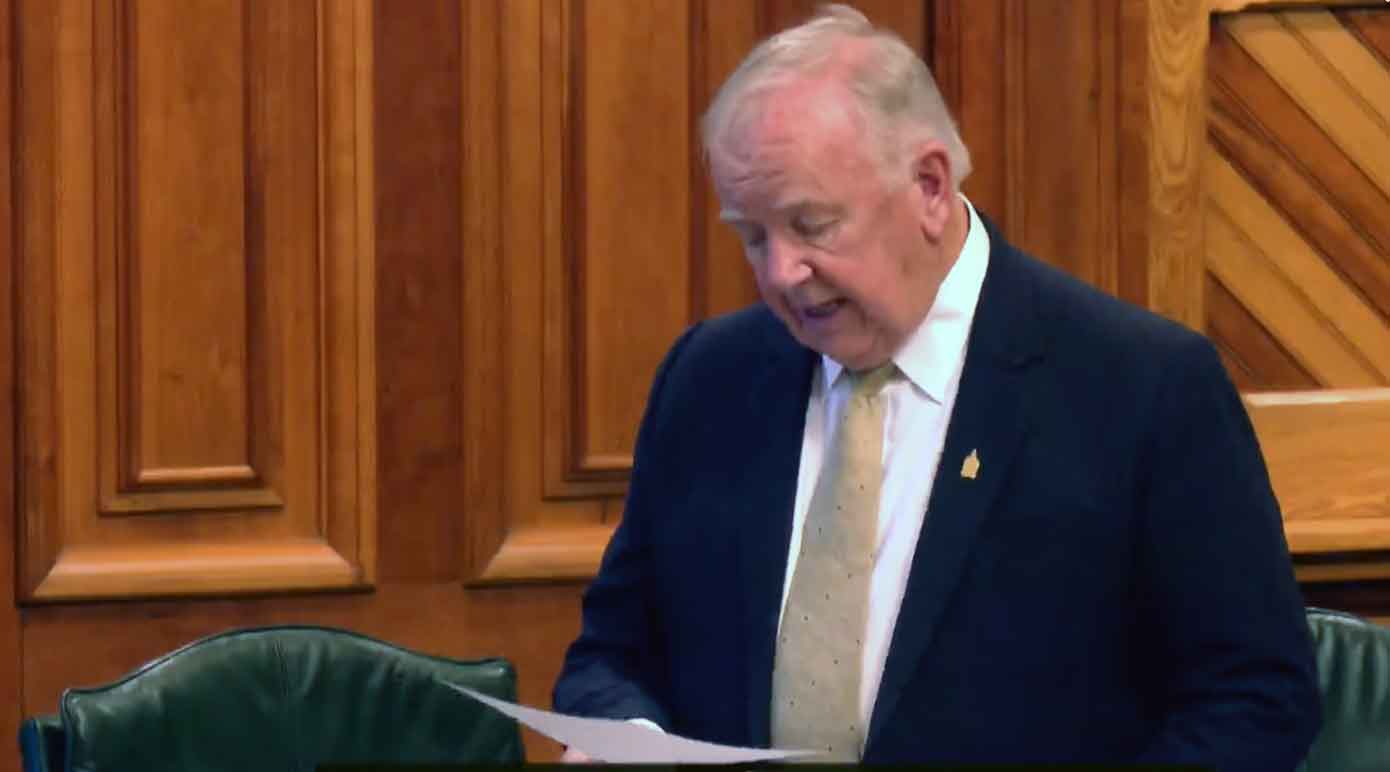
Bill Oliver, a Progressive Conservative Party legislator in New Brunswick, Canada, delivered a rousing speech to last week.
"One of the dangers associated with creating advocacy offices is that citizens often develop expectations that exceed the powers actually granted to those offices. Here's a more natural, flowing version of that section that reads like a legislative speech rather than a series of short points," he said, before continuing to detail "his" concerns.
At no point did he realize he was reading notes on the prompt from the LLM chatbot rather than the content of the speech it generated for him. Nor did anyone point it out to him or otherwise react: not a laugh, not a note, not a whisper. It took the internet to call it; local media eventually took note.
I was pleasantly surprised to see all these negative reactions to Oliver outsourcing his role to a robot. They expose, I think, a growing divide in our society: between the elites, who are only too happy to delegate their duties to the Borg; and the masses, who find this objectionable. The latter camp is correct — and the elites should take heed.
Justin Ling points out that the speech itself was vague hackwork, full of obvious tells even without the chatbot's framing responses.
It was a facile criticism of the utilities advocate bill, but it makes a great point about the dangers of American-owned AI. Uploading our politics to social media has been disastrous, and things are unlikely to get better if we become dependent on Trump-aligned Silicon Valley oligarchs.
But even if these shortcomings were addressed, we'd still hate the idea of chatbots doing our politicians' thinking for them. For decades, Canadian voters have been taking parliamentary democracy less seriously, and Canadian politicians have taken it less seriously in turn. That elected representatives will do only the bare minimum of critical thinking is now our expectation. No wonder they're using ChatGPT to write speeches.
He's not the first, and won't be the last. A federal judge in Oregon fined two lawyers $110,000 after they submitted fabricated citations and invented quotations. The Alabama Supreme Court sanctioned an attorney whose briefs referenced numerous cases that did not exist. A Mississippi federal judge removed every lawyer from a case after finding both sides were misusing AI. It's not just lawyers: South Africa withdrew its draft national AI policy after it was found to cite fake research on AI.
From the entire Channel 4 news team, I'm Veronica Corningstone.