
Remember me

EUROPE: Negotiations between EU officials and national governments are due to start in Brussels on July 16 to shape the Military Mobility Regulation. The package aims to translate the bloc’s ‘Military Schengen’ concept into an operational transport framework, though reaching a final deal will require months of intense negotiations. Thomas Wintle assesses the implications for Europe’s railways.
With the European Parliament having voted through its position earlier this month, negotiations with the Council and Commission over the EU’s emerging regulations for military mobility are set to begin on July 16. Forming part of the EU’s wider Military Mobility Package, these are intended to remove barriers that still slow military transport across Europe, from paper-based customs procedures and lengthy permissions to unclear emergency rules and infrastructure that is not always capable of handling military traffic.
 Parliament’s Roberts Zīle and Michał Szczerba © EP
For civilian rail, the military mobility talks carry both promise and risk. As industry groups have argued, the push for faster cross-border movements could help accelerate investment and remove some of the administrative barriers that have constrained European interoperability for years. But in a crisis, military deployments could disrupt passenger and freight services on already congested networks. How the sector absorbs that disruption will depend on the final text of the Military Mobility Regulation, including how it sets priority rules, permission deadlines, access to public and private assets, and compensation for affected operators and infrastructure managers.
Parliament’s lead negotiators Michał Szczerba and Roberts Zīle said during a press conference on July 8 that the plenary vote gave MEPs a ‘clear mandate’ for the negotiations, with the aim of concluding the regulation by the end of the year. This would pave the way for launch of the EU’s emergency military mobility plan, EMERS, operational no later than 2028. However, while Parliament and the Council broadly support the same overall architecture, their positions differ on how far the plan should go.
Parliament is pushing for faster deadlines, broader emergency powers, stronger EU-level coordination and a wider compensation mechanism, while the Council’s position reserves greater national control and backs limits on Member States’ obligations. As the talks get underway, five areas are likely to determine how the final regulation works in practice for Europe’s railways.
 Military mobility alongside passenger rail in Steenwijk, the Netherlands. Image: Wikimedia Commons. © Ministerie van Defensie
EMERS: Emergency triggers, scope and duration
Military mobility alongside passenger rail in Steenwijk, the Netherlands. Image: Wikimedia Commons. © Ministerie van Defensie
EMERS: Emergency triggers, scope and duration
Perhaps the sharpest institutional difference concerns EMERS, the European Military Mobility Enhanced Response System, which would change how military movements are handled once an emergency is declared.
Parliament backs a Commission-led process, under which the EU executive would propose activating EMERS and the Council would have 48 h to approve it. The Council wants individual Member States to be able to request activation directly, with up to 72 h to bring the system into force, with or without a Commission proposal. Parliament also supports a maximum duration of 12 months, while the Council would limit the regime to six.The geographical scope could prove equally contentious. Parliament is preparing to defend a broader version of the regime than Member States may be comfortable with, arguing that once EMERS is activated it should apply across the EU rather than only in the countries closest to a crisis or along the most exposed military corridors.
 Zīle is also EP Vice-President. Image: © EP
A related, apparently less sensitive point of friction concerns the Military Mobility Transport Group, the body coordinating cross-border military movements. Parliament would keep the Commission in the lead, while the Council wants greater Member State control, although Zīle said Parliament was ‘open to discuss’ the issue.
Digital permissions and shorter deadlinesThe institutions also differ over how quickly the Military Mobility Digital Information System should be introduced and how rapidly transport permissions should be decided. The system would bring transport permissions, traffic arrangements and customs formalities linked to EU Form 302 into a common digital framework, replacing what the MEPs called fragmented and often paper-based national procedures.
Parliament wants the Military Mobility Digital Information System operational ‘as soon as possible, but no later than 2028’, bringing implementation forward from the Commission’s original 2030 target. Both sides support cutting standing permissions to one month, while Parliament wants ad hoc requests decided within two working days. The Council appears more cautious, having retained the later timetable in its position. Meanwhile, it allows five calendar days for ad hoc requests.Parliament also wants the system to remain compatible with NATO’s Logistics Functional Area Services, which is used to plan and coordinate deployments, movements and transport.
Zīle pointed out that waiting until 2030 is unnecessary given that pilot digital systems are already active in 11 Member States. ‘We are in 2026,’ he said. ‘We will be very strong with the Council on positions like this, so that what we are already able to do, we do much quicker.’
 Disruption and compensation
The most commercially sensitive part of the talks is likely to concern what happens when the activation of EMERS overrides standard capacity-allocation procedures, and who carries the cost when that path displacement disrupts commercial timetables.
Both Parliament and the Council accept that military traffic may receive priority network access during an emergency. The Council says the cancellation or re-routing of scheduled civilian services should be a last resort, but the institutions differ sharply on compensation.
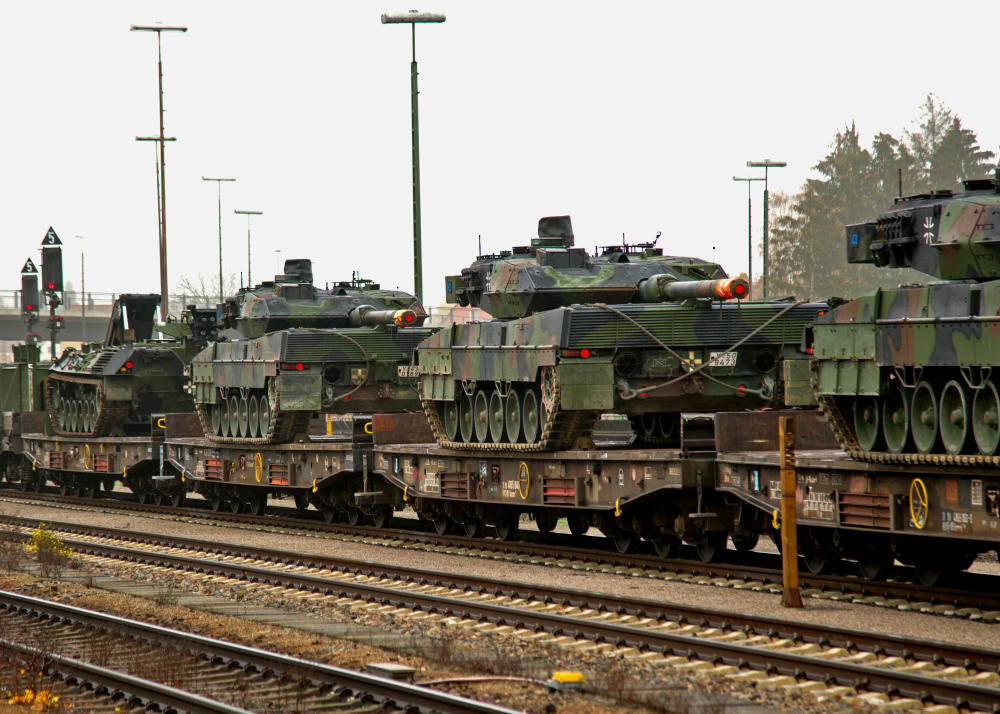
Parliament wants infrastructure owners, operators and managers compensated for justified costs, damage or lost revenue caused by emergency military priority. The Council takes the opposite approach. It deleted wording that limited the exemption to compensation paid ‘by the armed forces’ and now says that ‘no compensation should be due‘ to affected passengers or transport operators, while leaving Member States free to create national schemes. Convoy in Germany. © Wolochow/Shutterstock
Highlighting what has emerged as one of the clearest fault lines in the talks, Zīle said that Parliament had met with private-sector stakeholders, including logistics companies with experience of military convoys, and that companies were willing to work with the armed forces. But they ‘expect some compensation for priorities regarding access to railway infrastructure’, he said.
‘Compensation is in our mandate to negotiate with the Council, and we will see at the end’, Zīle added. ‘If the Council disagrees with this, it’s their problem, a Member State problem. If they don’t want to compensate the private sector in their countries, they would have a problem with the private sector in their own Member States.’
He acknowledged, however, that Parliament had not developed the principle into a full article, leaving room for negotiation over whether compensation should be handled nationally or through a wider EU mechanism. Szczerba linked the issue directly to private assets brought into the proposed Solidarity Pool. ‘If we have this chance to use it, we have to compensate the private sector for their property’, he said.
The Solidarity PoolThe proposed Solidarity Pool, one of the key features of the regulation, would bring together transport and logistics assets that could be called on during military deployments. Parliament and the Council broadly support the concept, but Parliament calls for a more explicitly defined and operational system.
It outlines that the Pool should be established within six months of the regulation entering into force and explicitly names vehicles, personnel, ICT systems, medical units, vessels and trains among the included assets. It also advocates opening access to non-EU NATO allies, Ukraine and Moldova.
Furthermore, Parliament aims to empower national coordinators to identify available rail assets directly during an emergency, a provision Zīle noted was absent from the Council text. ‘In a case of emergency, national coordinators have access to ERA registers for rolling stock in the railway sector, and also access to national track registers’, he said, giving military planners ‘a clear view’ of the dual-use rolling stock and infrastructure available for a convoy.
Market access: lessors seek role in the Solidarity PoolOne practical question is how privately owned locomotives and wagons would be identified, contracted and made available. Leasing companies have ordered more than 40% of Europe’s new locomotives over the past decade, while more than 60% of their fleets are cross-border, giving lessors a potentially significant role in shaping the Pool. Yet the Association of European Rail Rolling Stock Lessors (AERRL) says it has had little direct involvement so far.
‘Up until now, we have not really been involved in official meetings’, AERRL Secretary General Carole Coune told Railway Gazette International’s sister publication RailFreight.com. ‘That is what we are asking for, because all the players need to be involved in this broad approach … until now, we have not been contacted by anybody, so we do not yet know what we are talking about in practical terms.’
 Secretary General Carole Coune. Image: © AERRL
AERRL has also raised concerns that military transport work could increasingly be awarded directly to state-backed incumbents, reversing some of the market opening achieved under the Single European Railway Area. Coune pointed to Poland’s new framework agreement giving state-owned PKP Cargo a central role in its future military rail transport and logistics.
‘If military mobility is used as a reason to move back towards direct awards and state-owned incumbents, then we have to worry about the future of that market’, she said.
Governments may see rolling stock supplied through state-backed operators as the more natural choice for sensitive military movements, particularly where security, availability and clear command lines are priorities. However, AERRL argues that privately owned European fleets should not be treated as inherently less reliable or secure.
‘We are talking about a potential war against countries outside Europe. So we are all concerned by this potential crisis’, Coune said. ‘Lessors are European companies as well. We are ready to commit as European companies, just as a Belgian, French or German company would. We are ready to be as reliable as a national company, as we already are for commercial traffic.’
Parliament is also pushing for tighter supplier rules within the Solidarity Pool, including restrictions involving companies linked to ‘non-friendly countries’. Zīle said the Council had not developed the issue to the same extent, while acknowledging that existing supply-chain dependencies could not be removed immediately.
‘Let’s be honest, in Ukraine as well, many drones are built with motors from China, and so on. That is how it works today’, he said. ‘In the long run, we have to avoid non-friendly country suppliers, but we have to think in the short run as well.’
Infrastructure obligations and the funding gapThe fifth fault line concerns how far the regulation should go in turning Europe’s military infrastructure needs into concrete obligations for Member States.
The Commission’s original proposal said Member States ‘shall upgrade’ dual-use infrastructure on military mobility corridors. The Council has softened that to ‘with a view to upgrading’ and made delivery conditional on project maturity, legal procedures and available funding, without creating new financial commitments for either Member States or the EU. The regulation would still cover bottlenecks, interoperability, capacity and infrastructure resilience, but the Council’s wording gives national governments more discretion over delivery. Parliament has strengthened the regulation’s infrastructure and resilience provisions, but stopped short of trying to settle the funding question inside the file. ‘Here we didn’t touch money issues’, Zīle said. ‘It’s low-hanging fruit. We have to remove obstacles for military mobility, so money is a different issue.’The next EU budget proposal would increase military mobility funding tenfold, from €1.7bn to around €18bn, but Zīle said that would still not cover the roughly 500 priority hotspots already identified, let alone the thousands of individual requirements that could emerge from detailed mapping. Additional funding would have to come from other EU instruments, national budgets and potentially public-private partnerships. ‘Otherwise, we will not be able to develop them’, he said.

Already have a subscription? Log in.
Choose your subscription Most popular! Digital Onlyi Prices are displayed as monthly rates (exc. VAT), but billed annually. Please refer to our subscription terms for more details.
€18,17 per month per user *
£15.75 per month per user *
$19.17 per month per user *
Unlimited access to all Railway Gazette content Monthly digital Railway Gazette International Magazine 2000+ Operator Profiles Newsletters & Breaking News Updates Subscribe with 1, 3, or 5 user logins Digital + Printi Prices are displayed as monthly rates (exc. VAT), but billed annually. Please refer to our subscription terms for more details.
€25,67 per month per user *
£22.33 per month per user *
$26.67 per month per user *
Monthly print Railway Gazette International Magazine Unlimited access to all Railway Gazette content Monthly digital Railway Gazette International Magazine 2000+ Operator Profiles Newsletters & Breaking News Updates Subscribe now ›Considering a corporate subscription? Contact us to find out more.