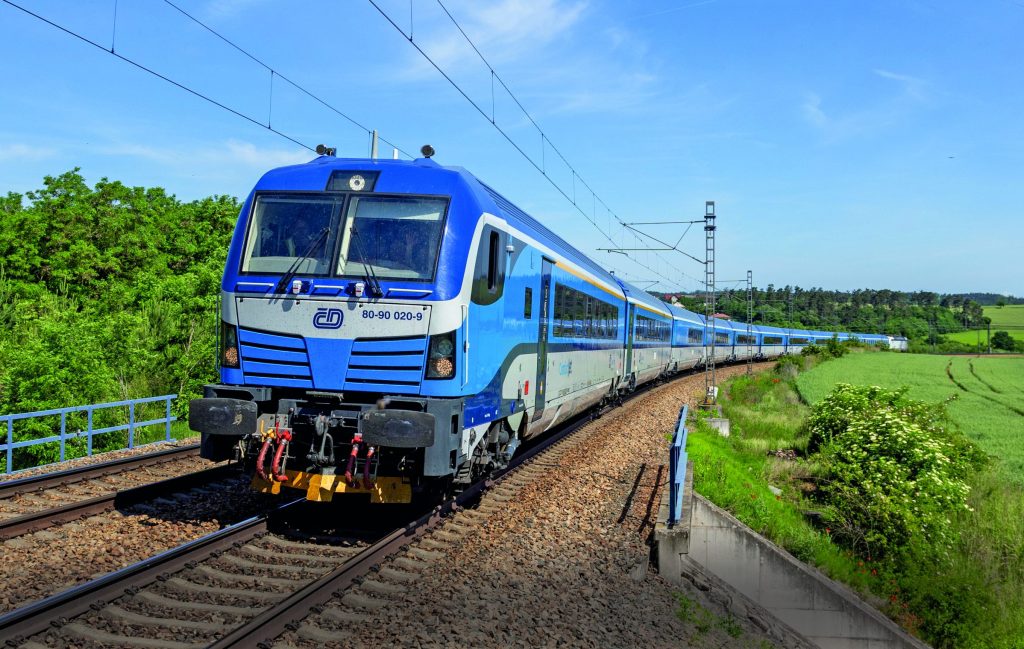
EUROPE: Rail industry stakeholders are expressing growing concern that the sector faces exclusion from the successor to the EU’s Horizon Europe R&D programme under the 2028-34 budget round.
An open letter was published on July 7 by 15 rail bodies including suppliers’ association UNIFE, infrastructure managers’ trade body EIM, the Community of European Railways & Infrastructure Companies and wagon keepers’ association UIP. This calls on the EU to support and invest in the creation of a successor to the Europe’s Rail and Shift2Rail research and innovation joint undertakings that have been supported for the past 12 years.
The letter was released just over a year after a previous push by rail stakeholders to secure a successor to the current Europe’s Rail initiative.
The latest letter says the joint undertaking model is vital to the deployment of future technologies such as ERTMS, the digital automatic coupler and the emerging FRMCS telecoms standards. Discontinuing the rail joint undertaking would fragment European research efforts, slow deployment of common products and technologies, weaken Europe’s industrial base and ultimately increase the cost and duration of railway transformation, the associations warned.
EU budget negotiations are due to continue throughout 2026, with the announcement of a future European research agenda expected before the end of the year.
‘A dedicated railway joint undertaking is essential to maintain Europe’s technological leadership, competitiveness and industrial strength. Continuing will support jobs, exports and Europe’s strategic autonomy by keeping railway innovation and manufacturing in Europe’, said UNIFE Director General Enno Wiebe.
‘A real risk’
While lobbying of EU policymakers by industry is inevitable at this stage in the Multi-Annual Financial Framework cycle, rail advocates in Brussels insist that the risk of the sector being frozen out of the R&D programme is real.
One source close to the negotiations told Railway Gazette International that under the EU’s latest thinking, the aviation and maritime JUs are in line to receive funding, while rail would not. This would have ‘dire consequences’ for the sector, they added, noting that a ‘rail JU is an important and proven platform in channelling a European strategic vision into the sector and for leveraging EU funds’.
Another insider added that an initial round of negotiations under the Cypriot presidency of the EU had led to a 4% cut in the Horizon Europe budget, which was ‘not a good start’. A further complicating factor is understood to be the campaigning to stabilise or increase funding streams like the Connecting Europe Facility. These focus on the operational railway and its infrastructure, but they do not help the sector to develop and then commercialise emerging technologies. ‘There is still a lot of heavy lifting to do to get technologies like DAC and FRMCS ready for widespread adoption’, they added. ‘Losing the sector-wide forum to achieve this would be very harmful.’
Already have a subscription? Log in.
Choose your subscription
Most popular!
Digital Only
i
Prices are displayed as monthly rates (exc. VAT), but billed annually. Please refer to our subscription terms for more details.
€18,17
per month
per user
*
£15.75
per month
per user
*
$19.17
per month
per user
*
Unlimited access to all Railway Gazette content
Monthly digital Railway Gazette International Magazine
2000+ Operator Profiles
Newsletters & Breaking News Updates
Subscribe with 1, 3, or 5 user logins
Digital + Print
i
Prices are displayed as monthly rates (exc. VAT), but billed annually. Please refer to our subscription terms for more details.
€25,67
per month
per user
*
£22.33
per month
per user
*
$26.67
per month
per user
*
Monthly print Railway Gazette International Magazine
Unlimited access to all Railway Gazette content
Monthly digital Railway Gazette International Magazine
2000+ Operator Profiles
Newsletters & Breaking News Updates
Subscribe now ›
Considering a corporate subscription? Contact us to find out more.