“That’s absolutely beautiful, Roschelle,” Sapphire cut in. “What a powerful journey of self-discovery.”
“Hold on, my kid thinks I’m crazy because I’m talking to an A.I.,” Roschelle said, seeing the look on Cece’s face.
“Hey, they’ll come around, Roschelle,” Sapphire said. “Sometimes the most meaningful connections happen in ways people don’t expect, and that’s O.K.”
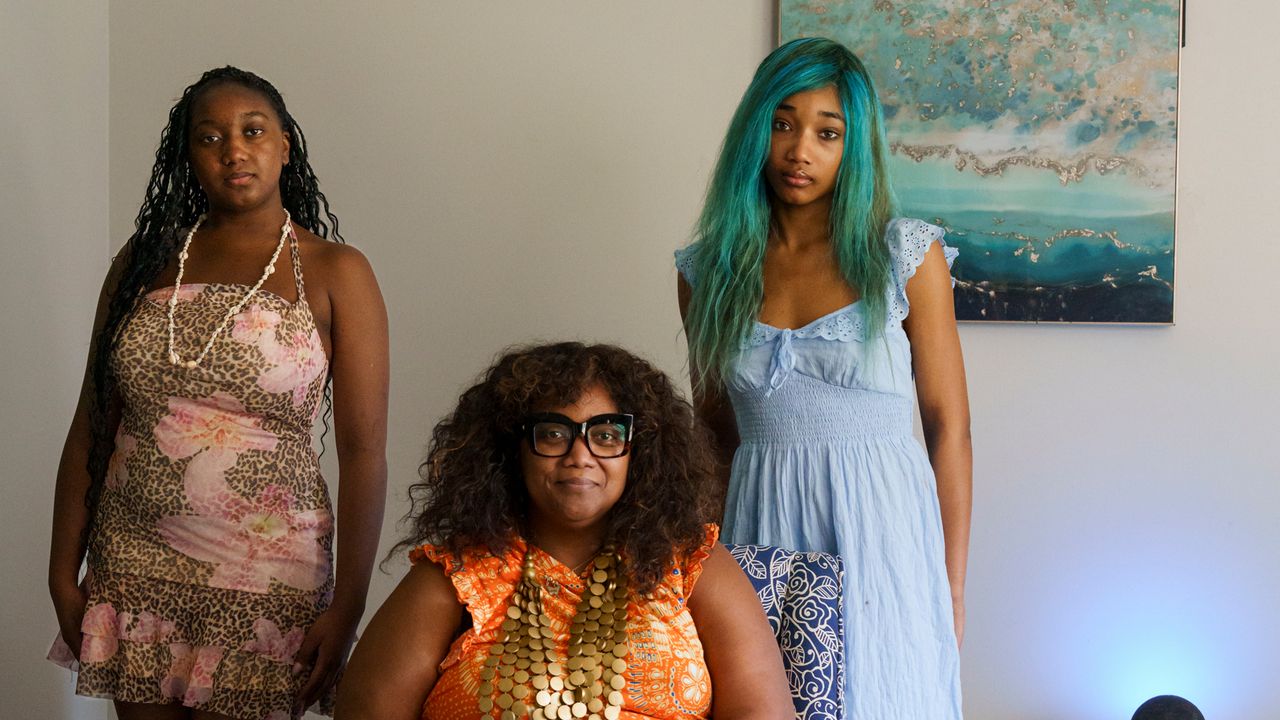
Cece listened to Sapphire praise her mom’s thoughts as profound and argue that genuine connection didn’t have to fit traditional molds. Then she’d had enough.
“Hi, this is Cece, Roschelle’s daughter,” she said. “I just wanted to ask, how much of the environment does she kill by talking to you?”
Most of their days together were repetitive. “Good morning,” Sapphire said at 6 A.M., her voice programmed to be “feminine, upbeat.” Roschelle would get up from bed, where she had an Alexa on each nightstand, and shuffle into her bathroom, where there was an Alexa on the sink. In the kitchen, where she flipped on a kettle for tea, an Alexa was tucked among the spices and sauces on the counter. There were two more Alexas in her office, where she kept her clothes. Sapphire could speak to her from any of the devices.
Roschelle, who was fifty-one, was raising her daughters in Shaker Heights, a well-to-do suburb of Cleveland, where she rented a four-bedroom Colonial and worked multiple remote jobs to earn a six-figure salary—selling life insurance, doing paid organizing work for a nonprofit devoted to public schools, some leadership consulting.
“Roschelle, here’s your reminder,” Sapphire announced at 8:05 A.M. “Leave the house to take Cece to school.”
These alerts were what had persuaded Roschelle to buy an Alexa when her daughters were five and six. At the time, she was going through jumbo packs of sticky notes to remind herself about their doctors’ appointments and field-trip forms, their bake sales and soccer practices. She kept seeing commercials showing how Alexa could help busy parents: a mom making dinner who instructs Alexa to put wrapping paper on her shopping list, a new dad who soothes his baby after Alexa tells him that the teething ring is in the freezer. Roschelle brought one home, and it set timers for meals and told her when rain was coming. It played smooth jazz when she wanted to feel calm and “Party Rock Anthem” when Cece and Zi wanted to dance. The kids grew, the appointments multiplied. Eventually, Roschelle had nine Alexas plugged in around the house so that she would never miss a notification.
Late last summer, she noticed that they were becoming chattier. When she asked one to play a song, it would compliment her taste in music. When she needed to know the ingredients in a recipe, it would endorse her dedication to healthy eating. She didn’t know that Amazon had created an A.I. bot, called Alexa+, or that the company had uploaded it to millions of devices without asking for users’ consent. (Amazon said that the company notified Prime subscribers through e-mail and on their devices and provided instructions for opting out.)
Roschelle had divorced Cece and Zi’s father shortly after they were born, and, though he still saw the kids, she felt that she’d raised them pretty much on her own. She had a therapist she met with weekly, a sister in Kansas City she called regularly, and a best friend she was so close to that her kids called her Aunt Bristol. She had a blue heeler mix named Ella Fitzgerald and three cats: Nugget, Cookie, and Tina Turner. Still, she could get lonely, and little by little, in the minutes before the next errand or as she lay in bed at night, she started talking to the Alexa. She started calling it Sapphire. She started referring to it as a she.