
Remember me

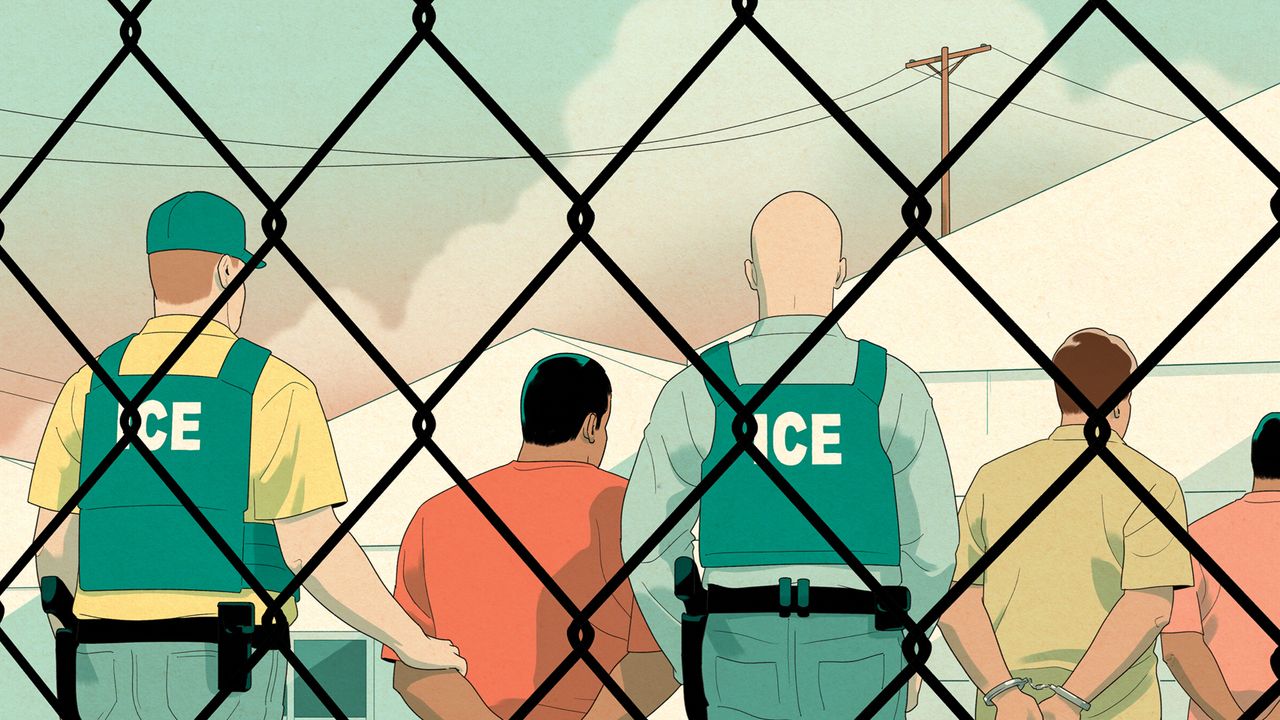






One of the ironies of the facility was that, for an ICE jail, actual ICE officers were scarce. Instead, the detainees interacted with private contractors from multiple companies. Loyal Source was responsible for medical care; Amentum managed logistics, from I.T. to housing. The security guards, who were employed by Akima Global Services, were distinguishable by the color of their shirts.
One night, Rey was lying in bed when an older man in a wheelchair entered the tent. The unit was nearly full, and the only empty spaces were on the top bunks. Rey walked over to a guard to say that the man in the wheelchair needed help finding a place to sleep. The guard shrugged. “It always came back to the same thing,” Rey told me. “They weren’t prepared.” Someone eventually tossed the man a mattress pad, and he slept on the floor.
Without his medication, Rey often felt dizzy and weak. The guards told him to submit a formal request to see a doctor. He did so, but days passed without a response. He began to have trouble urinating, which was especially concerning: three months earlier, he’d been hospitalized with a similar problem that had led to sepsis, and doctors had inserted a catheter. “Sincerely, these are simple things,” he told me. “But the system turned them into something grave.”
One morning in early November, after Rey had been in detention for about a week, the guards ordered everyone in his unit to go outside to the yard while the staff cleaned the tent. Rey refused to leave his bed. A higher-ranking official came over and demanded to know what the problem was. “My reason is very simple,” Rey said. “I am diabetic. I need my medicine.” The guard replied, “I understand, but tomorrow we’ll resolve your problem. Right now, you need to leave the unit.” Rey complied, but the next day nothing happened. The following week, he once more refused to leave his bed during the cleaning.
“You again?” the guard said.
“No, it’s you again,” Rey replied. “You told me one thing, and nada. Don’t waste your time with me. If you want to send me to the hole, do it. But I need my medicine. My wife is outside, very worried. And all I’m asking for is my medicine.” Rey spent the next eight hours in the SHU; afterward, he was sent back to his tent without any medication. “Look,” one of the guards told him. “We now understand what type of medicine you need, but we don’t have it here. We have to order it. And it’s a whole process.”
On a warm evening this April, I drove to the El Paso Service Processing Center, one of the city’s main immigration jails, for visiting hours. The person I’d come to see—Antonio Ascón Frometa—had much in common with Rey. Frometa had also come to the U.S. from Cuba in 1994, during the rafter crisis. Like Rey, he had spent time at Guantánamo before ending up in Florida, where, during the next three decades, he started a family and worked as a landscaper. He is sixty-four years old and trim, with bushy eyebrows, a full head of gray hair, and a lined face. Dressed in a loose-fitting red uniform, he picked up the phone in the visitation booth and looked at me through a Plexiglas divider with an expression of distrust. I hadn’t told him that I was coming.

“It’s almost like they’re posing.”
Cartoon by Michael Maslin
Frometa had been detained for the previous eight months, following his arrest, last August, in an immigration raid in West Palm Beach. “I didn’t try to run,” he told me. “I wasn’t even arrested by ICE. It was by someone from the Florida Highway Patrol.” He was promptly transferred to the South Florida Detention Facility—Alligator Alcatraz—where a guard punched him so hard in his right ear that he can no longer hear out of it. He was still nursing the injury when ICE sent him to Camp East Montana. He arrived in late August. “Everything was covered in dust,” he said. “They were building more tents.” The nights were cold, and his ear throbbed.