Locked into the grind of city living, it’s easy to feel depressed, isolated, alienated. The world we live in feels so hostile, and it’s all too easy to feel completely disconnected from your peers, your purpose, and, especially the Earth itself. If you’re particularly unlucky, you might see less than a dozen trees and a sole grassy knoll during your daily flat-bus-work-bus-flat strife knot.
It would be naive to say the fatigue and implied hopelessness of modern life are solely down to our loss of connection to nature, but it’s a significant factor. There’s a clarity of thought that is best found in the forest clearing, on top of an ancient hill, or even feeding the ducks, and it is important to always feel connected to something far greater than ourselves.
In Britain, there is a great history of music that takes its muse from the idylls of the countryside, and turns it into something life-affirming. Maybe the work of Delius and Vaughan Williams, the ‘English Pastoral School’, is too distant to feel like a tonic to modern ills, but the first wave of British post-rock also encapsulated this perfectly. Talk Talk’s dazzling panoramas, Disco Inferno’s atmospheric collages, and Hood’s forlorn slowcore transmissions all take more than a little nourishing influence from the natural world around them.
One contemporary band that has recognised this disconnect from the starting gun is Squid, one of Britain’s greatest active rock bands. A mutating quintet that feel just as at home making gut-punching grooving art-punk songs as they do making post-rock collages from the detritus, they have maintained a definitive pastoral influence throughout their three albums. You can hear the grandeur of the English landscape in their sprawling, motorik wig-outs, and Ollie Judge’s lyrics are tilted vignettes deeply informed by the landscape and humanity’s choices shaping it.
The band’s guitarist, Anton Pearson – as well as being a shredder with real chops – is the band’s resident nature boy, the band’s driving pastoral influence. He’s an avid birdwatcher, and keen acoustic ecologist. He spent much of the rural recording of Squid’s second album O Monolith traipsing through Wiltshire taking field recordings of chirping great tits and sparrows. His debut solo album sees him revelling even more in the thralls of nature.
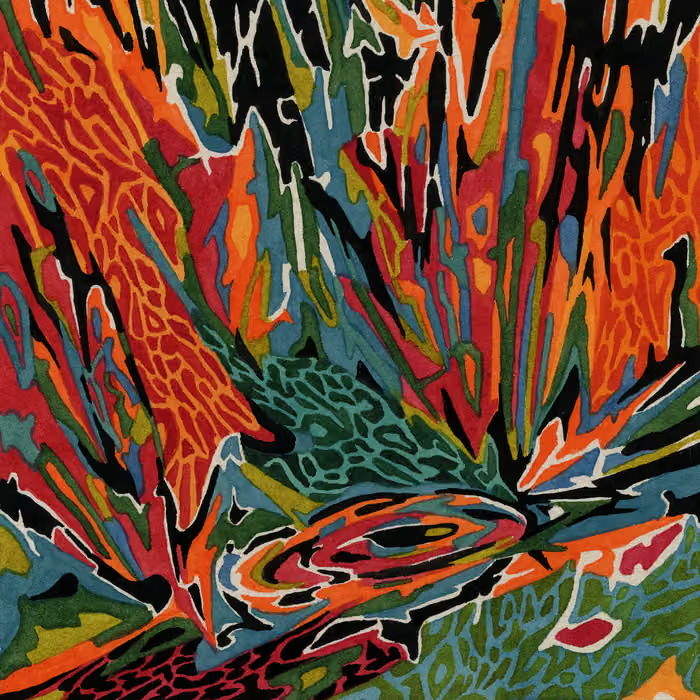
Driving Through Belgium is made of six naturalistic ambient works that take their muse from the vibrancy of the world outside: drones as verdant as the algae on the album cover, songs that photosynthesise in real time. He aims throughout to meld the electronic and the organic – to create a kind of music that sounds like a naturally occurring phenomenon – and succeeds on all counts.
It was made at his home in Brighton, during lulls in Squid’s hectic touring schedule. Presumably, for a shredder of Pearson’s acumen, this patient and delicate work is akin to guided meditation for a boxer, a no-phones spa day for Miranda Priestly – becalmed dispatches from the eye of the storm.
Across Driving Through Belgium, droning guitars, a glittering Korg, and a cosmic Pianet make up a sound palette that will be relatively familiar to anyone who’s been attuned to Squid’s frequency this decade. But here, Pearson deploys it in a wholly new way. He gives single ideas and sparse, brittle textures room to breathe, as his compositions come together with all the speed of continental drift. There is no midi, click track, or samples, as Pearson uses each track as an opportunity to let his instruments of choice call out naked.
‘Driving Past Muscular Cows in Belgium’, the masterful 20-minute piece that makes up the whole first side of the album, is the best example of this – something of a (very) deconstructed Squid song. The first ten minutes see the lethargic awakening of a droning, slowed-down guitar, before Pearson introduces more elements to his grand collage. Abstract synths whirr first, before a wall of muted brass fanfare, and, finally, a rising arpeggio of glittering keys give it a minimalist finale.
You can hear the ballasted, burnt-out drone of Stars of the Lid in the track’s beginning, before a bright, hopeful ambience a la Apollo: Atmospheres and Soundtracks takes hold.
There is often an absence of simple melody, but it is employed to great effect with the synth on ‘Driving Past Muscular Cows in Belgium’, and then again with the Pianet on ‘Tintinnabulation I’, the album’s finest moment. Beginning with glittering high-end synthesizer twinkles, it ends with an emerging exoskeleton of looped purgatorial keys.
Meanwhile ‘Tintinnabulation II’, later on the album, sees Pearson opting to slow this down even more – crunching, technicolour electric drones build into euphoria. There are shades of OPN, glows of the vaporwave storefront of the Floral Shoppe. But something about the verdant colour palette remains earthy and organic. The reverb feels like ocean spray, and it feels like Pearson’s synthesizers breathe, pant and wheeze.
These two pieces take their name from “tintinnabulation”, the sound of ringing bells. But while both pieces are united by the tactile resonance of their textures, it’s hard not to play word association and think of the stark, minimalist arrangements of Estonian composer Arvo Pärt’s “tintinnabuli” composition style.
Of course, Pärt’s sacred minimalist works are far from ambient, but something about the way both Pearson and Pärt strip away the unnecessary – subtract radically – and focus on one or two stark instrumental voices, certainly rings true here. Like Pärt, oftentimes Pearson will let textures fizzle out to near complete silence. He finds joy giving individual drones and ideas room to be born, live, and then decay to nothingness at their own speed. The result is a record that is to be experienced from front to back.
Closer ‘Tern Daylight’, one of the record’s busier numbers encapsulates this life cycle perfectly. Hums, bells, oscillating reverb-laden chords all fade in and out in a tidal rhythm, before the track ends on one ultimate drone: a sustained note on the Pianet that echoes out like one final breath.
Throughout, the best thing about Driving Through Belgium is its strong feeling of earthliness. In spite of complicated synth-work and a spaceship-control-console pedalboard, Pearson presents six pieces that teem, bustle, and then decay like the natural world. He so ably evokes the everyday beauty of his garden pond, of a quick walk to clear the head, of looking out the window on a long journey.
Driving Through Belgium is Pearson’s breather from his wild ride with Squid, but it functions as the perfect accompaniment for anyone that needs a moment away from the restlessness and relentlessness of normal, everyday life. For when you simply need to touch grass.