
Remember me
There comes a moment in every Dolly Parton concert, as cherished as it is predictable, when the country icon reels out her famous scripted off-the-rhinestone-cuff remark: “It costs a lot of money to look this cheap.”
It’s a quip which could easily be adapted to fit Ramones: it takes a lot of brains to sound this dumb. Because, if there’s one defining question which still dangles over the New York City punk pioneers, it’s the precise levels of clever / stupid underlying their act and, indeed, whether it was an act. And whether, in fact, that clever / stupid cocktail was – at least in part – the very thing that changed the world.
Craig Leon, who produced their earth-shaking 1976 debut, has a clear view. Casting his mind back to the impression the four ‘brudders’ made on him back then, his view is that they were brainy and dumb, simultaneously. “The thing that was really odd about the Ramones was that they would say things as a joke, but they would mean it at the same time,” he told me, “The things they’d say would be really dumb, and you’d think that was just what they were trying to project… but then you’d find out that they actually believed those things, in addition to projecting them! It was brilliant.”
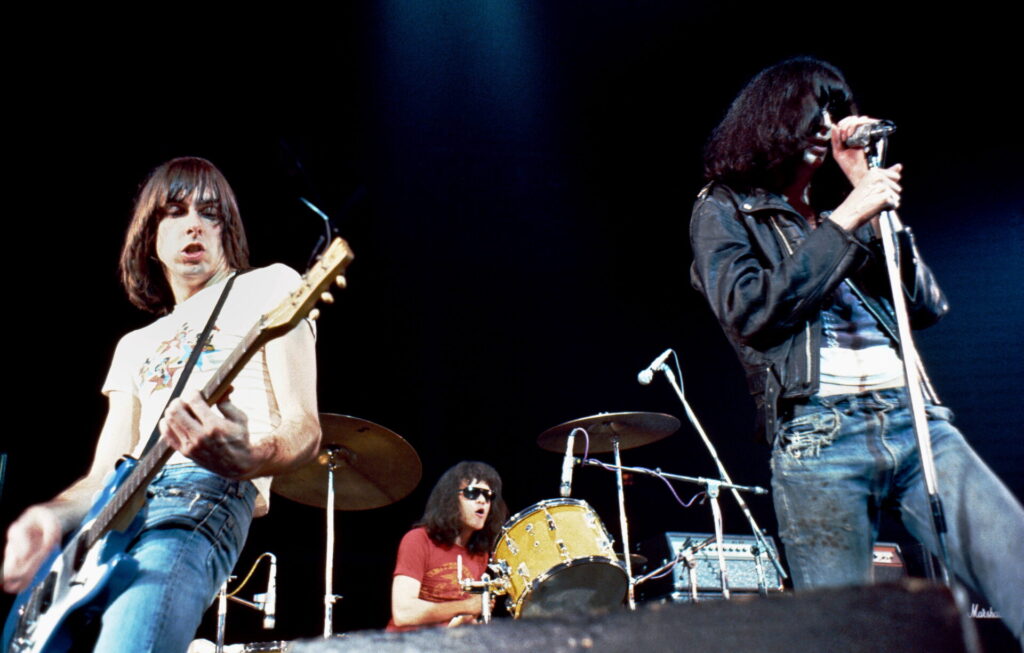
The band’s original line-up of Johnny Ramone (John Cummings, guitar), Joey Ramone (Jeffrey Hyman, vocals), Dee Dee Ramone (Douglas Colvin, bass) and Tommy Ramone (Tamás Erdélyi, drums) played their first two UK shows in one weekend. At London’s Roundhouse on Sunday 4 July 1976 and the following night at Dingwalls. For some, this weekend was a catalytic, life-changing flashpoint. The question shouldn’t be whether they changed the world – they demonstrably did, and especially Britain – but how they changed the world. In the audience at the Roundhouse were The Damned (who were just 48 hours away from playing their debut gig) plus members of Wire, Gaye Black, Shane MacGowan and Adam Ant. The following night members of the Sex Pistols, Buzzcocks and The Clash (only 24 hours after playing their debut gig) plus future members of Adam and the Ants, The Slits, Siouxsie & The Banshees and The Pretenders were also inducted into the nascent punk family.
Ramones visiting the UK became the glue that bound the various factions of the British punk scene together while providing a blueprint of how an assault on the British cultural mainstream was now entirely possible.
 The Ramones and Mickey Leigh on Park Lane in London 1976. Photo by Danny Fields
For others, notably critics, it was the cause of some confusion, perplexed as to whether Ramones’ love of trashy, disposable pop was genuine.
The band’s open appreciation of low culture was, apparently, sincere. “For example,” Leon recalls, “they would come out and say the Bay City Rollers were a major influence, and you’d think, ‘That’s a joke’, but it wasn’t.” [The “Hey, ho, let’s go!” chant on ‘Blitzkrieg Bop’ was based on BCR’s “S-A-T-U-R-D-A-Y… Night!”] “But there was an art side to them,” Leon continues. “Not really to Johnny, but the other three. Tommy was involved in film school, Dee Dee was a painter, Joey was a great writer of lyrics. And they all had a love of rock & roll at the same time. So they were what they were: there was nothing false about them.”
Their genius, in part, lay in this ability to be simultaneously authentic and an art statement. Joey’s mother owned an art gallery, where the band held their early rehearsals. He came from that world, and was more than capable of conceptual thought. Robert Christgau called Ramones “the most cleanly conceptualized New York rock show there is to see”.
Not that everyone cottoned on. Charles Shaar Murray, an early advocate, wrote in the NME in 1975: “The Ramones aren’t worried about being genuinely creative, and if you told them they provided a unique insight into anything, they’d probably piss on your shoes, and you’d deserve it too.”
Before too long, however, critics began to unpick the band’s intentions. Mary Harron, in a Melody Maker piece in 1980 on the influence of pop art and Andy Warhol upon music, wrote “Only after pop music had become self-conscious could you have a group like the Ramones, with their amazing ironic dumbness. The Ramones eternally stand back from themselves. They are both an expression of American teenagehood and a comment on it, and perhaps for that reason perhaps they have never been embraced by the mass of American teenagers.” Nail, head.
In this sense, the Ramones were pioneering postmodernism in pop in a way which perhaps only two other acts – David Bowie and Roxy Music – had previously managed with any notable success. And one doesn’t need to dig too deeply into Ramones’ lyrics to find evidence that Joey was far cleverer than imagined. For example, the line “Second verse, same as the first” (in ‘Judy Is A Punk’), lifted directly from Herman’s Hermits’ version of ‘I’m Henery The Eighth, I Am’, and “Third verse, different from the first” (in the same song), are simultaneously examples of pop-referencing-pop and breaking the fourth wall. And the couplet “Now I guess I’ll have to tell ’em / That I got no cerebellum” (‘Teenage Lobotomy’) is not the work of an idiot. As John Cooper Clarke perceptively put it, “They wrote clever lyrics about moronic subjects, rather than the other way around.”
The noise the Ramones made, almost from the first demo, remains one of the base elements of rock & roll. Like AC/DC. Like Motörhead. (There was a mutual love-in between the Ramones and the latter: Lemmy was often pictured in a Ramones T-shirt, and Motörhead recorded a song called ‘R.A.M.O.N.E.S.’ which the Ramones performed, with him as guest, at their farewell concert.) Ramones were just as unchanging and irreducible as those two bands. It’s a sound which functions in the same way as the shot of adrenalin John Travolta stabs through Uma Thurman’s sternum in Pulp Fiction: an exhilarating jolt of pure energy.
Craig Leon, who was working for Sire Records at the time, remembers first hearing those earliest tapes, now sadly lost to history, when Tommy dropped by his office one day in 1975. “I was seeing him with a view to signing them anywhere, not necessarily Sire. I just wanted to help them out. So he played me this demo that was really rough. It was done on a home tape recorder or something. I wish we could hear that now – that would be really historical.” The 2016 deluxe reissue of Ramones contains a second set of demos. “The ones that he made later were rough,” Leon explains, “but they were trying to be kind of conventional so that they could get a record deal. They were slower than how the band actually played, and cleaner. And people these days get amazed when they hear those, and say ‘Gosh, the Ramones sounded like the Ramones!’ Well, I hate to tell everybody, but most every band sounded like themselves, ‘cos that’s all they could do, back then. There was no svengali team of eighteen Swedish producers and beatmakers standing behind them. If you listen to The Beatles’ demos, The Beatles sounded like The Beatles. Lo and behold – mirabile dictu! – the band sounded like the band, and that’s why I liked them.”
That sound didn’t, however, come to them like a bolt from the blue. For Joey, the radio pop of his childhood was a huge influence. As Craig Leon remembers, “He was completely knowledgeable about early rock & roll, doo-wop and rockabilly, and he loved the English invasion of the 60s. Not necessarily the slick stuff, he liked the Mickie Most stuff.” The four Ramones were also fans of bands from the New York and New Jersey scene such as The Vagrants, the Young Rascals and Vanilla Fudge, and especially cartoonish gonzo rockers The Dictators, whose proto-punk sound was a direct precursor of their own. Glam rock was a strong influence: they were keen followers of the New York Dolls, as well as their British counterparts like Bowie, Slade and especially T. Rex.
The centre of New York City in the 70s was up for grabs. ‘White flight’ to the suburbs, economic ruin and urban decay had left many buildings derelict, and in 1975 the city came within one day of being officially declared bankrupt, only saved by the United Federation of Teachers union buying $150 million’s worth of Municipal Assistance Corporation bonds. The litter-strewn streets of areas like the Lower East Side and East Village became playgrounds for the young, gifted and poor. The conditions for the nascent punk scene could barely have been more perfect.
 Joey Ramone on the steps of the Roundhouse 4 July 1976. Photo by Danny Fields
The first ever Ramones concert, with the band still a trio, took place on 30 March 1974 at the Performance Studio on East 20th St in Gramercy, now the Flatiron District. The setlist consisted of ‘I Don’t Wanna Go Down To The Basement’, ‘I Don’t Wanna Walk Around With You’ (the first song they ever wrote together), ‘Now I Wanna Sniff Some Glue’, ‘I Don’t Wanna Be Learned’ (or ‘I Don’t Wanna Be Tamed’), ‘I Don’t Wanna Get Involved With You’, ‘I Don’t Like Nobody That Don’t Like Me’, and ‘Succubus’. Just look at those titles: no fewer than four I-don’t-wannas. The language of negation and refusal. Mid-20s they may have been, but they were setting down an immortal and enduring template for the sullen teenage brat.
It was the second Ramones gig, however, and their first as the classic four-piece, which would prove most significant. CBGB, Hilly Kristal’s legendary shit-and-sawdust dive bar, had opened in 1973 and rapidly became Ramones’ home venue. It benefited from the closure of the Mercer Arts Center and a subsequent influx of new wave and punk acts. Before the Ramones had played a note, the likes of Wayne County, Television, Patti Smith and Suicide had already gigged there. The pre-existing scene which lurked in the sticky-floored corners took to Ramones immediately on 16 August 1974. Suicide’s Alan Vega was an instant fan. Marc Bell of Richard Hell and the Voidoids remarked “Shit, I wish I was in this band” (and before too long, he would be).
Getting gigs off home turf was difficult however; and even when they happened, they were often disastrous – they were bottled offstage in Waterbury, Connecticut. At CBGB, however, where they played an incredible 18 of their first 20 shows, their reputation grew and grew. They weren’t making any money yet, and were so poor that they all ended up living with Arturo Vega, a gay Mexican artist with right-wing politics and a fondness for pop art day-glo swastikas, who had a loft next to CBGB. (It was Vega who made the mock-Presidential roundel which became Ramones’ iconic and much-bootlegged logo.) But they were building a name for themselves.
Music industry movers and shakers began to check them out. Danny Fields, soon to become their manager, nearly swerved them because the name Ramones made him assume they were a Spanish flamenco act. Luckily, curiosity got the better of him, and he brought along the influential Warhol crowd with whom he was connected.
The music press began sniffing around, too. Lester Bangs was the first to review them in print, and compared their sound to being run over by “a berserk locomotive barreling downhill with a broken throttle, no brakes, and Bugs Bunny in the driver’s seat”. Photographer Leee Black Childers, one of the Warhol demi-monde, used strikingly similar terms. “You could see […] the audiences holding onto things, like they were on a rollercoaster”, he later told Jon Savage.
Craig Leon, over at Sire, had heard the rumours and read the reviews. “It wasn’t Paul on the road to Damascus or something,” he says. “I didn’t just run into them.” The rough-diamond Ramones made a powerful impression. “They were pretty chaotic. They must have been very broke, and they had no clothes sense. They didn’t even have the leather jackets yet. But they had a tremendous energy, and a tremendous fusion of the New York downtown art scene and the essence and spirit of rock & roll. And they had a tremendous sense of humour. And there was a lot of pent-up antagonism that they released when they played. They could barely finish a song without having an argument about the next song that they were gonna play. And they’d play one big blob of noise. You could barely pick out individual songs. People ask me, ‘What was the song that you heard first?’, and I couldn’t tell you, quite honestly.”
Lester Bangs, was an early adopter – though not originator – of the term ‘punk rock’, and his first review of the Ramones described them as such. The word ‘punk’, in its pejorative sense, had mainly reached British ears via hard-boiled cop movies and episodes of Kojak and Starsky & Hutch, used to describe a low-down, worthless, good-for-nothing individual, and the inversion by Bangs et al – giving it a broadly positive connotation – was a neat bit of detournement, identifying it as a genre which was proudly made by, and for, the losers and rejects of society.
Its etymology, however, stretched back over 350 years or more. Shakespeare used the word ‘punk’ no fewer than four times to mean ‘prostitute’: once each in The Merry Wives Of Windsor and All’s Well That Ends Well, and twice in Measure For Measure (“My lord, she may be a punk” says Lucio, “for many of them are neither maid, widow, nor wife…”). It’s a sense which evidently survived down the centuries, because in Captain Francis Grose’s 1785 tome A Classical Dictionary Of The Vulgar Tongue, ‘punk’ is defined as “A whore; also a soldier’s trull”, a ‘trull’ being “A soldier or tinker’s female companion […] ‘trulli’ are spirits like women, which shew great kindness to men”. By pure happenstance, the Ramones were literally punk rockers: Dee Dee Ramone had actually worked as a male prostitute to raise money to score drugs. This meaning of ‘punk’ even ties in with their image: their trademark ripped jeans were a coded signifier from queer culture, deriving from the idea that prisoners who gave blow jobs would have trousers torn at the knee.
NME‘s Charles Shaar Murray was the first British writer to review them, catching them at CBGB in November 1975, calling them “a band the London rock scene could really use […] They’re simultaneously so funny, such a cartoon vision of rock & roll.”

The ‘cartoon’ aspect is a recurring trope in Ramones commentary. They were, literally, cartoon characters. Artist John Holmstrom, who caricatured Joey for the cover of the 3 April 1976 edition of Punk magazine (later reused by Creem) and the whole band for a 1980 edition of Comical Funnies, would eventually devote a whole comic, Weird Tales Of The Ramones, to them. (It was given away with a compilation.) Craig Leon understands the connection. “They were straight out of the old Superboy and Superman comics where they had Bizarro World, where everything was a parallel of earth except it was all reversed. It was htraE or ‘Earth’ spelt backwards, their faces were cracked and really ugly, they spoke like that film Idiocracy […] And when I saw them, it was like the Ramones were No.1 in Bizarro World.”
Reviews like Murray’s had a palpable effect. His NME colleague Savage believed people were forming bands based on journalists’ descriptions of the Ramones, without even having heard them: short, fast simple pop songs with “ONETWOTHREEFOUR!” shouted at the start. Tony James, of The London SS, Chelsea and Generation X, verifies this. “My first experience of the Ramones was reading about them in Melody Maker and NME, and reading that they were only doing two or three-minute songs. And back in those days, obviously there was no way you could imagine how it sounded, until the actual record dropped in Britain.”
Ramones had more in common with The Beach Boys and Ronettes than with, say, The Stooges. Their trick was this: take the classic three minute pop song, trim off the excess bullshit, speed it up, and you’ve got a two-minute pop song. “They should never make an album,” wrote Charles Shaar Murray. “They should make a single every week.”
But they did make an album. Recorded in Plaza Sound Studios in Radio City Music Hall for only $6,000, their self-titled debut was co-produced by Craig Leon with Tommy Ramone.

There was a desire to record as quickly and cheaply as possible, in the hope that they could live on whatever budget remained. As a result, the sessions were surprisingly disciplined. “They were very co-operative,” Leon remembers. “They had their discussions and their arguments, but – unfortunately, for the punks – it wasn’t particularly ‘punk rock’. It was very precise, very detailed and very planned-out. And that’s why they got it done in such a short amount of time.”
Media reactions to the debut were generally positive. Nick Kent, reviewing Ramones for NME, used a word that wouldn’t get used now, calling their sound “early Stooges retard-bop” and “hard-ass retard rock”, in a broadly positive write-up. John Peel played the whole of side one on his radio show. Ramones came out on 23 April 1976, if you knew where to find it. Danny Baker, who was working at One Stop Records on South Molton St, believes he was the first British person to own the album, on an unmixed white label promo, sent back to him by a friend who’d gone to work for Sire. His friend Mark Perry didn’t hear of it from Danny, but from the press. “The odd live review was coming out of America, because NME was a bit more on-the-ball than the other papers. The first time I heard they had a record out was Nick Kent’s review. He reviewed it on import, because records would come out in America before they came out in the UK.” By late June, he’d managed to find a copy in Soho. “I went to a little shop on Newport Court. You had to go through a sari shop, down the back stairs, and this place had all the imports. I was always in there, and I bought the first Ramones album on a Sire import, late June 1976.”
For Perry, it lived up to the hype. “It was refreshing because, as I wrote in the first issue of Sniffin’ Glue fanzine, it was totally unlike anything else that was around at the time. It was a breath of fresh air. It took rock back to the basics. Even more so than pub rock did, because the Ramones didn’t have any R&B licks. It was one of those strange things where, even though it was being very basic by taking things back to the roots of rock & roll, it was also very modern because of that. It was almost like a performance art piece, although I wouldn’t have said that at the time. It was an amazing, massive statement, saying this is the start of something new, and we don’t want those 20-minute guitar solos. And this is what rock should sound like, again.” Captain Sensible, original bassist with The Damned, remembers the first time he heard it. “I was a Soft Machine fan, and Brian [James, Damned guitarist] sat me in front of his Dansette and put the Ramones album on auto repeat while he went down the pub, reprogramming the prog out of my brain. To a certain extent it worked, although I did notice that he was listening to Miles Davis on the quiet!”
Before the band even set foot in the UK, Ramones was already shaping the sound of punk. It didn’t chart in the US or the UK but, as Joe Strummer put it, “If that Ramones record hadn’t existed, I don’t know that we could have built a scene here.” Despite not shifting significant units, it was, agrees Tony James, “the single most important record for the English punk rock scene, ever.” It wasn’t the first album to be talked about in such low sales / high impact terms: the first Velvet Underground album, as Brian Eno famously stated, may have sold poorly, but “everyone who bought one started a band”. A similar claim is often made about the first Manchester gig by the Sex Pistols where, according to most eye-witness accounts and the film 24 Hour Party People, a crowd of 30 men and a dog included virtually every significant future luminary of the Mancunian scene.
That gig, which has assumed the status of the Sermon On The Mount in rock folklore, took place at the Lesser Free Trade Hall on 4 June 1976. And one thing we know for sure is that Manchester’s foremost punk band, the Buzzcocks, held their first rehearsal with their classic line up the very next day. However, another thing we know for sure is that the first song they rehearsed was not a Pistols cover, but ‘Judy Is A Punk’ by the Ramones, from the debut album which Howard Devoto already owned. And it wasn’t just a warm-up exercise but a defining template: as guitarist Steve Diggle told John Robb in an interview for his book Punk Rock, “You can hear the Ramones influence on […] the first Buzzcocks album”. The idea that an explosion went off inside Manchester’s collective head after that Sex Pistols concert, then, is clearly somewhat simplistic, at least in the Buzzcocks’ case: the blue touchpaper had already been lit long-distance by Ramones when the needle hit the black plastic in Devoto’s bedroom.
 The Ramones at the Roundhouse, photo by Danny Fields
Exactly a month after that fabled Pistols performance, the New Yorkers themselves played that first UK gig. The Flamin’ Groovies, a Beatle-suited power pop band from San Francisco who had emerged in the early 70s but decided to make another go of it after a five-year hiatus, came to London. The date was Sunday 4 July – not just any old Independence Day, but the Bicentennial of the American Declaration of Independence, smack bang in the middle of the famously long hot summer of 1976. The venue was the Roundhouse, a former Victorian railway turntable shed in Chalk Farm which had been repurposed in the 1960s as a music venue, hosting hippy happenings and gigs by the likes of Pink Floyd, The Doors, Jimi Hendrix, David Bowie, The Rolling Stones and Jefferson Airplane.
Ramones were the Groovies’ special guests, with Guildford band The Stranglers opening the show. A sizable percentage of the crowd of 2,000 were there to see the middle act, not the headliners. And while it would be an exaggeration to say that everyone who was there formed a band, it’s closer to the truth to say that everyone who had formed a band was there. The congregation on that first night included The Damned, Gaye Black (The Adverts), Adam Ant, musicians who would go on to form Wire, Shane MacGowan and the schoolboy Rob Lloyd who was still three years from forming The Nightingales. In fact, the only notable absentees from the nascent punk scene were Sex Pistols, who were away in Sheffield that night, and their support act, The Clash, playing their first ever gig.
It wasn’t a perfect start. Dee Dee’s microphone died, so the band walked off stage for five minutes. But a poor-quality bootleg, capturing the awkward lull, proves one thing: this crowd wasn’t blindsided by Ramones’ brilliance. From the excitable Cockney-voiced chants of ““Hey! Ho! Let’s go!” and “Beat on the brat with a baseball bat!”, it’s clear that many were already converts. And when they finally started, from the first ONETWOTHREEFOUR of ‘Loudmouth’, it feels like having your nipples crocodile-clipped to the battery of a juggernaut. And that’s at 50 year’s distance, muffled through someone’s shirt pocket.
There’s a bit of hard to discern patter: “Happy fourth of July!” after ‘Beat On The Brat’, “This is for all the special girls” before ‘I Wanna Be Your Boyfriend’, but it’s clear there was no desire to slow the velocity for too long. Most of Ramones gets played, but each song is between 20% and 36% faster than the album version. (Yes, I put it through Serato to check.) There are also five new songs, held back for second album Leave Home, of which ‘Gimme Gimme Shock Treatment’ takes on an enhanced meaning, becoming reflexive, projective: it is the Ramones who are delivering the shock, and it is London who craves, or at least needs, the treatment.
On the hottest night of the year, in an era before air con or ice machines had reached lowly gig venues, NME‘s Max Bell called the venue a “malignantly swampy sweat box”, noting that “the chic were forcibly unrobed, and young female worthies were seen baring their ample chests”[ugh]. Over the course of their half-hour set, the band were all forced to take their leather jackets, except for Joey, who defiantly kept his on, drooping like a stick of liquorice.
Unusually, despite being a support act, they were brought back for an encore. After a closing cover of Chris Montez’ ‘Let’s Dance’, they flung their instruments to the floor and stomped off for good. As they left, Joey gave out toy Ramones-branded baseball bats to the crowd – part of the benefits of a Sire budget; a stunt devised by PR Janis Schacht to promote the ‘Blitzkrieg Bop’ single. But they didn’t need freebies or gimmicks to make an impression.

Tony James tells me that the sheer physical assault and velocity was overpowering. “It was like nothing else we’d ever seen before, because it went two minutes, stop, two minutes, stop, two minutes, stop. It was this relentless Panzer tank of a sound.”
As Gaye Advert, another eye-witness, would later recall, “Thirty seconds into the track and you would realise what song it was, and then the song was over.” As Graham Lewis of Wire put it, talking to Jon Savage for England’s Dreaming, it was “this delirium of noise, you walked in and out of it, a physical environment of noise”.
Captain Sensible, whose band The Damned who would play their own debut gig at the 100 Club two nights later, mainly recalls the second Ramones show in London on 5 July at Dingwalls for the band’s tonsorial failings. “I remember wondering why the Ramones hadn’t thought of chopping their hair,” he tells me. “I mean, that was the obvious way to differentiate yourselves from the current rock scene.”
As a long time Groovies fan, Mark Perry reckons he would probably have gone even if Ramones weren’t playing. “But as soon as the Ramones came on, The Flamin’ Groovies became old news in a way,” he recalls. “And the Ramones were the future. And I slagged off the Groovies in my review [for Sniffin’ Glue] a little bit, because it was like they didn’t ‘get it’ any more, still sounding like The Beatles in 65. If you read interviews with Greg Shaw, who was managing The Flamin’ Groovies, you realise they knew it as well. They’d just got a new deal on Sire themselves, and released ‘Shake Some Action’, and must have been thinking ‘Wow, this is our time!’, then they hear the fucking Ramones and think, ‘Oh my god, we’ve missed the boat again.’”
The two London dates were the 107th and 108th gigs the Ramones had ever played, of which 67 had taken place at CBGB. Furthermore, 87 of those shows took place in New York City, and they’d never been outside the USA before. London was getting the unadulterated, authentic CBGB/NYC Ramones experience. Ramones were getting a new experience, too: adulation. “England was amazing,” Tommy told Everett True, the author of Hey Ho Let’s Go: The Story of the Ramones. “In New York they hardly knew we existed, and in England we were treated like stars.” (Well, to a point: luxurious it was not. “We were staying in a bedsit in Shepherds Bush, getting sandwiches instead of dinner”, Dee Dee later remembered.) “Europe was famously hipper than America,” manager Danny Fields told True. “The English were always trend-crazy and lived in a country compact enough for a trend to sweep the whole culture overnight.” Six weeks after they’d been playing to 50 people in New York, they were playing to 2,000 in London, largely due to excitement whipped up by the music press.
Perry recalls an intangible crackle in the air, across those two nights. “I just remember the excitement. The intensity. A very powerful rush. I was already going to do the fanzine, and I was talking to people, full of excitement about all this new music. There were other people who were in bands, like Captain and The Clash, who knew what was going on, but I couldn’t quite grasp it. I hadn’t even heard the Pistols yet, although I’d read the odd live review, so I didn’t connect what they were doing to what the Ramones were doing. That all came together within the following weeks and months. It felt like the start of something, and I wasn’t really sure what it was, but I was caught up in it.” By September 1976 he’d quit his job to commit fully to Sniffin’ Glue and, within a year, form his own band, Alternative TV.
 Outside Dingwalls: Chrissie Hynde, the Ramones, and members of the Damned (L to R) Rat Scabies, Captain Sensible, Brian James. Photo by Danny Fields
Ramones’ lightning raid on London had direct effects on the London bands, both musically and stylistically. “Overnight, all the English groups tripled in speed,” says Tony James. “And I do think it’s as dramatic as that. From our own experience, we were listening to the American garage groups, the Nuggets collections, and it was all Flamin’ Groovies speed, so we’d never heard anything like it, when it was rama-lama-lama for two minutes and then it stopped. It totally changed everything. It definitely affected Generation X. The only band it didn’t affect, interestingly, was the Pistols, who stayed resolutely at a sort of Small Faces pace, I guess because Glen [Matlock] was writing the songs, and he’d written a lot of them already. But certainly if you look at The Damned, they went rama-lama. ‘White Riot’ by The Clash, rama-lama, and Generation X, with ‘Your Generation’. They were definitely a huge influence on us.”
Some UK bands even covered Ramones tunes: ‘Blitzkrieg Bop’ was the first song The Slits rehearsed. Across the Irish Sea, Mickey Bradley of The Undertones got a copy of the album, as bandmate Damian O’Neill told John Robb. They thought, “Fuck, we’ve got to sound like this!” and started doing Ramones covers. Dee Dee’s low-slung stance was something The Clash’s Paul Simonon admitted copying, as did Sid Vicious. Sid, according to the testimony of Chrissie Hynde, learned to play guitar by sitting around listening to Ramones records. And Sid started wearing a padlock because he saw Dee Dee wearing one. (Dee Dee later claimed it was the same padlock, which he gifted to Sid.)
For Captain Sensible, the Ramones’ were an example of what could be done. “Here was a bunch who had actually made a record – that was the biggie. It showed us anything was possible, even if we weren’t likely to be Whispering Bob’s new fave act. They didn’t really influence us musically – it’s more that they encouraged us to believe we could make some impact on a music scene that was at the time all stadium rock, extended drum solos and songs about wizards.”
And their impact rippled outwards from London. Steve Morrissey (yes, that one) wrote a letter in the 23 July 1976 issue of Melody Maker calling Ramones “the latest bumptious band of degenerate no-talents”, but by the time of their first Manchester gig in 1977 he was a convert, describing them in his Autobiography as “astounding” and “mesmeric”, summarising their visual appeal as “models of ill-health, playing backwards, human remains washed ashore” and Joey looking “as if he had been murdered in a hospital bed”.
It may seem puzzling that a band with a striking image, an almost unlimited ability to knock out a pop melody and the might of a medium-large label behind them failed to make it properly big. Blondie-sized, let’s say, or even Talking Heads. “It is surprising,” says Tony James, “because they certainly had pop sensibility. The tunes were all very catchy on those first records. I think for the English general public the sound was just too relentless.” Craig Leon agrees. “You’ve got to understand that having a hit with something like ‘Beat On The Brat’ or ‘Blitzkrieg Bop’,” he says, “there’s just no way. Because they were too radical for the room. And unfortunately, whether you like it or not, they were too artistic for the room. Not in more liberal and musically-astute countries, but in America which is where they wanted to have their big hit.” Captain Sensible blames narrow-minded broadcasters. “Did they get on radio playlists? That’s how hits happen. The Ramones, amongst other punk acts, never had that support, so didn’t have the hits. Quod erat demonstrandum!”
John Lydon, talking to John Robb, compared them to Status Quo. “They were hilarious, but you can only go so far with ‘dur-dur-dur-duh’. I’ve heard it. Next. Move on.” Craig Leon believes that their dogged adherence to a formula held them back. “They never really progressed. If anything, they became even more retro, and John became the main force in the band as Tommy waned. And they went all the way back to Phil Spector, when they should have gone to Brian Eno. Can you imagine if Brian and I and Steve Lilywhite had done an album [with] them? I expected them to go that way, but they never did.”
Mark Perry is realistic about their capabilities. “I always think it’s funny when people talk about the Ramones as if they’re up there with Led Zeppelin and The Beatles. They had one great idea, which was OK for two albums, three maybe. But to carry it on for a whole career? No, that’s boring. They made their statement, but I was quite quickly bored with the Ramones. I think the reason the Ramones never progressed is that they didn’t have it in ’em. None of those American bands had it in ’em to do something as great as The Clash’s London Calling.”
For Perry, their brilliance was era-specific. “A lot of bands, if you take them out of their place and time, sound ridiculous. And the Ramones are one of those bands. If someone came out with that album now, you’d think it was passe and boring, cos it’s been done. But when that album came out, it was a perfect statement to make. The fact that they had that one idea, good on ’em. They should forever be held up as geniuses, for that one album.”
If their later records were unremarkable, they became a hugely popular live act, at least outside America. I first saw them in 1988, topping the bill at the Reading Festival. Towards the end of their touring days, they could headline the River Plate Stadium in Buenos Aires. Meanwhile, back home, they were still playing the 850-capacity Stone Pony club in New Jersey. Their final UK show was at Brixton Academy on 3 February 1996 (I was there too), bookending a London life which had begun at The Roundhouse twenty years earlier. Their final show of all was at the Hollywood Palace on 6 August that year.
Although it wasn’t made public, Joey had already been suffering from lymphoma for a year. Five years later, in 2001, he died aged 49. Belatedly, honours and memorials came their way. A street corner in New York was renamed Joey Ramone Place. A Ramones museum opened in Berlin, another city with which they were strongly connected. And the surviving members were inducted into the Rock’n’Roll Hall Of Fame in 2002. (In his acceptance speech, Johnny said “God bless President Bush, and God bless America.”)
Two months later, Dee Dee died of a heroin overdose. Johnny died of prostate cancer in 2004. Tommy, the last of the four original ‘brudders’, died of bile duct cancer in 2014. (The nearest thing to a surviving OG member is Marky, their second drummer whose first stint began in 1978, and is still out there touring Ramones classics with his Blitzkrieg band.)
They may never have scored the hit records they deserved but, says Craig Leon, they did something bigger: “They had enough impact, just by doing what they were doing, which other bands who had bigger hits never achieved. They influenced a whole bunch of bands for many generations to follow in their footsteps. Which may not be as economically soothing, but certainly historically more soothing.”
Ramones’ cultural legacy is almost immeasurable. Legs McNeil, founder of Punk fanzine and Spin magazine, believes they saved rock & roll. Genres like indie rock, grunge, pop punk, emo, even metal all carry some Ramones DNA. More trivially, their logo has proliferated via T-shirts from H&M and Primark, enraging gatekeepery middle-aged guys (it’s always guys who do it) into challenging teenage girls (it’s always girls they pick on) to “name three Ramones songs”. One way or another, Ramones are better-known now than they were in their lifetimes.
That Independence Day concert 50 years ago by the faux-stupid foursome deserves to be memorialised as a hugely important cultural exchange. Ramones gave London a kickstart. And London gave the Ramones a career, enabling them to leave their mark as one of the most influential bands of all time.
It’s no exaggeration to say that the Ramones shaped the world we live in. And if you can’t see that, you aren’t too clever. You’re too dumb.
With thanks to Captain Sensible, Tony James, Craig Leon, Mark Perry, Andrew Harrison, Danny & Louis