
Remember me
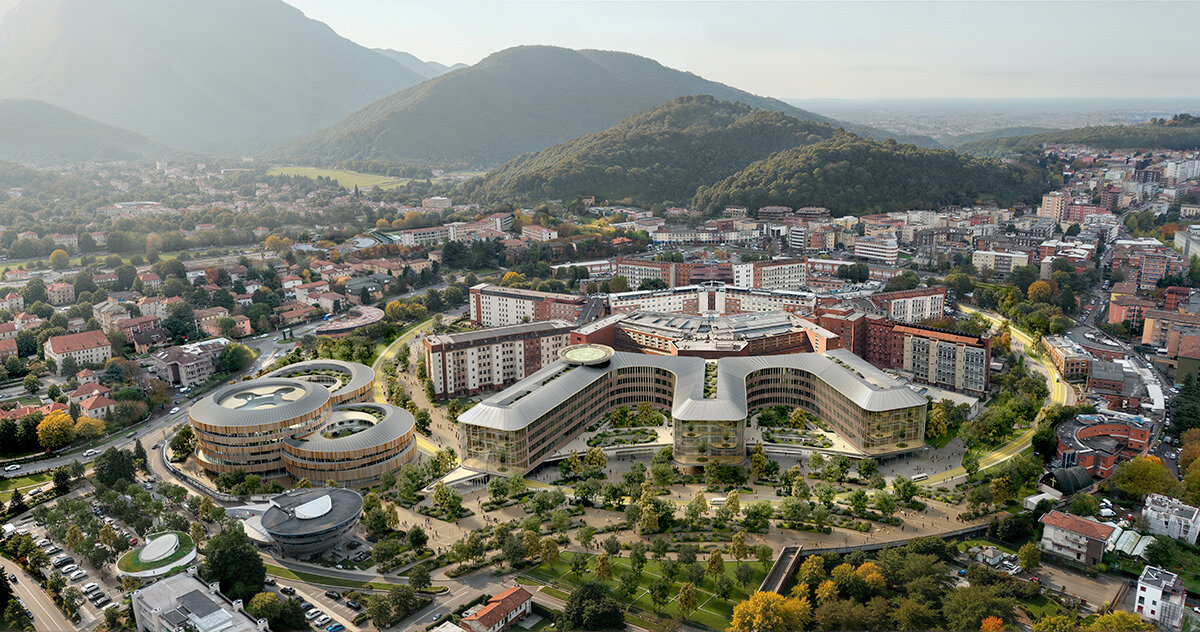





In Brescia, the future of one of Lombardy’s major healthcare institutions is being drawn by a team led by CRA-Carlo Ratti Associati and Park Associati as a campus of gardens, glazed wings, and public routes.
The winning proposal for the new Main Hospital and Children’s Hospital of ASST Spedali Civili di Brescia has been unveiled at Teatro Grande, bringing together CRA, Park Associati, and Politecnica Building for Humans with Openfabric, DOTDOTDOT, Eckersley O’Callaghan, and Studio Mattioli.
The project, selected through an international design competition, reworks the existing hospital campus through the lens of One Health, linking medical treatment with research, landscape, and the public realm.
Construction is expected to begin in 2028, while the new facilities will gather clinical and technological functions across 60,500 square meters and more than 745 beds.

visualization © Park Associati
extending Brescia’s radial plan
The design by Carlo Ratti Associati, Park Associati, and Politecnica Building for Humans begins with the early twentieth-century masterplan by engineer Angelo Bordoni, whose hexagonal core and radial layout shaped the identity of the Spedali Civili campus.
Instead of erasing that structure, the new proposal extends its logic outward, organizing the Main Hospital as three connected wings that open toward the city and frame views of the surrounding mountains. At ground level, a fully glazed lobby faces a new public piazza, giving the hospital a more visible civic front.
Inside, the project places emphasis on daylight, direct wayfinding, acoustic comfort, and views toward the Brescia Prealps. Patient rooms are designed with visual links to the landscape, while large glazed winter gardens cap the ends of each wing, softening the transition between treatment spaces and the outdoors.
The facade, developed with Eckersley O’Callaghan, manages solar control and glare while keeping the building visually open.

visualization © Park Associati
CareRing connects treatment, logistics, and public space
The Children’s Hospital takes shape as an independent building made from rounded volumes of different heights. Its courtyards, terraces, and internal gardens bring outdoor space into direct contact with departments, while the entrance atrium includes play areas, consultation zones, and places for families to gather.
The geometry gives the building a distinct identity within the campus, with spaces that are easier to read at a child’s scale.
The proposal’s strongest spatial move is the CareRing, a continuous route stretching for more than one kilometer around the campus. Below ground, it organizes logistics, services, and technical flows away from clinical circulation.
At ground level, it becomes a green system of squares, therapeutic gardens, and public paths, designed with Openfabric to connect the hospital to the city while improving biodiversity and microclimate.

visualization © Park
a timber hospital planned for future change
The new buildings will use a hybrid timber and steel structure assembled through dry construction techniques, reducing embodied carbon while allowing the campus to adapt as medical technologies shift.
A digital layer developed with DOTDOTDOT will support wayfinding, flow management, and environmental monitoring without taking over the architectural experience.
The technical systems are present, but the design keeps attention on movement, light, landscape, and the legibility of the campus.

visualization © Park Associati

visualization © Park Associati