
Remember me





Human hair rarely enters conversations about the future of design, as it belongs to the routines of everyday life. It’s cut, swept from salon floors and discarded without much thought. Yet for more than a decade, London-based designer and researcher Sanne Visser has been following those discarded fibers through an expanding network of hairdressers, rope makers, scientists, architects and local communities through a material experiment that has gradually evolved into a broader investigation of labor, local production and how craft might help rebuild the systems that connect people to the things they make.
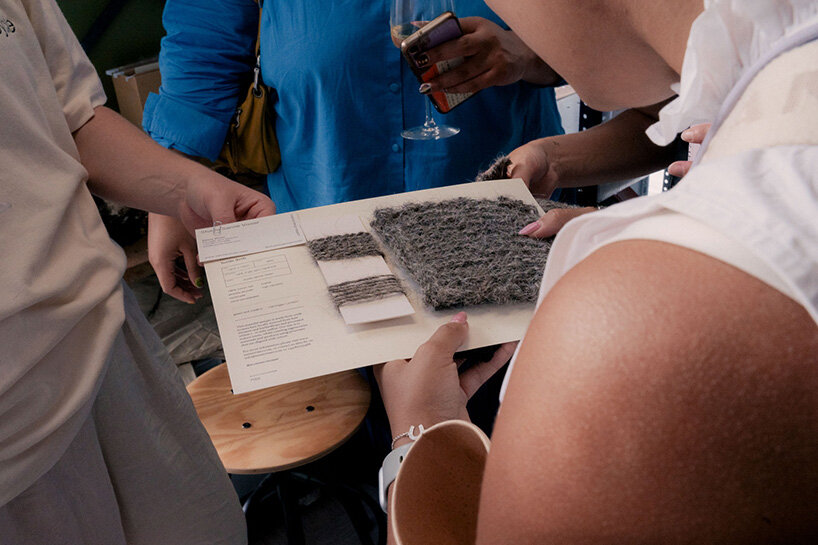
That research arrives at a new chapter with The Ropery, a participatory exhibition opening at Whitechapel Gallery on July 15th as part of Backyard Biennial: East. Drawing on East London’s ropemaking history, the project invites visitors to twist rope, braid fibers, and contribute to an installation that grows throughout the exhibition, while introducing a new collection of objects made from human hair, reclaimed wood, and locally sourced materials. The exhibition feels like a natural continuation of HairCycle, the community-led initiative Visser founded in Newham in 2024. Working with local salons and barbers, HairCycle collects discarded hair and turns it into yarns, ropes, textiles, building materials and agricultural products while building relationships between designers, researchers, makers and neighborhood organizations. Yet speaking with Visser, it quickly becomes clear that the project is no longer really about hair. ‘The first time I saw value in human hair was during my master’s at Central Saint Martins,’ she tells designboom. ‘I thought, why would we mine materials on the other side of the world and cause enormous destruction, all the while we are growing hair on our own heads and simply throwing it away?’
That simple question gradually became more complex. Hair, she discovered, is lightweight, biodegradable and remarkably strong, with more than 6.8 million kilograms discarded across the UK each year. But understanding the material itself proved to be only the beginning. The longer she worked with it, the more she realized that its greatest challenges were not technical but social, cultural and political. The research eventually grew into a PhD in systemic design, submitted earlier this year, while HairCycle itself launched in 2024 as an AHRC-funded pilot before evolving into an independent initiative. As the project expanded, so did the questions surrounding it.
‘If it were simple,’ she says, ‘we would already be using it.’

all images by Angela Tozzi
the ecosystem behind HairCycle
‘We have become so detached from materials,’ Visser observes. ‘We expect objects to arrive at our doorstep with one click of a button, and similarly, magically make them disappear when we’re done with them. But it isn’t magic.’
Watching rope form from loose fibers becomes a reminder that every manufactured object begins with a material, a process and someone else’s skill and labor. Over the past decade, her work has expanded well beyond spinning fibers into rope. It has drawn together marine biologists, chemists, anthropologists, policymakers, community gardeners, architects and local councils, each discipline bringing a different perspective to the same material. At the center of that network, however, remain the people who encounter hair every day: hairdressers and barbers.‘I’ve worked with so many different communities, practitioners and experts,’ the London-based designer shares with us. ‘People feel and value hair in completely different ways, and holding all of those perspectives at once has changed how I see the material itself.’
That shift has fundamentally changed HairCycle’s direction. Initially driven by material experimentation, the project has evolved into an attempt to understand how value circulates through communities. Hair may be donated freely by salons, but Visser increasingly questions how ecological, social and economic value might return to the people who make that system possible. As HairCycle has evolved, so has Visser’s understanding of the people at its center. Hairdressers and barbers have become key collaborators in a wider ecosystem that asks how ecological and economic value can return to the communities where the material originates. ‘The material couldn’t be more human,’ she explains. ‘It comes from everyone and therefore should belong to everyone. It shouldn’t become something extractive.’
For Sanne Visser, the biggest challenge lies in reconsidering the systems that support it. As manufacturing has shifted away from local production, craft has increasingly been pushed toward galleries and limited editions, while material innovation continues to chase industrial scale. HairCycle asks whether new materials can generate ecological, social and economic value at the same time. One conversation with a local barber captures that transformation perfectly. During a collection round, he apologetically suggested that the short clippings from his shop were probably useless. Visser explained that those fibers were being used to reinforce bio-based bricks and natural plasters. ‘He just said, ”Wow… so my hair is in a brick? I am a brick!”’ she recalls. The exchange lasted only a few moments, but for Visser it represented exactly the kind of shift HairCycle hopes to create. The material had not changed, but the perception of its value had.

participants sort donated hair during a public workshop
on craft, place and material culture
For Visser, this is where craft becomes a way of reconnecting people with the origins of materials and the often invisible labor that makes them more valuable. Rope, one of humanity’s oldest technologies, became a natural place to start, as it allows short fibers that might otherwise be discarded to be spun into yarn before being twisted into structures capable of carrying weight. The process is ancient, but its implications feel strikingly contemporary.
‘I’d often say that I haven’t invented anything,’ she reflects. ‘Most of this already exists but perhaps never been placed in this particular context.’
Through exhibitions, public installations and community events, HairCycle brings making into the open, inviting visitors to follow materials as they move from salon floors to spinning wheels, from yarn to rope, from waste to architecture. The aim of the project is to rebuild a familiarity with processes that industrialization has steadily pushed out of sight.
Earlier this year, Sanne Visser contributed to When Apricots Blossom, Uzbekistan’s debut exhibition at Milan Design Week 2026. Working alongside local artisans, she developed Shan’araq, a hand-twisted rope inspired by the domed crown of the traditional yurt, a symbol of family and protection. Bringing together Karakalpak wool, Fergana cotton, Tashkent human hair and reclaimed British yarn, the piece became an exploration of how local materials carry the histories of the places they come from. ‘Working with Uzbek crafts, local materials and artisans emphasised how much location, tradition, climate and local needs reshape what a material is, how it is made and valued,’ she highlights.

HairCycle Recycling Hub
The Ropery at Whitechapel Gallery
That same philosophy carries into The Ropery. Opening on July 15th, 2026, the exhibition looks back to East London’s rope-making industry, where generations of workers, many of them women, spun fibers that powered Britain’s maritime economy while remaining largely invisible themselves. Visitors are invited to learn those techniques through making and contributing to an installation that grows over the course of the exhibition and to reflect on the histories of labor and material knowledge embedded within the craft.
For Visser, those histories speak directly to the present. Craft, she argues, cannot survive simply as nostalgia or limited-edition production. If it is to play a meaningful role in the future, it must once again become part of everyday systems of manufacturing, education and community life. ‘I hope craft evolves into something seen beyond art objects or bespoke limited editions,’ she says. ‘It has to earn a real place within our economies and communities. The future of craft is so much more than the material and the technique. It is about where the material comes from, what it means to be making something, how it draws people together within a system,’ Sanne Visser notes.
Perhaps that is why Visser repeatedly insists that HairCycle is not really about hair. Hair simply happens to be the material that opens the conversation.
‘I often say that what we do is about hair, because hair is the material we work with,’ the designer concludes. ‘But actually, it is not about hair in many different ways. It is about how I want people to think about materials, our relationship with them, where they come from, how they are transformed into objects, how we use them, how they create impact or risk and so on.’