
Remember me
On the fourth of July 1826, at around 6 o’clock in the evening, John Adams, the second president of the United States, died at his house in Quincy, Massachusetts. According to newspaper reports, the 90-year-old’s final words were: “Thomas Jefferson survives.”
For the last time in his long and eventful life – though by no means the first – the former president was wrong. At the age of 83, Jefferson had died several hours earlier at Monticello, that founder’s self-designed plantation house in Virginia. On the
50th anniversary of the Declaration of Independence, “the very hour of public rejoicing”, as the lawyer and statesman Daniel Webster said in his eulogy to those two heroes of the American Revolution, “they took their flight together… Adams and Jefferson are no more.”
Left unsaid – perhaps because it was so obvious – the United States that Adams and Jefferson had hoped to found in 1776 also no longer existed. In the Declaration of Independence, Congress promised that Americans would treat the British as they treated the rest of mankind: “Enemies in war, in peace friends.” However, according to both Adams and Jefferson, the only way to live in peace and friendship with their former fellow subjects was to purge the entire continent of Britain’s hostile presence.
In autumn 1775, an army under Richard Montgomery and Benedict Arnold had invaded Quebec in an unsuccessful attempt to add the former French colony to the union. In the Model Treaty that Adams drafted to guide the hoped-for alliance with France, Congress cast the United States as the successor to all of King George III’s North American empire, including Quebec, Nova Scotia, Newfoundland, Bermuda, the Bahamas, and East and West Florida. Congress also invited Canada (at that time, the British-held province of Quebec) to become the 14th state in the Articles of Confederation, adopted in 1777 as the first federal constitution, and arranged for the document to be translated into French.

The Bostonians Paying the Excise Man, Or Tarring & Feathering of 1774 shows the punishment – tarring, feathering and forced tea-drinking – of tax collector John Malcolm | Credit: Alamy
With the benefit of hindsight, it’s easy to dismiss these hopes and dreams as wishful thinking, or worse. For Americans who supported independence, however, absorbing all of eastern North America promised to undo the damage done by George III and parliament’s ill-judged attempts to tax the colonies after defeating France and Spain in the Seven Years’ War in 1763. According to American critics – including both Adams and Jefferson – the annexation of French Canada had made it unnecessary for Britain to leave 10,000 regulars in America and tax the colonists to help cover the costs.
Dying British heroThat was one message conveyed by The Death of General Wolfe, painted in 1770 by the London-based American artist Benjamin West to celebrate Britain’s decisive victory at Quebec in 1759 during the Seven Years’ War. Although the dying British hero occupies the canvas’s centre, a Mohawk warrior and New England ranger in the foreground remind viewers of the crucial role played by the king’s colonial subjects and allies. Now that Canada no longer threatened Britain’s empire, Americans could defend themselves. There was no need for British soldiers or British taxes.

The Death of General Wolfe, after a 1770 painting by Benjamin West, captures the dying moments of James Wolfe at the 1759 battle of Quebec. This painting would serve as inspiration for John Trumbull’s epic artwork (top) | Credit: Getty Images
Both before and after independence, the best-known advocate for making Canada the 14th state was America’s favourite Englishman, Thomas Paine. In Common Sense (1776), the most influential pamphlet of the Revolutionary War, Paine argued that, once the former colonies were independent, Americans would be free to dispense with professional soldiers and taxes to pay them, and instead focus on trade – but only if Canada and Britain’s other North American colonies joined the union. As late as 1782, as talks were about to begin in Paris, Paine predicted that if Britain kept Canada, it was only a matter of time before Canadians decided to “revolt... and become part of the United States”. Without hostile British, or European, neighbours and with commerce their only connection to foreign customers, Americans would “shake hands with the world – live at peace with the world – and trade to any market where we can buy and sell”.
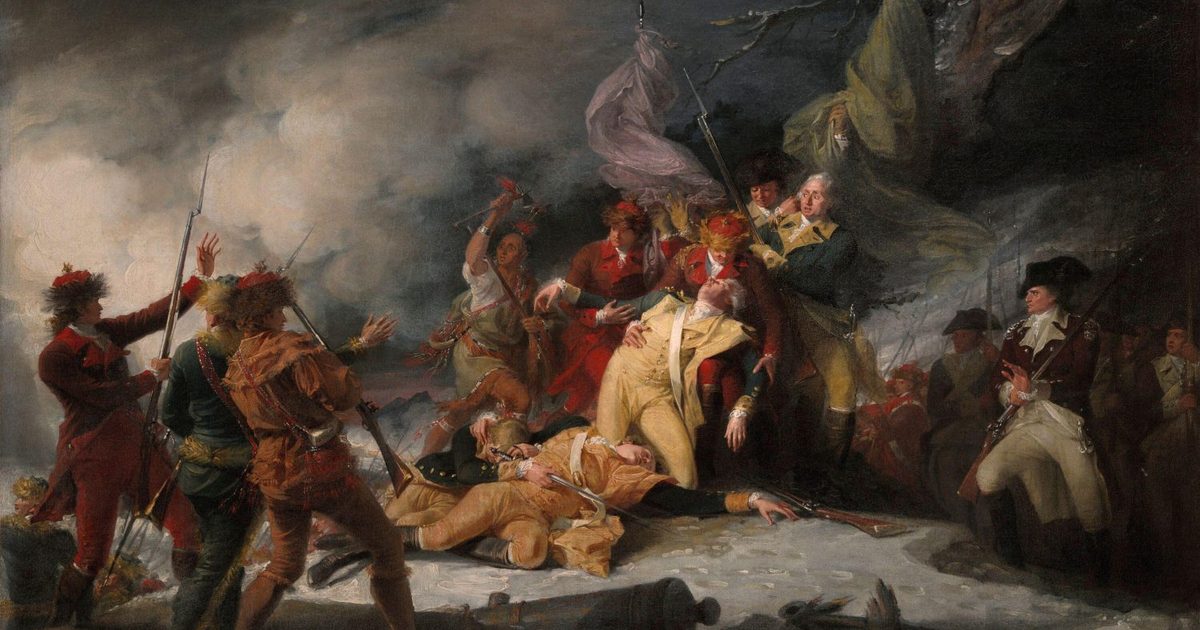
That hopeful vision helps explain why the ideal of a continental “empire of liberty”, as Jefferson liked to say, refused to die. During negotiations over the Treaty of Paris, which ended the American Revolutionary War, Adams and his fellow peace commissioner Benjamin Franklin tried repeatedly to acquire Canada and Nova Scotia. Meanwhile, General Montgomery, who lost his life at Quebec, became the revolution’s first war hero. In his epic Death of Montgomery, painted in 1786 in Benjamin West’s London studio, the Connecticut artist John Trumbull turned Montgomery into a latter-day Wolfe. Instead of a glorious victory, the painting celebrates a defeat and implies that Montgomery’s sacrifice was made for the colonies that would soon become the US, not for the British empire.

The last page of a draft of the 1783 Treaty of Paris, which ended the American Revolution and recognised US independence | Credit: Getty Images
The message of unity was the same, though. Montgomery and his aides wear the blue and bluff of the Continental Army (the army of the United Colonies, later United States). Forming a protective cordon are rangers from Connecticut, Pennsylvania and Virginia, and the Oneida war chief Colonel Joseph Louis Cook. Like the Mohawk in West’s painting, the colonel belonged to the Haudenosaunee or Iroquois Confederacy, whose ancestral lands included Canada. His presence helped validate the union’s continental ambitions.
During negotiations, John Adams and Benjamin Franklin tried repeatedly to acquire Canada and Nova Scotia
Among the many admirers of Trumbull’s handiwork were Adams and Jefferson, Congress’s representatives in London and Paris, respectively, when the artist painted the tableau. Unable to find an English engraver for the painting or its companion, The Death of General Warren at Bunker Hill, Trumbull travelled with a letter of introduction from Adams to France, where he stayed with Jefferson. Although he met with no more success in Paris, Jefferson shared Adams’s appreciation for Trumbull’s “noble ambition of immortalising the events of our history with his paintbrush” and urged him to keep trying. In 1798, when the engravings of Trumbull’s two paintings finally appeared, the artist gave copies to both men. To this day, The Death of Montgomery hangs in the dining room at Monticello.
Persistent fantasyFor the remainder of Adams and Jefferson’s careers, both as public servants and as private correspondents, Americans refused to abandon the fantasy for which Montgomery gave his life. During the Anglo-American War of 1812, soldiers from the US once again invaded Canada, crossing the border at Detroit, Niagara and the mouth of Lake Champlain (between Vermont and New York). According to General William Hull, commander of the Detroit expedition, Americans were fighting to free Canadians from British “tyranny and oppression”. They had come, he said, “to find enemies, not to make them”. Ultimately, however, Hull was no more successful than Montgomery. In the Treaty of Ghent, signed in the Belgian city on Christmas Eve 1814, the British and American commissioners agreed to keep the US-Canadian border where it was when the war began. With minor adjustments, the border has remained unchanged for more than 200 years.
Historians have proffered various reasons for the failure of the continental union that Adams and Jefferson both embraced. One was the inability of the US to protect or, often, pay Canadians who were willing to assist its soldiers. During the opening phase of Montgomery’s invasion in 1775, the American army captured Montreal and besieged Quebec, raising hopes that the province’s French habitants would join their neighbours to the south.

British and American commissioners signing the Treaty of Ghent, which reaffirmed the US-Canadian border, on Christmas Eve 1814, pictured here in a painting of 1914 | Credit: Getty Images
Such hopes were not entirely unfounded. In Nova Scotia, one of my ancestors, Louis Doiron dit Gould, fought in 1776 alongside soldiers from Massachusetts in a company of French Acadian auxiliaries. But Canadian merchants and farmers soon tired of being paid for food and supplies with worthless Continental Dollars, as Congress’s paper currency was known. When British reinforcements forced the ‘liberators’ to retreat, most were happy to see them go.
Another, equally formidable obstacle to acquiring Canada was the active hostility of the province’s Indigenous allies. Although the Oneidas accepted Congress’s offer of an alliance, most members of the Haudenosaunee Confederacy preferred the devil they knew and remained loyal to Britain. In 1775, as General Montgomery’s Continental soldiers were advancing on Montreal, the Mohawk war chief Thayendanegea sailed to England. In his audience with George III and Queen Charlotte, he refused to kiss the king’s hand because he was an ally, not a subject. (As a gentleman, he gallantly kissed the hand of the queen.) Upon his return, Captain Joseph Brant, as he now was, served with distinction under British general Howe at the battle of Long Island in August 1776 before leading a unit of Mohawk and loyalist soldiers in upstate New York and the Ohio Valley. Given a million-acre (400,000-hectare) tract on the Grand river in what’s now Ontario in 1784, Brant’s alliance helped secure the province’s southern and western border into the 19th century.

Thayendanegea, or Joseph Brant, was a Mohawk military and political leader loyal to the British during the American Revolution | Credit: Alamy
Numerically, the most serious barrier to the union’s northern expansion was the half-million Americans – roughly 20 per cent of the colonies’ prewar black and white population – who remained loyal to the crown. During negotiations over the Treaty of Paris, no issue proved more difficult to resolve than Britain’s insistence that the American states restore or pay compensation for property confiscated from the loyalists.
According to Britain’s Loyalist Claims Commission, losses sustained by the king’s adherents totalled £10m, roughly equivalent to £2bn today. Loyalists in the 13 states had also been subjected to whipping, tarring and feathering, banishment, imprisonment, bans from practising their profession or craft and, in extreme cases, death. Despite widespread sympathy for their plight in Britain, the most that Adams and his fellow commissioners would concede was a hollow promise for Congress to “earnestly recommend” to the states that they be compensated for their losses.
When they learned what was in the treaty, loyalists left the US in droves. In all, 60,000 to 80,000 refugees, black and indigenous as well as white, decamped to Canada, Jamaica, the Bahamas and, above all, Nova Scotia. Colonies that had once looked like prospective states became bastions of a hostile frontier. In place of Adams’ and Jefferson’s borderless empire of liberty, Americans faced an uncertain future in a divided neighbourhood.
Shadow of partitionThe effects of this revolutionary partition cast a shadow over the presidencies of both men. The most immediate consequence was to force Americans to abandon the fantasy that a union of any sort was possible without a professional standing army and a permanent national debt and revenue. During the war’s final years, both Adams and Jefferson urged the states to give Congress the power to tax, which it lacked under the Articles of Confederation. They also supported Philadelphia financier Robert Morris’s efforts to pay the army and fund the union’s debt with an American version of the Bank of England. Although Adams and Jefferson were in Europe when the Federal Convention met in Philadelphia in 1787, Morris’s reforms helped initiate the push to replace the Articles with the Constitution, which they also supported.
As members of President George Washington’s first administration (1789–93) – Adams as vice-president, Jefferson as secretary of state – the two friends’ views diverged, leading them to a bitter decade and a half of political rivalry and estrangement, but not before they had helped to place the new government on a secure military and financial footing. Much as they disliked Alexander Hamilton, Washington’s brilliant secretary of the treasury, and much as Jefferson, especially, worried about Hamilton’s admiration for Britain, it proved impossible to dispense with the fiscal system that he created.

An engraving shows the battle of Long Island, which took place on 27 August 1776 during the American Revolutionary War. Thayendanegea served with distinction in this British victory | Credit: Alamy
Americans also found themselves entangled with Britain in ways that they had hoped in 1776 to avoid. As had been the case before the war, some of the most important connections involved trade, despite Britain’s decision in 1783 to ban American ships and goods from the West Indies. Meanwhile, to no one’s surprise, least of all Adams and Jefferson, the border with Canada remained a zone of contestation and conflict as British agents covertly aided Native Americans fighting to keep American land speculators and settlers at bay.
Americans found themselves entangled with Britain in ways that they had hoped in 1776 to avoid
Thawing relationsGradually, however, Anglo-American interactions became less hostile, especially during Adams’s presidency. Along the Niagara river, relations between the British and American garrisons grew so friendly in the late 1790s that, when the river froze, officers would cross the ice with their wives and families for dinners and balls with their counterparts on the other side. According to the American commandant, the only downside to such encounters was the US Army’s refusal to match Britain’s allowance for food and drink.
The most important legacy of the continental vision that Jefferson and Adams did so much to encourage was to whet Americans’ appetite for continued expansion. In 1803, hoping to acquire New Orleans and, if possible, West Florida, Jefferson dispatched future president James Monroe to join Robert Livingston, the American ambassador in Paris. They negotiated the Louisiana Purchase, doubling US territory. In the Transcontinental Treaty (1819–21) with Spain, John Quincy Adams, President Monroe’s secretary of state and John Adams’s eldest son, extended the union’s western border to the Pacific and purchased the rest of Florida. Two years later, with Britain’s tacit support, the younger Adams was the principal architect of Monroe’s famous ‘doctrine’ declaring North and South America off-limits to future European colonial ventures.

The reverse of a 2004 US nickel commemorating the Louisiana Purchase of 1803, when the US doubled in size after buying the territory from the French | Credit: Bridgeman Images
Superficially, by casting the US as the western hemisphere’s pre-eminent power, the Monroe Doctrine fulfilled the continental vision that Adams and Jefferson had spent their careers pursuing. It comes as no surprise that both men approved. Crucially, however, so did Britain. Without the support of the States’ closest, most powerful neighbour, Monroe’s grand claim would have been meaningless. Accepting the border with Canada was a small price to pay.
As Americans prepare to observe the 250th anniversary of the Declaration of Independence, which also happens to be the bicentennial of the death of two of the nation’s greatest presidents, that is a lesson worth remembering. In their relations with other nations – whether those nations are next door or on the other side of the world – Americans have been at their best when they pursue their goals not through war and conquest but through negotiation and compromise. That remains as true today
as it was in 1776.
Eliga Gould is professor of history at the University of New Hampshire and, during 2025–26, Harmsworth professor of American history at Oxford. His books include Among the Powers of the Earth: The American Revolution and the Making of a New World Empire (Harvard, 2008)
This article was first published in the July 2026 issue of HistoryExtra Magazine