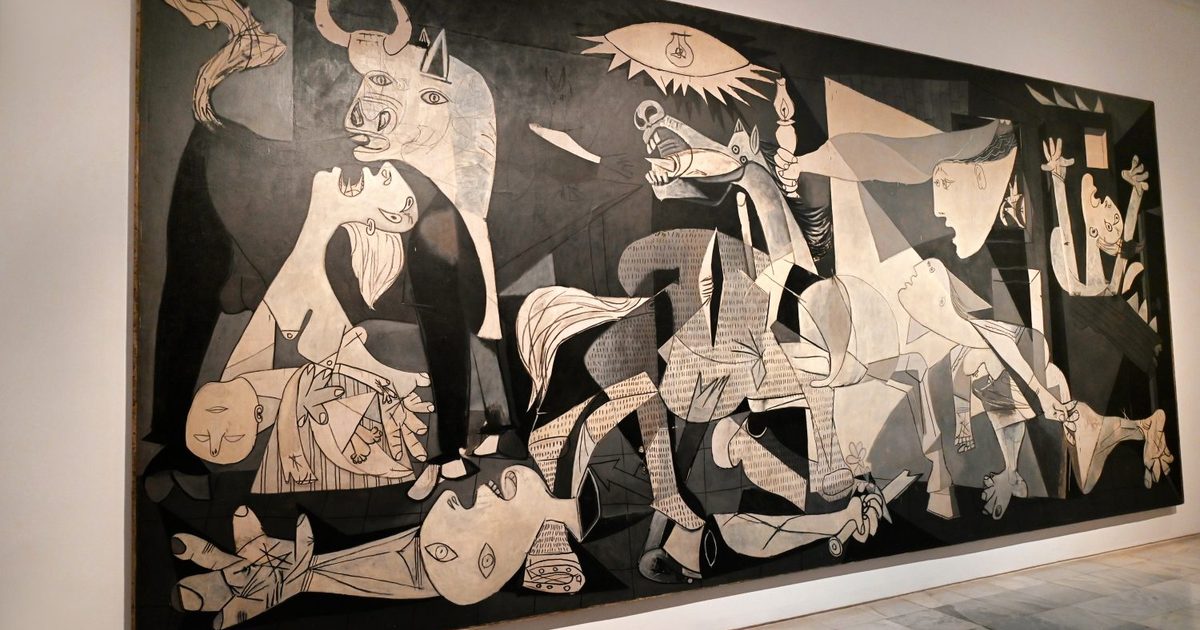
Next year is the 90th anniversary of the bombing of the town of Guernica in Spain’s Basque region during the Spanish Civil War. The brutality, captured in Pablo Picasso’s contemporaneous black-and-white painting, has become iconic of the horrors of war, as well as the country’s painful past. It is now at the centre of a new political tussle over where the painting should be to commemorate the anniversary.
I have been lucky enough to see Guernica twice. The first time I saw it was when I was covering the Madrid terrorist attacks on four morning commuter trains in 2004. When I stood before it, the country was in agony over the deaths of almost 200 people at the hands of a jihadist cell inspired by al-Qaeda. The second time was last year. It was a different experience. Tourists were taking selfies of themselves with the famous picture. But many Spaniards stood quietly in reverence, as if they had come in pilgrimage to see the painting that captures a terrible part of its recent history.
On 26 April 1937, Nazi and Italian air forces – allies of General Francisco Franco, the leader of Spain’s Nationalists during the Spanish Civil War – bombed Guernica for three hours. It was market day when the planes filled the sky. The town had no defences, and it resulted in devastating civilian casualties, though the exact death toll is unknown. Three quarters of the town was destroyed.
When the planes struck, Picasso was working on a commission to create a mural for the 1937 International Exposition in Paris, and had started work on a series of anti-Nationalist images. After the attack, Picasso began a new canvas. In a statement he issued at the time he said: “In the panel on which I am working, which I shall call Guernica, and in all my recent works of art, I clearly express my abhorrence of the military caste which has sunk Spain in an ocean of pain and death.” It took him around a month to complete, and it went on display in July in Paris, before travelling around the world.
Picasso didn’t want the painting to travel to Spain until Franco’s dictatorship had ended, so it eventually arrived in the country in 1981. In the early days, at the Prado Museum in Madrid, it was shielded behind bulletproof glass and armed guards. Now housed in the Reina Sofia Museum in the same city, there is a cordon that separates the public from the masterpiece.
The Basque government has requested to borrow the picture to display it in an exhibition marking the 90th anniversary of the massacre, which will be held at the Guggenheim Museum in Bilbao, not far from Guernica. The Madrid museum has refused many requests for it previously, saying moving the painting is too risky given its fragile state. Spain’s culture minister confirmed recently that the request was being denied for conservation concerns. He said his obligation was to preserve heritage, and he wanted to ensure it would be seen for another 90 years. It’s provoked heated discussion in Spain about where this artwork should be seen.
Picasso never lived to see Guernica on show in Spain. In the decades since he painted it, its meaning has become elevated beyond Spain’s Civil War to encompass the atrocities of all war. A tapestry reproduction hangs at the United Nations in New York.
But for Spanish people Guernica will always be a record of a time that is still hard to speak of. A war that divided a nation, and pitted family members against each other. Where unspeakable crimes were committed, almost in living memory. A town whose name everyone knows, because of a horrific crime committed against it, that is immortalised in a painting.
This article was first published in the June 2026 issue of HistoryExtra Magazine