
Remember me





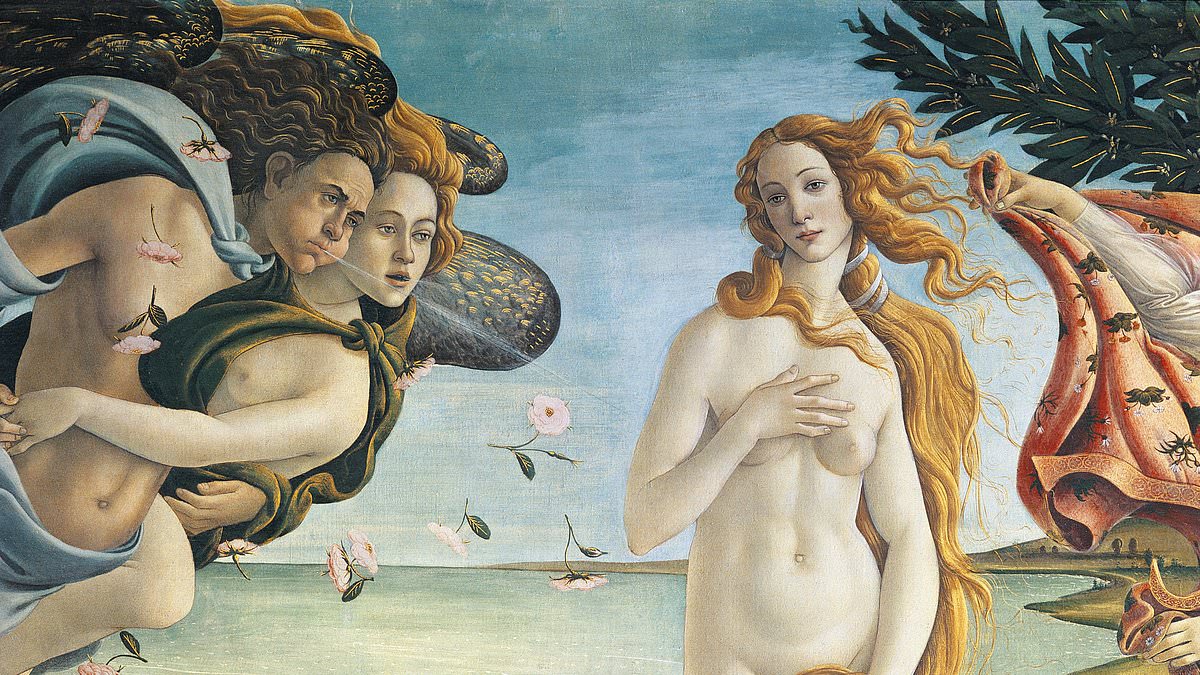




It's a question that has baffled art lovers for centuries: why does Venus have a wonky eye in Botticelli's Birth of Venus?
Some experts have previously suggested that the squint was simply used as a symbol of piety and beauty.
However, scientists have a new theory.
According to researchers from Queen Mary, University of London, Simonetta Vespucci – the model for the world–renowned painting – had a brain tumour that caused a squint.
In their study, the researchers used a facial recognition algorithm on five portraits of Simonetta.
And the results uncovered several signs that she had a pituitary adenoma.
This is a common, benign tumour that grows on the pituitary gland at the base of the brain.
'It's possible that the irregular eye positioning in the Birth of Venus – the "strabismus" or squint later considered a trait of piety and beauty – may be caused by the pituitary tumor,' said senior author Paolo Pozzilli.

It's a question that has baffled art lovers for centuries: why does Venus have a wonky eye in Botticelli's Birth of Venus?

Some experts have previously suggested that the squint was simply used a symbol of piety and beauty. However, scientists have a new theory
Simonetta Vespucci was well known in Florentine high society, and was painted five times by Sandro Botticelli.
Botticelli was so taken with her that he asked to be buried at her feet in 1510, in what the researchers call a 'final devotional act to his muse'.
With her womanly curves and flowing hair, Simonetta's features are now thought to embody the aesthetic canons of the Renaissance.
Sadly, she died at the age of just 23.
And until now, the circumstances around her death have remained unclear.
In the new study, the team researched a range of documents and concluded that an expansion of the adenoma causing tumor apoplexy – a sudden medical emergency – was the probable cause of her death.
They also suggest that dancing or a suspected rape by the infamous Alfonso II D'Aragona, Duke of Calabria, could have precipitated a medical emergency.
'Letters between Piero Vespucci and Lorenzo de' Medici about Simonetta's final days discuss how she collapsed during a ball and was then resting in a darkened room where she suffered from terrible headaches, hallucinations, vomiting and high fever,' said first author Dr Domiziana Nardelli.

Botticelli's Allegorical portrait of a Woman shows Simonetta with an eye squint and lactating - two symptoms of a pituitary adenoma
Birth of VenusDate: 1485
Artist: Sandro Botticelli
Museum: Uffizi Gallery, Florence
Size: 172.5 x 278.5 cm
Model: Simonetta Vespucci
Value: Priceless
'These are all symptoms of a rapidly expanding pituitary tumor.'
To confirm this diagnosis, the researchers used a facial recognition algorithm based on a pre–trained deep learning model on five portraits of Simonetta.
The results flagged not only her eye squint, but also another sign of a brain tumour – lactation.
Dr Nardelli explained: 'Botticelli's Allegorical portrait of a Woman shows a woman – the model is Simonetta Vespucci – lactating, and yet we know she had no children.
'This is a surprising way to portray her, and we believe that this – along with changes in facial traits – could show the real physical symptoms of a prolactin–growth hormone secreting adenoma.'
This isn't the first time an artist has quietly painted a health condition into their paintings.
In 2024, researchers from the University of Paris-Saclay identified signs of breast cancer in a woman featured in Michelangelo's Sistine Chapel masterpiece, 'The Flood'.
This includes a deformed nipple and a slight bulge in her breast, which is 'consistent with a lump'.

In 2024, researchers from the University of Paris-Saclay identified signs of breast cancer in a woman featured in Michelangelo's Sistine Chapel masterpiece, 'The Flood'
The researchers believe the representation of breast cancer may have been a message on the inevitability of death.
'Michelangelo's depiction in "The Flood" suggests characteristics of breast cancer,' the researchers wrote in their study.
'The evidence of the pathology is fully corroborated by the symbolism and the theological meaning underlying this representation of life and death.'