
Remember me






If you've booked a holiday to Albania this summer, you might want to think twice before heading for a dip in the sea.
A new report has revealed Europe's dirtiest beaches, where the water quality is rated as 'poor'.
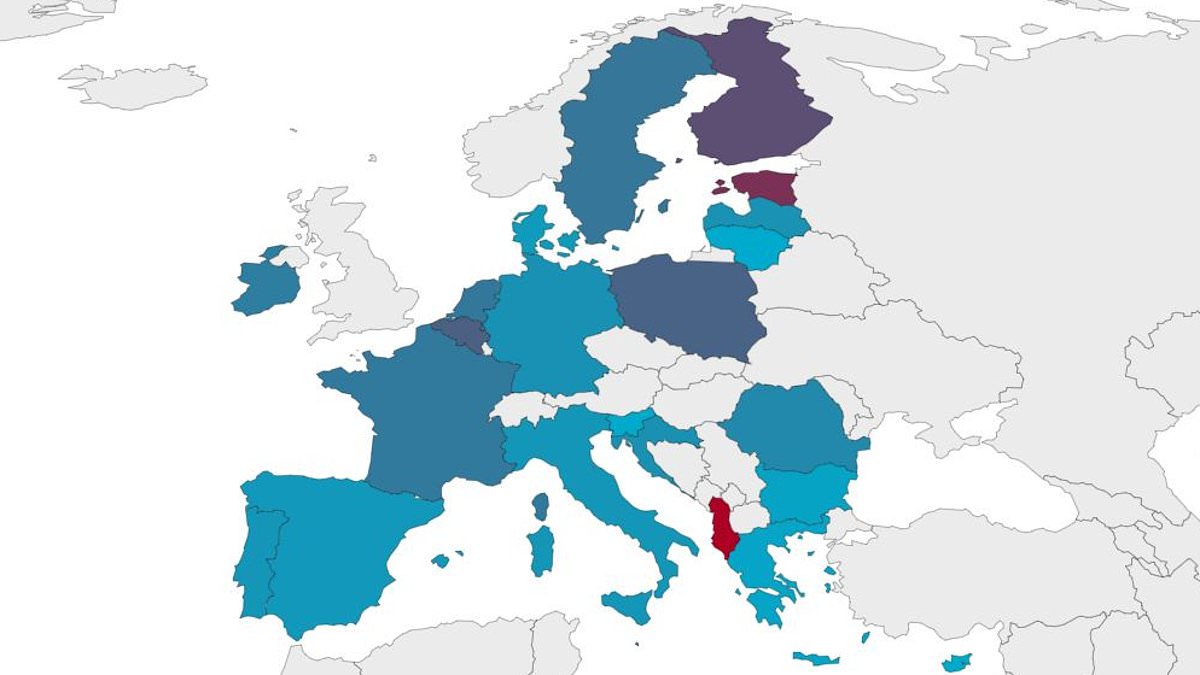
Albania tops the list for the worst water quality in Europe, with a whopping 23 per cent of coastal swimming spots getting a poor rating.
That is over three times the proportion in the second worst nation, Estonia, where 6.7 per cent of beaches were ranked as poor.
To make matters worse, just 16 per cent of Albanian beaches were given an 'excellent' rating, while 38 per cent are considered 'good'.
That is over five times fewer excellent coastal bathing areas than the EU average of 88 per cent.
However, the report will come as good news to holidaygoers heading for Cyprus, Lithuania, or Slovenia.
In these countries, 100 per cent of coastal bathing spots were rated as excellent.

Albania tops the list for the worst water quality in Europe, with a whopping 23 per cent of coastal swimming spots getting a poor rating

Overall, Europe's water quality remains high, with the majority of locations being rated 'excellent'. However, in Albania, just 17 per cent of bathing locations got this top rating
The findings come from monitoring carried out at 22,000 coastal and inland bathing sites across the EU, Albania, and Switzerland in 2025.
This 'Bathing Water Directive' (BWD) measures how safe water is for swimming by analysing bacteria that indicate the presence of faecal matter and sewage.
If ingested, polluted water can cause illness, including gastrointestinal problems and diarrhoea – making this a serious concern for swimmers.
Sites are tested throughout the swimming season and receive a ranking of poor, sufficient, good, or excellent depending on their level of faecal contamination.
To explore specific beaches and check if your holiday destination has clean water, you can use this link to see a full interactive map.
The results revealed that Europe's bathing waters are generally safe and remain remarkably clean across the continent.
Overall, 87.4 per cent of coastal waters were classified as excellent, and only a tiny fraction came out as poor.
Leena Yla–Mononen, director of the European Environment Agency, says: 'This summer we can all reap the benefits of solid implementation of EU bathing water rules, which have made a vast majority of our bathing waters clean enough to swim in.'

Many of Albania's unsafe beaches (pictured) were located outside populated areas, suggesting that faecal contamination from sewage may be to blame

Albania had three times the proportion of beaches ranked as poor compared the second worst nation, Estonia, where 6.7 per cent of beaches got the bottom rating
Europe's dirtiest beaches Albania: 23 per centEstonia: 6.9 per centFinland: 2.7 per centFrance: 1.7 per centSweden: 1.6 per centCountries ranked by highest proportion of coastal swimming areas rated 'poor'
Source: European Environment Agency
Travellers to Belgium, Bulgaria, Latvia, Malta and Romania will be pleased to know that these nations didn't have a single coastal location rated poor.
For those looking closer to home, 78 per cent of Ireland's coastal swimming locations received the coveted excellent status, while just 0.7 per cent came out as poor.
Despite Albania's disappointing results, coastal waters are generally easier to keep safe since currents naturally move waste away from the shore.
However, inland bodies of water are a very different story.
Across Europe, 78 per cent of inland bathing sites were rated as excellent – the vast majority of which are lakes.
While rivers made up just 5.5 per cent of all bathing spots in Europe, only 47 per cent were rated as excellent.
In Spain, a staggering 11 per cent of all inland swimming locations were considered poor.
The second worst inland bathing conditions were found in Croatia, with 7.1 per cent ranking as poor, closely followed by France with six per cent of spots getting the lowest rating.

There is a similar issue with river pollution in the UK, where just two of the 14 official river swimming locations are safe to use
Even locations with exceptionally clean coastal waters, such as Portugal, struggled to keep their lakes and rivers safe for bathing.
While this European data does not include the UK, separate studies show that British bathing spots suffer from similar woes.
As of the time of publication, DEFRA data show that just two of the UK's existing river bathing sites had sufficient water quality.
The rest were rated as poor and have been issued 'advice against bathing' notices, warning people not to enter the water for their own safety.
Likewise, 26 coastal locations currently have 'advice against bathing' notices due to poor water quality.
However, concerns have been raised about water quality even at locations currently listed as safe.
In May, the charity Surfers Against Sewage found that people have fallen ill 6,000 times after swimming at official bathing locations in the past five years.
The charity collected reports of sickness from swimming areas, revealing that a total of 1,263 of their sites' users got sick after bathing last year alone.