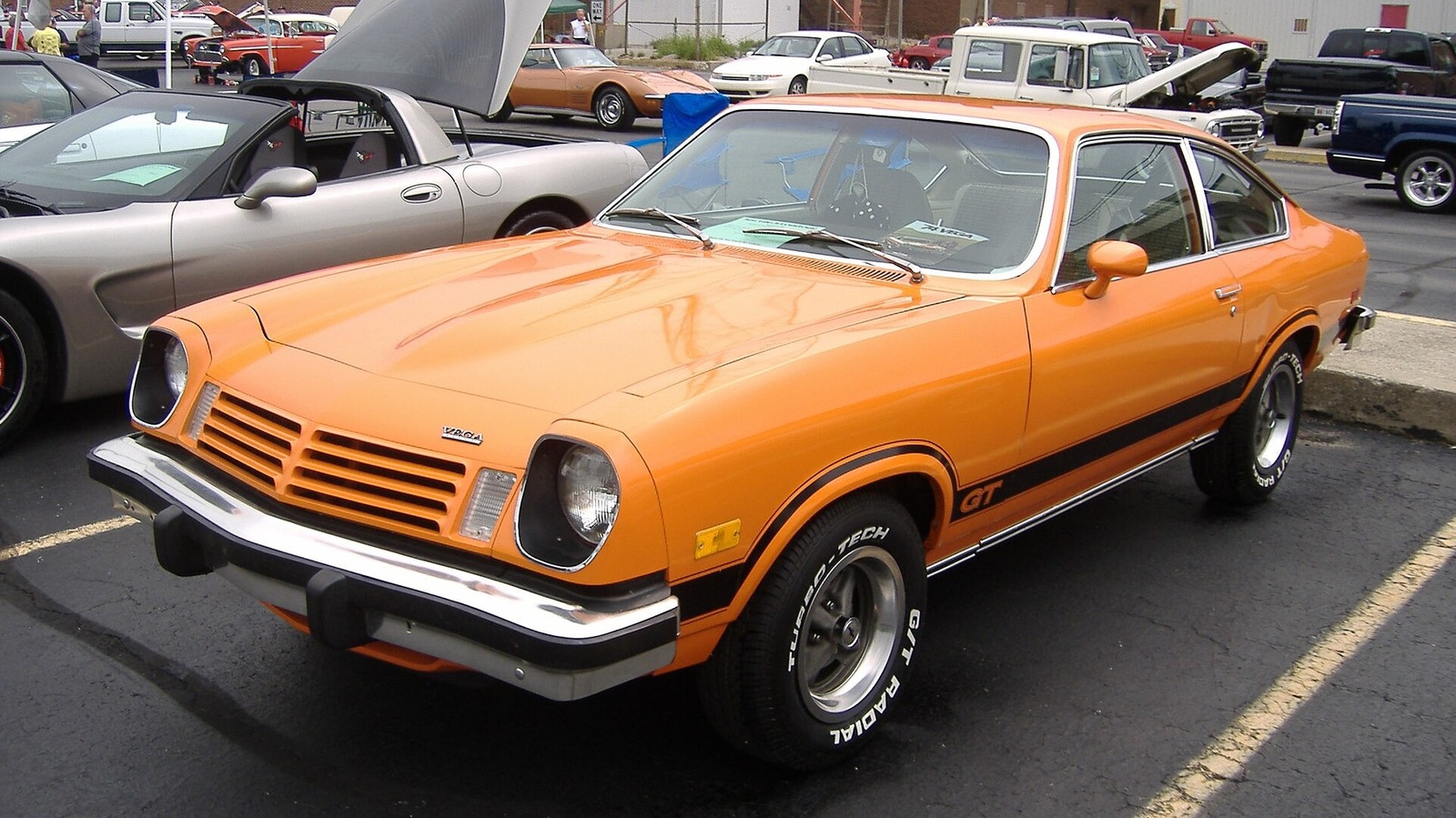
How Chevy's Rushed 1971 Vega Aluminum Engine Wrecked GM's Subcompact Promise
Although some of today's automakers are using AI to drastically cut development time for new vehicles, it's still considered a "quick" process when it takes 20 months to accomplish. In the 1970s, a 24-month timeline to get a new car fully buttoned up for road use must have seemed nearly impossible — and it was, at least when it came to the 1971 Chevrolet Vega.
The deadline had been imposed by Ed Cole, president of GM at the time, who had formerly been chief engineer and then general manager of Chevrolet. Cole had had his share of success at Chevy, playing a key role in the creation of both the small-block V8 and the Corvette, even proposing a rotary-powered mid-engine version in the 1970s. But he seemed to have a blind spot when it came to small cars. As an example, he had backed the Corvair as Chevy's answer to the increasing number of compacts being introduced in the 1960s. Then, when that flopped, he had to rush its replacement to dealerships after a mere 18 months of development.
It was a similar story with subcompacts the next decade. Yet while Chevy was able to meet its timing goal for the Vega, the rush job reared its ugly head once the car went public. Engineers simply hadn't had enough time to fully validate many of the car's innovative-for-the-time components, including the Vega's 140-cubic-inch (2.3-liter) four-cylinder OHC engine.
The motor impressed the buff magazines during initial reviews, but drivers quickly discovered that it couldn't stand up to the heat of real-world use. Enough motors would go on to destroy themselves that the Vega's credibility became collateral damage, and it lasted only a single generation.
Engine issues
To be clear, the engine itself wasn't that much of a problem — except for its valve stem seals. Those had a tendency to harden and crack under use, eventually degrading to the point where they allowed oil into the combustion chamber.
Okay, there was also a situation on some of the motors where the screws holding the top of the carb would loosen due to the engine vibrations. It could set off a chain reaction that would somehow activate the accelerator pump, which would then pump unburned fuel into the exhaust system. In fact, the engine vibrations were so severe that noise levels could reach 88 decibels in the car's cabin (at wide-open throttle). For context, the Center for Hearing and Communications notes that ongoing exposure to noise about 70 dBA can cause hearing loss.
And in a way, this situation really puts the Vega's race to production in perspective. Chevy had gone to great lengths to make the car quiet, installing noise-reduction measures under the hood, around the underpanels, and under the carpet, for instance. Yet apparently there wasn't enough time left over to make sure that stuff was doing its job.
Nor had there been time to get all the bugs out of the Vega's cooling system. And the most serious problem with the Vega's engine may have been that it couldn't handle the heat otherwise.
Other ways the Vega vexed its owners
The Vega was originally specced without a radiator, but the idea of air-cooling quickly went by the wayside. When a new, more traditional cooling setup was installed, the radiator ended up in a position that was too low relative to the engine, reducing its cooling power. The system's coolant capacity wasn't high enough, either, and recovery tanks were initially optional for the Vega.
All of that can contribute to higher engine temperatures, and this is where the trouble begins. First off, the Vega's engine block was aluminum, but its cylinder heads were cast iron. Now, that's not typically a concern for engines at normal operating temps. The issue is that if they rise too high, the metal can start expanding, and iron and aluminum expand at different rates. The mismatch can damage the head gasket, putting you on the path to catastrophic engine failure.
A related concern comes from the cylinders. True, aluminum blocks weren't new for Chevy — the Chevrolet Corvair had one in 1960 — and most cars today use aluminum engine blocks as well. But the Vega's mill did use a new type of alloy created by Reynolds Aluminum. The metal was notable for being 17% silicon overall for enhanced hardness. The sleeveless cylinder bores, however, were pure silicon — which would break down quicker from heat, becoming soft enough for the walls to be scored or scuffed by the moving pistons.
A flurry of changes for 1975 and 1976 would bring the car a little closer to reaching its potential, but the damage had been done: Chevy axed the Vega after 1977, though its improved platform would live on in models like the Pontiac Sunbird.