Back to the future: 'Spooky' 62-year-old time capsule discovered in a London park tells the finder to back a horse running in this weekend's Derby
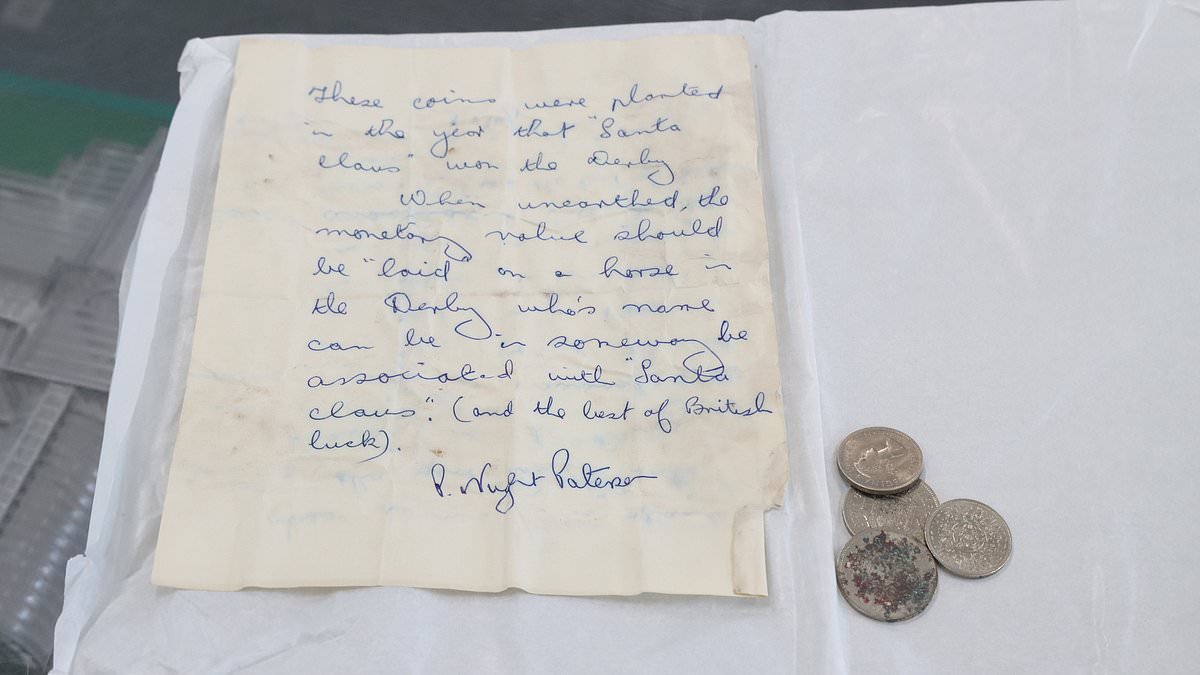
A builder working in a London park was in for a surprise after stumbling across a 'spooky' time capsule. Craciun Marius Dorin was working on the £22 million regeneration project in Crystal Palace Park when he found a capsule containing a bizarre betting tip.Hidden beneath a statue, the note came with old coins and instructions for the future finder to place a bet on a horse whose name could be linked to Santa Claus.In an uncanny twist, a horse called Christmas Day is running in Saturday's Derby at Epsom Downs.Mr Dorin found the capsule in April and immediately handed it to site manager Josh Smalls.'It was very exciting,' Mr Smalls said.'I was like a child on Christmas Day.'To find a piece of history like that – and for it to link up so well with the horse this year – it was kind of spooky.' A builder working in a London park was in for a surprise after stumbling across a 'spooky' time capsule Florin Chiric of Maylim with Bromley Mayor, Christine Harris at the site where the time capsule was foundThe discovery was made while construction workers were working on the park's regeneration project.While moving a statue of Sir Joseph Paxton – the Victorian designer who built the Crystal Palace between 1850 and 1851 – the team found a note wrapped in plastic. Inside the 'time capsule' were also six old coins – four shillings and two half crowns – worth around £10 today. The note explained that the money inside had come from winnings on a horse called Santa Claus in the Epsom Derby.And its author – who remains unclear – instructed whoever discovered the capsule in the future to use the money to back another horse with a similarly festive name.The discovery immediately caught Mr Smalls' attention as he grew up around horse racing.'My uncle was a racing horse trainer, I'd go to about two races every year,' he said.'So this note sparked quite a bit of interest.' While moving a statue of Sir Joseph Paxton – the Victorian garden designer who built the Crystal Palace – the team found a note wrapped in plastic Bromley mayor Christine Harris has placed a £15 bet on Christmas Day, with any winnings set to go to her chosen charitiesOut of curiosity, Mr Smalls looked back through the rosters of the last few years – and couldn't find any other horse with a Christmassy name.'Unbelievably, there is a horse in this year's Derby called Christmas Day,' he said.'And after going down a bit of a research rabbit hole, I found out that the trainer of Santa Claus was a fellow called Vincent O'Brien, and it turned out the trainer of this horse, Christmas Day, is actually called Aidan O'Brien.'So I'm not sure if there was a direct relation there, but I thought it was quite cool.'Mr Smalls placed a £20 bet on Christmas Day shortly after reading the note.'Hopefully he'll win on Saturday and make everyone a bit of money,' he added.Bromley mayor Christine Harris has also placed a £15 bet on Christmas Day, with any winnings set to go to her chosen charities.The finding comes shortly after scientists uncovered how the Crystal Palace was constructed by the Victorians in just 190 days.Researchers say the huge glass building pioneered the use of identical nuts and bolts – made in bulk by machines to match one standardized size and shape.Before this, nuts and bolts had been laboriously made by hand – and no two screws and bolts were built to be alike. Designed by renowned English architect Sir Joseph Paxton, the Crystal Palace was built in Hyde Park at a cost of £80,000 (nearly £10 million in today's money). What are the Crystal Palace Dinosaurs? The Crystal Palace 'Dinosaurs' comprise of approximately 30 palaeontological statues, although only four actually represent dinosaurs.The others include plesiosaurs, icthyosaurs, pterodactyls, crocodilians, amphibians and mammals. The statues were sculpted by renowned natural history artist Benjamin Waterhouse Hawkins between 1853 and 1855, and were the world's first attempt at models of life–size extint animals. While we now know many of the sculptures are wildly inaccurate, that somewhat adds to their charm, with thousands of tourists flocking to South London to see them every year. The Crystal Palace 'Dinosaurs' comprise of approximately 30 palaeontological statues, although only four actually represent dinosaurs