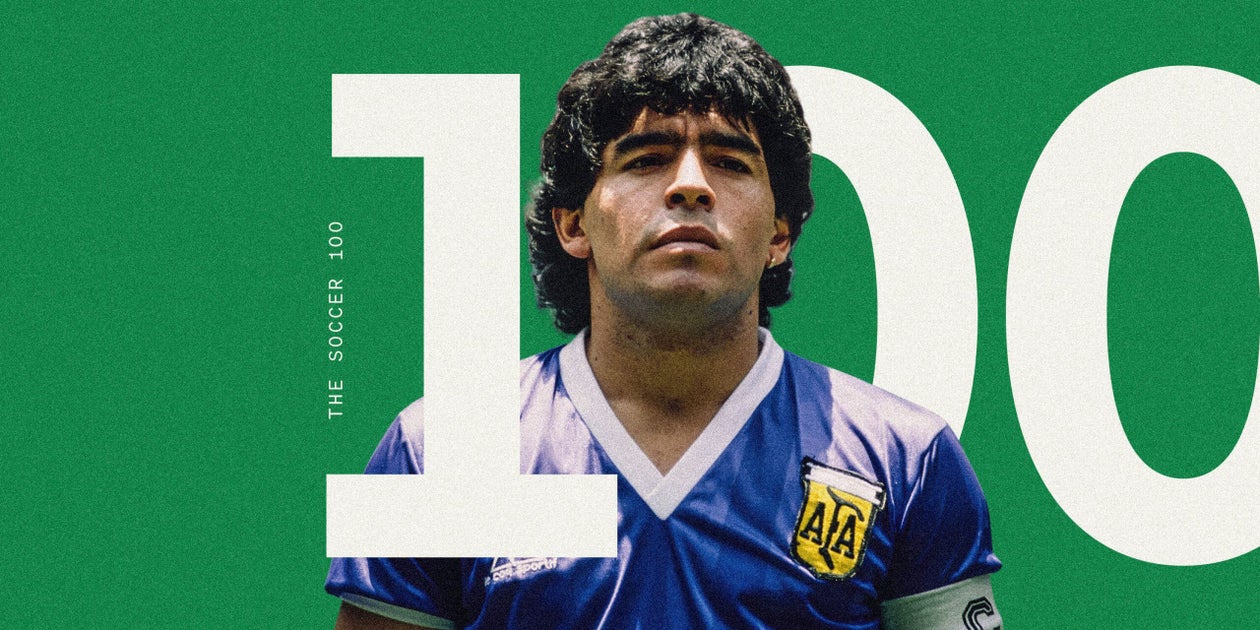
The Soccer 100: Diego Maradona — How the master showcased his brilliance, and resilience, in the Estadio Azteca
As part of our buildup to the 2026 FIFA men’s World Cup in the United States, Canada and Mexico, we are publishing excerpted chapters from The Soccer 100, The Athletic’s definitive book on the 100 greatest players of all time, courtesy of HarperCollins Publishers.The 10 players we will feature are the highest ranked World Cup winners of our 100. Today, in our penultimate extract, we turn to one of the greatest ever individual performances at the tournament.Can we quantify the most legendary individual sporting performance ever? It’s impossible to compare goals to home runs, touchdowns, or three-pointers, but there is one viable, if somewhat reductive, measure: Diego Maradona’s shirt from Argentina’s 2–1 victory over England in the quarterfinal of the 1986 World Cup is the most valuable match-worn jersey in the history of sport.In May 2022, Maradona’s shirt from that historic contest at the Estadio Azteca was put up for auction by Sotheby’s. It eventually sold for about $9.1 million, around a 60 percent increase on the previous record, Babe Ruth’s New York Yankees top between 1928 and 1930. While Ruth wore his jersey for two years, Maradona only wore his for 45 minutes, having changed at halftime because of the sweltering conditions in Mexico City.Sotheby’s conducted “extensive diligence and scientific research” to verify it was the correct shirt — not the one Maradona used throughout a tame first half, but the one in which he scored two of the most famous goals in football history within the space of five minutes; more celebrated than any of his many goals in the colors of Argentinos Juniors or Boca Juniors back in Argentina, or in Europe as he elevated Napoli to unprecedented levels.The first goal at the Azteca was blatant cheating. The second was indisputable brilliance. They served as a perfect microcosm of Maradona’s character.The shirt’s previous owner, England midfielder Steve Hodge, was never in doubt. Last to leave the pitch because he was conducting a pitch-side television interview, he happened to be walking back down the tunnel alongside a jubilant Maradona, ambitiously proposed the swap, and was surprisingly handed a shirt he possessed for 36 years and eventually earned him several times his career earnings.The shirt itself had essentially existed for less than a day.
Diego Maradona’s 1986 World Cup match-worn shirt is presented at Sotheby’s in London (Tristan Fewings/Getty Images for Sotheby’s)With England wearing white, Argentina were unable to play in their traditional blue-and-white stripes. Therefore they were set to play in their away colors — solid blue — for the second game running, having done so for a 1–0 second-round win over neighbor Uruguay. But Argentina’s players had been troubled by the heaviness of those shirts and worried they would be even more uncomfortable for a midday kickoff.So, the day before the England quarterfinal, Argentina procured a lighter shirt, with faint vertical stripes, from a run-of-the-mill Mexico City sports shop. The Argentina crest was sewn on the night beforehand, alongside the logo of shirt manufacturer Le Coq Sportif — who, of course, had not actually made these shirts — while the shirt numbers were silver-gray, glittered, and designed for American football jerseys. Somewhat unexpectedly, this slapdash design process created the most valuable sporting item of clothing ever.But all this was in keeping with the amateurish nature of the tournament. Mexico, who stepped in as replacement for Colombia as host in May 1983 largely due to economic issues, produced a finals featuring stadiums with poor facilities and dreadful pitches. Argentina manager Carlos Bilardo said his players were so exhausted from their club campaigns that he did not hold proper training sessions — the side effectively pretended to train to prevent criticism from journalists for not training at all.As several Argentina players would later agree, while the conditions made the tournament unpleasant, it perhaps suited the plucky nature of their side.
Diego Maradona shakes hands with Peter Shilton prior to kick off (David Cannon/Allsport/Getty Images)The narrative in the buildup to Argentina’s clash with England was heavily based around the Falklands War, the 10-week conflict in 1982 that began when Argentina invaded the Falkland Islands (or, as Argentinians refer to them, las Islas Malvinas), a British territory in the South Atlantic about 300 miles from the Argentine coast. The conflict cost the lives of 649 Argentinians, 255 Britons, and three islanders before Argentina surrendered.Four years on, the meeting between the countries was inevitably framed in relation to that war. Both camps were under strict instructions not to engage with politically motivated questions in prematch press conferences. Most obeyed the order, although Argentina goalkeeper Nery Pumpido did veer off-message and declared that “beating the English would represent a double satisfaction for everything that happened in the Malvinas.”Argentina had breezed through the group stage, with routine 3–1 and 2–0 victories over South Korea and Bulgaria sandwiching a 1–1 draw with Italy, the nation where Maradona now played his club football with Napoli — and a team he would inspire to the first Scudetto in their 61-year history in 1987 — before the win over Uruguay in the last 16.The eternal debate about facing Maradona’s Argentina was whether opposition managers should elect to man-mark him. A player of his talent necessitated special attention, yes, but the only match of the four in which Maradona had scored was the game against Italy, who were the only side who had man-marked him. It was thus far from certain that it was the right option.Besides, Maradona had increasingly embraced a free role, moving deep or wide in search of space. England, accustomed to playing a 4-4-2 with zonal defending, simply weren’t comfortable playing with a man-marker. Bilardo, meanwhile, made a significant tactical switch, scrapping his 4-3-1-2 and instead using a 3-5-2 formation to provide a spare man against England’s strike duo, with Maradona playing off Jorge Valdano rather than behind two strikers. This was a hugely surprising decision because it involved dropping Pedro Pasculli, the striker who had scored the only goal against Uruguay. He did not play another minute at the World Cup.
Diego Maradona evades Gary Stevens to cross (Staff/AFP via Getty Images)Despite theoretically playing higher up the pitch, Maradona popped up everywhere against England. He dropped deep to collect short passes from Argentina’s less technical players but remained between the lines when the ball was at the feet of Sergio Batista, whom Maradona trusted to thread the ball between opponents and toward him. He moved to the flanks to find space before prompting one-twos with teammates, particularly Valdano.
On four occasions, Valdano responded with a heavy touch, taking the ball into the air — presumably because of the bobbly pitch. Maradona, for his part, repeatedly backheeled the ball while sprinting at full pelt, leaving England defenders unsure whether to follow the player or the ball.Maradona produced, even in an unmemorable first half, quite an individual performance. He boasted a peculiar, distinctive manner of striking the ball — a close-range free kick was whipped in such an understated way that it was remarkable the ball traveled over the wall, let alone nearly flew inside the near post. There were some wayward passes and a hopeless cross midway through the first half, but even if you had never watched a game of football beforehand, you would still understand that Maradona was the most talented of the 22 players on show.There was room for an element of comedy, too. Midway through the first half, Maradona jogged across to take a corner from the right flank. Several photographers were in the way of his run-up, so he responded by picking up the corner flag and throwing it to the floor, allowing him to take a straighter run-up at the ball.Costa Rican linesman Berny Ulloa wasn’t having any of that. He ordered Maradona to replace it, an instruction that was only partly followed because Maradona replaced the pole, but left the flag itself on the ground. Ulloa insisted upon the flag, too, and stood in Maradona’s way until it was replaced.So Maradona picked up the flag and carefully, sarcastically balanced it on top of the pole. Ulloa still wasn’t happy, so eventually Maradona reluctantly threaded the flag back onto the pole. It was a complete waste of time — Maradona being Maradona — but it was a small example of why he was so popular. He was a natural entertainer.
Steve Hodge, who would gain from the game in a different way, moves in to tackle Diego Maradona (Peter Robinson – PA Images via Getty Images)Clearly, this isn’t the officiating incident everyone remembers from that game.What is often overlooked in the controversy around Maradona’s handballed opener, however, is the level of physical abuse dished out to Maradona throughout the game. Of the two sides, it was England who focused on a somewhat unsporting approach.It started after just two minutes when Maradona, receiving the ball on the turn inside the center circle, was body-checked by defender Terry Fenwick right in front of the referee. Nothing too unusual about that; Argentina had the ball and played on. But it took just 30 seconds before Maradona was fouled for a second time, by midfielder Peter Reid, and this time he was awarded a free kick.Of course, Maradona’s constant determination to dribble meant he naturally invited challenges and fouls. He dribbled past an opponent 53 times at this World Cup, which was 37 more than any other player and the most at any World Cup according to Opta, who have statistics for every game going back to 1966. Remarkably, he was the most-fouled player at the World Cups in 1982, 1986, and 1990. Nevertheless, England brought him down repeatedly, often with considerable force, in a manner that is truly shameful when viewed today.Nine minutes in, Maradona chested the ball down, dribbled inside left-back Kenny Sansom, and was chopped down with remarkable force by Fenwick — who was absolutely nowhere near the ball and went in with a scissor motion that ensured he hacked down Maradona as aggressively as possible. Having only just returned from a suspension for collecting two bookings in the group stage, Fenwick was booked again. For 81 minutes, he was playing against the world’s best dribbler on a yellow card.
Terry Fenwick slides in on Diego Maradona (Allsport/Getty Images/Hulton Archive)And for those 81 minutes, that initial yellow card should have proved irrelevant; not because Fenwick was composed enough to resist confrontations with Maradona, but because he could have been shown a straight red card at least twice afterward.The most blatant occasion came five minutes before halftime. Maradona dribbled forward from an inside-left position and knocked the ball out to right-sided center-back José Luis Cuciuffo, who produced a terrible shot that was made to look even worse by the fact he was wearing the No. 9 shirt. (Argentina’s squad was numbered not by position, but instead in alphabetical order — with the three exceptions being center-back Daniel Passarella, Maradona, and Valdano, who were allowed to wear their favored No. 6, No. 10, and No. 11 respectively.)As Cuciuffo blazed over, Maradona had continued his run in behind Fenwick and been flattened with a blatant elbow. He received treatment from the Argentina physio for a couple of minutes afterward. Having finally clambered back to his feet, he went up to Fenwick and told him what he thought of the challenge, pointing to him and gesturing with an elbow. Fenwick claimed it was accidental. Maradona shook his head — he wasn’t having any of it.The second incident came two minutes before the opening goal and is laced with irony.A big Argentina clearance bounced midway between Fenwick and Maradona in the center circle. The Argentina captain sprang up toward the ball while Fenwick launched himself into the air and led aggressively with his arm, a somewhat unusual manner of challenging for an aerial ball. It almost looked like he was trying to win the ball with his hand, although realistically he was surely just trying to smash Maradona’s face with his elbow again.But Fenwick, in trying to cheat, actually lost the challenge — Maradona got his head to the ball and knocked it past the defender, although he was unable to reach his own flick-on because he was again on the floor, holding his head. Fenwick had missed the ball, but he’d gotten the man.All things considered, watching England repeatedly trying to injure Maradona, it is difficult to have too much sympathy when, two minutes after that second incident — and after Valdano yet again miscontrolled a Maradona pass, with Hodge nipping in to knock the ball into the air — Maradona went up for a challenge with goalkeeper Peter Shilton and led with his arm. Maradona, though, missed the man and got the ball. It bounced into the goal.
Diego Maradona outjumps Peter Shilton and palms the ball into the unguarded net (Allsport/Getty Images)Was he inspired by Fenwick’s challenge? Was he initially trying to match England’s aggression and using his elbow for brute force, then ended up being in a position to handball it in?Whatever the truth, the goal stood. The manner the ball traveled from Maradona suggested a feebler contact than a pure header. But Tunisian referee Ali Bennaceur did not spot a hand and neither did Bulgarian linesman Bogdan Dochev. If either of them suspected anything, it hardly helped that they did not share a common language, and so could not discuss the situation. Curiously, for the 2-2 group-stage draw between Paraguay and Belgium, they had also worked together — but on that occasion, Dochev was the referee and Bennaceur was the linesman.Maradona reacted as if nothing untoward had happened, running across to celebrate in front of his father in the stand. Then, as England’s defenders desperately appealed for handball, Maradona somewhat unwisely celebrated by repeatedly raising his left fist to the crowd, replicating his decisive touch. Valdano ran across and told him to stop in case the officials realized what had happened.Then came arguably the most celebrated goal in football history.As a general rule, there are three genres of great goal in football: a team move, a spectacular strike, and a solo dribble. Each has an almost “official” greatest ever: Carlos Alberto against Italy in 1970, Marco van Basten against the Soviet Union in 1988, and Diego Maradona against England in 1986. There is simply no arguing with this triumvirate.This particular dribble was outstanding from the outset. Maradona produced a double dragback to evade Peter Beardsley and then Reid, which earned cheers from the crowd when he was still on the halfway line. Then came his typical change of pace, picking up speed before going past Terry Butcher on the inside, then Fenwick on the outside, and then rounding Shilton to score.The manner in which he dribbled past Shilton feels entirely natural after he’d already beaten four England players, but Maradona later revealed that, in the moment, he had thought back to a similar incident against England six years earlier in a friendly at Wembley. On that occasion, he attempted to side-foot past goalkeeper Ray Clemence but put it wide of the far post.The evening after that encounter, his younger brother Hugo had phoned him to rebuke him for shooting when Clemence had already committed himself and left space to dribble around. Maradona was, at the time, furious at his 11-year-old brother’s armchair punditry. But he recalled that conversation when bearing down on an England goalkeeper half a decade later, and this time took Hugo’s advice, rounded Shilton, and converted into an empty net under pressure from Butcher. There was no doubting the legitimacy of that one.
Diego Maradona’s dribble culminates in a finish beyond the grounded Peter Shilton (Archivo El Grafico/Getty Images)Even after both the goals, there was yet another incident when Fenwick threw his elbow at Maradona. This time, Valdano had flicked on a long pass, Maradona and Fenwick were again chasing the second ball, and Fenwick jumped and threw out an elbow into Maradona’s face. This brought another free kick, although Maradona couldn’t take it because he was off the field receiving treatment again for a couple of minutes.Fenwick, in fairness, was far from the only offender. There was a two-footed foul from Beardsley, a strong challenge from Reid after he was beaten by Maradona’s skill, and a trip from Hodge that sent Maradona headlong into a collision with Sansom, again leaving Argentina’s No. 10 on the floor holding his head. Football was refereed differently all those years ago, but watch the entire 90 minutes here and the physical treatment handed out to Maradona should embarrass even the most partisan Englishman.Afterward, it was that controversial first goal, rather than the glorious second, that dominated the discussion. Maradona initially claimed the goal was legitimate. “I swear on my life, but I hit it with my head,” he said. “You could see (Shilton’s) fist and that’s why there’s confusion. But it was a header. No doubt. I even have a bump on my forehead.”In fairness, that final part was probably true given how frequently Fenwick had clobbered him.Nestor Ferrero, an Argentine journalist who worked for an Italian news agency and had covered Maradona’s travails in Serie A, knew he was lying. “Well,” said Ferrero, “it must have been the hand of God.” Maradona liked that. “It must have been,” he agreed.The famous phrase was not actually Maradona’s own and it didn’t initially take off. As noted by Guillem Balague in his biography of Maradona, only one Argentina-based newspaper ran the phrase “the hand of God” the following day, although Maradona subsequently mentioned it frequently, often in relation to revenge for the conflict in the Falklands.
Diego Maradona in full flight against Belgium in the semi-final (Staff/AFP via Getty Images)Arguably, Maradona’s best was yet to come. He again scored twice in a stunning performance in the 2–0 victory over Belgium in the semifinal. Again, both his goals came shortly after the break. First, Maradona opened the scoring by running in behind and converting Jorge Burruchaga’s outside-of-the-foot through-ball with an outside-of-the-foot clip over goalkeeper Jean-Marie Pfaff. Then he settled the game, receiving the ball between the lines, dribbling past four Belgium defenders, and firing home.This was already being spoken about as possibly the greatest World Cup campaign any individual had ever produced.Maradona failing to score in the 3–2 final victory over West Germany was, therefore, treated as something of a disappointment. Germany’s key man Lothar Matthäus was handed the responsibility of marking him and largely did it well, although his unnecessary late foul after 21 minutes brought a booking and conceded the free kick that led to Argentina’s opener, headed home by José Luis Brown. Maradona was involved in the passing move for Valdano to score the second and played the crucial through-ball for Burruchaga’s winner. That was his fifth assist of the tournament, to go with his five goals, a neat summary of how he was both creator and provider.
Diego Maradona holds aloft the World Cup (Mike King/Allsport/Getty Images/Hulton Archive)Still, his goals against England live longest in the memory and feel even more unlikely in the context of watching the entire 90 minutes. Maradona was subject to disgraceful physical treatment and still won the match, well, single-handedly.“I boshed him two or three times and tried to intimidate him, but I couldn’t do that,” conceded Fenwick in an interview with Sky after Maradona’s death in 2020. “He was talking to me throughout the game, just chatting away to me, like this was a walk in the park.”But Fenwick’s costliest error came after the final whistle. Maradona offered to swap shirts — and Fenwick said no.Excerpted from The Soccer 100 by Oliver Kay & James Horncastle with The Athletic Soccer Staff, published by William Morrow. Copyright © 2025 by The Athletic Media Company. Reprinted courtesy of HarperCollins Publishers.