‘We’ve lost a few crops in recent years, like iceberg lettuce. There is just one grower left’
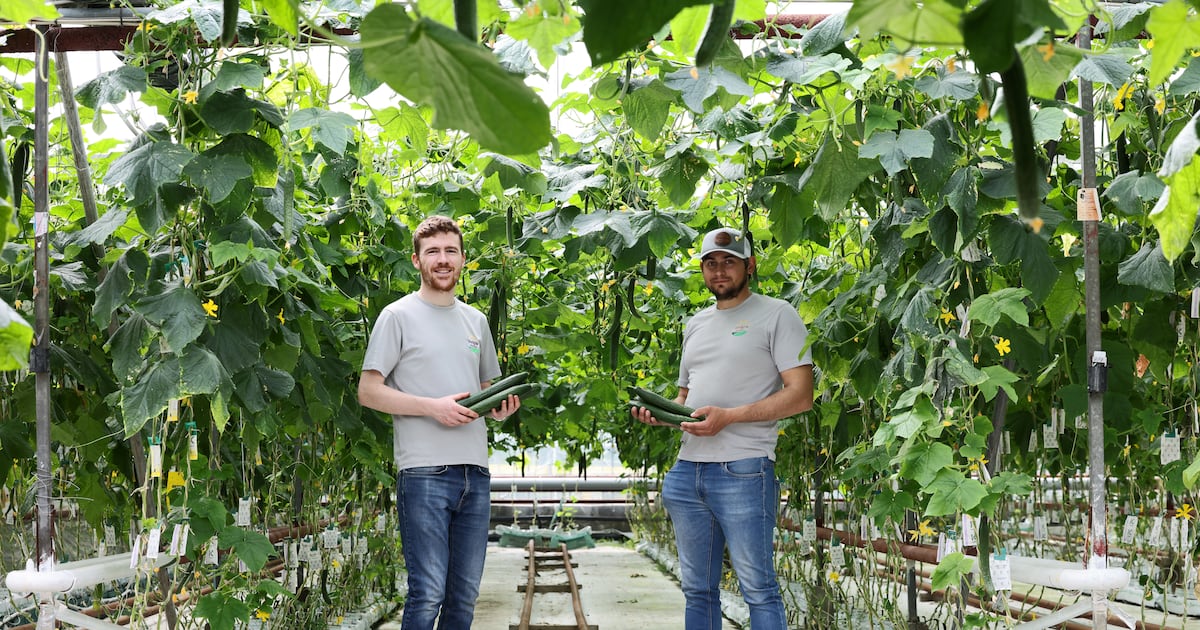
The two wind turbines are hard to miss. Emblazoned with the Country Crest logo, they perch proudly on a hilltop overlooking the massive potato grower’s operation.When the wind blows, the company has more energy than it needs.The company farms 3,500 acres and its produce will have been consumed by anyone who has visited a supermarket in Ireland.In the middle of its main farm near Lusk in north Co Dublin, the Hoey homestead still stands. Around it are Country Crest’s offices, processing and packing plants, a small haulage operation and a car park that hosts its over 400 staff. READ MOREFrom strawberries to carrots to potatoes: who are Ireland’s biggest fruit and veg growers?History signals more hawkish central bank response to Iran war price shockReport calls for renewed coal use for energy and where does your food come from?No more ‘summer Fridays’: Welcome to the Great Hunkering Down in the jobs marketMichael Hoey and his brother Gabriel have turned the small family farm where they grew up into a production titan – supplying the Irish retail sector with huge amounts of potatoes and onions.The advent of cold storage in the 1980s allowed the brothers to farm significantly more potatoes than up to that point – and move closer to a year-round operation.It was in the 1990s, however, that the family-run farm was transformed. “I remember one night [in the 1990s] the interest rates went to 23 per cent,” says Michael, casting his mind back to the moment the farm started to evolve into the company it is now.“Our accountant at that time advised us that it was time to start a company, that it was too dangerous as a sole trader.”The company built on this throughout the decade, packing and supplying potatoes for the likes of Superquinn, Quinnsworth (now part of Tesco), Dunnes Stores and SuperValu. They listened to what the consumer wanted and the consumer wanted quality— Michael Hoey“Feargal Quinn was very good to us,” he says, but it was the re-emergence of Tesco in the Irish market which really fuelled its growth.“They brought a whole new lease of life to the consumer,” says Hoey. “They listened to what the consumer wanted and the consumer wanted quality. They wanted to be able to use everything in a pack, and they wanted to produce in a completely different way, and we were fortunate enough to be part of that whole involvement.” As Country Crest has become a fixture of the Irish retail scene, other smaller players have fallen by the wayside.The landscape of north Co Dublin is pockmarked by stories of smaller farmers and growers who have abandoned the sector. The lure of the property market has seen land sold to developers for housing estates, while many younger farmers have chosen not to keep going due to financial pressures and insecurity.“I suppose that challenge is there today, that challenge of keeping people in this industry,” says Hoey.“Young people today are looking at … much better opportunities out in the workplace than being in a wet, cold field on a January afternoon. And people are seeing a way out, and they’re seeing a pension. And we’ve lost a lot of growers, especially over the last 10 years.”He theorises that many youngsters believe a mortgage for a home is better won with a secure nine-to-five occupation, rather than through a precarious farming role.Two recent events highlight the challenges facing Irish growers. In March, a provisional liquidator was appointed to a Co Kilkenny farming company that was said to produce about 12 per cent of the €66 million Irish carrot market. This was to ensure Hughes Agriculture & Farming Limited’s €2.8 million worth of carrots, parsnips and daffodils could be harvested. A variety of factors were cited as the reason behind its perilous financial position over the last three years, including wage and input-cost inflation, while forecast annual sales reduced by €600,000 this year due to weak market demand and poor growing conditions caused by “relentless rain”. Last month, the largest broccoli producer in the State said the Government’s strategy on targets for solar farms “is fatally flawed” and threatens food security when they are sited on “the best land in the country”.[ Why is Kerrygold butter 65% dearer in Kerry than it is in Berlin?Opens in new window ]Paul Brophy’s family-owned farming business, Brophy Produce Ltd, produces 70 per cent of our fresh broccoli. The Naas-based enterprise is one of scores of third parties to raise concerns over plans for a €168 million, 140MW solar farm on a 338-acre site at Ballindrum, Co Kildare.The site, located 5.1km northeast of Athy, covers 16 fields that are currently used for both arable and pastoral farming. In addition, many growers speak about how difficult it is to hire seasonal workers at a time of full employment. Hoey says automation and machinery only go so far when it comes to the quality control work demanded by the retailers. Workers are needed to be hands-on, filtering out potatoes and onions that aren’t up to the standards required by the likes of Tesco. As Hoey chats, 200 metres away workers belonging to Welgro Produce are tending to glasshouses at the bottom of the complex. Previously used by Country Crest, cucumbers are to be grown there by the smaller company.Sean Weldon and Shane Halpin in one of their glasshouses in Rush Co Dublin. Photograph: Alan Betson/The Irish Times
Owned by Shane Halpin, Sean Weldon and Gary Weldon, Welgro employs up to 35 people during harvesting.Hoey cites Halpin as an example of a younger grower who has made a proper go within the sector.The 32-year-old Halpin says he grew up around the industry and was never far from the side of his grandfather and uncles who were market gardeners. “I had a grá for it from a young age. I’d be out with grandad planting spuds, rhubarb, whatever,” Halpin says. After training as a mechanic, Halpin spent some time in New Zealand and in the United States working on commercial farming operations before returning to Ireland and studying horticulture.“I did a placement on a large farm in North Carolina where they were growing sweetcorn and pumpkins on a massive scale. It was an eye-opener.” While working with the Weldon market gardeners from Swords, he says they pointed him in the direction of a friend who was retiring from the cucumber business. Along with their son Sean Weldon, Halpin decided to pick up the baton.“This was during Covid and we said to ourselves ‘there is a market there’. The glasshouses and the pack houses were already there. “There is an appetite there for an Irish cucumber. Because they are pure water they deteriorate quickly. But we are based in Lusk and within 20 minutes drive of all the facilitators for the retailers.”Halpin says the north Dublin location puts them at a big advantage over foreign growers of cucumbers. “What we pick today could be in the shop today or tomorrow. The chefs are telling us as well that they are fresher and juicier [than foreign imports].”There is not the same volume of growers as there was 20 years ago— Shane HalpinThe consolidation in the Irish vegetable and fruit-growing market has been rapid over the past 10 years.From an estimated 300 operations, farming experts believe the number of significant growers in the country has fallen to around 60.Halpin has witnessed this first hand – in what Hoey calls “the fruit and vegetable basket of Ireland”.“There is not the same volume of growers as there was 20 years ago,” says Halpin. “Even in my time the number of growers that went out of business, you are probably talking about 40 or 50.”Halpin says part of this was driven by price pressures and the arrival of imports, but was also down to the significant investment required to keep pace with the industry. “A lot of growers didn’t have a successor coming up and weren’t able to justify the investment. To be at it at scale you need the right machinery and that doesn’t come cheap – it is specially built.”He also says the reduced margins for many smaller growers will have put off the next generation. “A lot of them might have asked themselves: ‘If Daddy is out there toiling away and not getting the money, why would I want to?’ No one is going to run away from a business opportunity that is making money.”[ Investors back Glanbia as a rare food company that might benefit from people eating lessOpens in new window ]Industry experts say margins have become so squeezed that many smaller players have had no choice but to fall by the wayside.“We see far more pressure on margins in the sectors directly exposed to Irish retailers, and you have to wonder why,” says Tadhg Buckley, an economist with the Irish Farmers’ Association (IFA).A report commissioned by the IFA in 2022 identified what it called “retail price compression” as being to blame. In other words, horticulture retail prices fell sharply – due to intense competition in the sector – and so too did the price being paid to farmers and suppliers. It called out the arrival of Lidl and Aldi in Ireland as a turning point. At the same time, costs for growers have risen. Wage costs are cited as problematic in what are very labour intensive sectors. “It is much more difficult to get seasonal workers – they are just not there any more,” says a farming source.Energy and labour costs remain a major concern and margins in the near term will be under renewed pressure.“The big challenge is to pay people enough to keep them there, to keep growing it,” says Hoey. “Because the growing costs are escalating at an enormous rate.” The conflict in the Middle East is likely to contribute a significant burden over the coming months, he adds.We had a real baptism of fire with the Ukraine war— Shane Halpin“You’re also looking at distribution costs, looking at packaging costs. It’s going to bring a whole wave of increases that we’re bracing ourselves for. You know, that is the worry, really.” He says Country Crest have increased their efforts to become energy independent as much as possible. In addition to the two wind turbines, the company is seeking permission to build an anaerobic digester. Digesters break down compost, food waste and sewage to produce biogas. “We intend to build that,” he says. “And we will grow forage crops to feed that. And our waste vegetables and whatever will feed into that.”The business also has 280 kilowatts of solar panels, which he says will feed into the energy mix.For Welgro Produce, any spike in the cost of gas is of real concern.“We had a real baptism of fire with the Ukraine war,” says Halpin, noting the energy-intensive nature of growing cucumbers. “Cucumbers are a heat-loving plant,” he says. “They need 21 degrees during the day and 18 to 19 degrees at night. We burn gas in a boiler to heat the glasshouses, that’s what we rely on. That’s why we love to see the sun, it’s free heat.He notes that while gas prices fell back dramatically after 2023, the money that was handed back to Welgro has been eaten up by rising wages. “Labour is something that has crept up – it is now €14.15 an hour.” Despite the success of Country Crest and Welgro Produce, Halpin notes that the loss of growers is still occurring and in some cases certain types of domestically produced vegetables are being lost with them.“We’ve lost a few crops in recent years, like iceberg lettuce. There is just one grower left and I’m not sure if he is growing it this year or not.”Halpin claims that much of this is down to the prohibition of certain chemicals in Ireland – rules that are not in place in some other European countries.“Some chemicals are used in Spain and Holland that are not allowed here,” he says. “That can be an issue. And then those products come into Ireland and are on our shelves here.”For Hoey, the Irish growing scene remains robust, given the continued strong demand for Irish produce. “We need in some way to be able to guarantee some sort of future to vegetable growers because consumers will always want Irish vegetables. “But we need to be able in some way to guarantee them a margin, guarantee them that there will be a living for them and that there won’t be this cost-cutting exercise all the time.”