Great white sharks could soon appear in BRITAIN: Scientists warn warming waters could bring the predators back to the North Sea
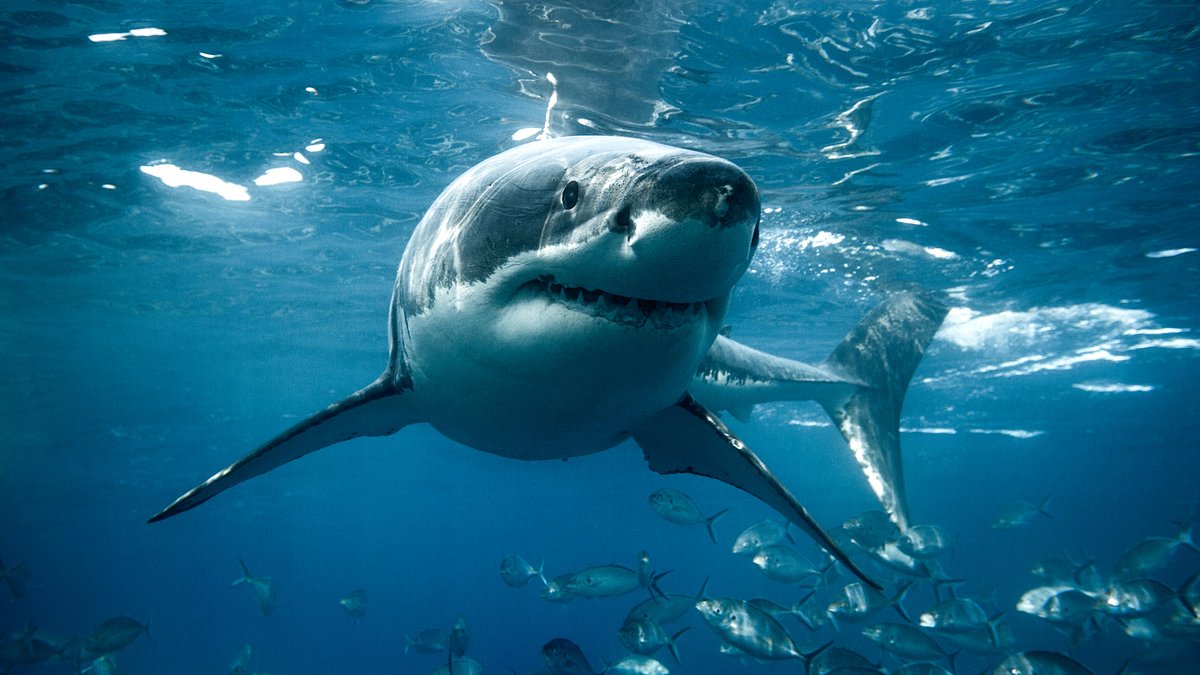
The scariest thing about swimming in British seas is the temperature – but that could all be about to change, experts have warned.Researchers have warned that great white sharks could soon appear off Britain's coast thanks to global warming.There has never been any official confirmation that the 16–foot (4.9–metre) marine predators, which gained notoriety from the film Jaws, currently lurk in our seas.However, a new study has shown that their extinct relatives once roamed these waters, feasting on large whales.Now, warming temperatures could create the perfect environment for great whites to return and even thrive, experts said.'Our new study of two whale fossils, with preserved fragments of shark teeth, suggests the modern descendants of these animals could once again roam the southern region of the North Sea, between the UK, Belgium and Denmark,' researchers wrote in a blog on The Conversation.'Climate change may recreate the conditions that allowed the ancestors of great white sharks to hunt in these waters.'Despite no official record, there have been numerous unconfirmed sightings of great whites around Cornwall and northern Scotland – indicating they may actually already be here. Warming temperatures could create the perfect environment for great whites to return and even thrive in British waters (stock image) For their study, the researchers analysed whale fossils dating back millions of years that featured bite marks. Remarkably, some even contained fossilised shark tooth fragments For their study, the team – consisting of Professor John Stewart from Bournemouth University and Olivier Lambert from the Royal Belgian Institute of Natural Sciences – analysed whale fossils dating back five million years that were found in the North Sea.These whales had bite marks and, in a rare discovery, also contained fossilised tooth fragments from the predators that had eaten them.One of the whales had likely been attacked by an extinct mako shark – a relative of today's great white shark.'It appears that the shark was attempting to separate the whale's head from the rest of the body,' the researchers wrote.They explained that climate change will have – and is already having – an impact on the distribution of marine mammals.'Warming seas could attract dolphins and seals, and in turn great white sharks or other large marine predators,' they said.A separate study, published in 2022, found that British waters 'display near–perfect habitat suitability' for great white sharks.Author Max Kimble explained that there have been 'over 100 reports' of great white sharks in British waters in the last decade. This map shows unconfirmed great white shark sightings in the UK, as well as confirmed sightings in Europe The great white shark Great whites can typically reach 13–20 feet (4–6 metres) long, with exceptional individuals exceeding this length.They are found in coastal and offshore waters worldwide, especially in temperate regions – common around places like South Africa, Australia, California, and the Mediterranean Sea.Some individuals migrate thousands of kilometres between feeding and breeding areas.They sit at the top of the marine food chain, feeding on fish, seals, sea lions, and occasionally whale carcasses.Their bite force is estimated at over 1.8 tons, making it one of the strongest of any animal.Despite their reputation, attacks on humans are uncommon. Globally, there are typically five to 10 fatalities per year from all shark species combined, with great whites responsible for a portion of these.They can live 70 years or more, based on recent scientific studies.The species is listed as 'vulnerable' by the International Union for Conservation of Nature due to threats like overfishing, bycatch, and habitat pressure. The nearest known population resides in the Mediterranean – although numbers are thought to be rapidly declining.'British waters are home to the largest grey seal population in Europe and are less than 200 miles away from a known great white population,' Mr Kimble wrote.'This coupled with the shark's global distribution and preference for more temperate waters has left many wondering why there has not been a confirmed sighting of this species.'To examine the suitability of British waters, four white shark's migrations were mapped spanning nine years.'The results of this report showed that British waters display near–perfect habitat suitability for both sexes year–round, thus indicating that there is no environmental reasoning for their apparent absence.'He said that if a great white were to visit British waters, it would most likely be a male from the Mediterranean population swimming at depth.This could explain why, despite 'perfect conditions', they have not yet been confirmed in British waters.'This species is currently experiencing a latitudinal shift north in habitat suitability due to climate change, indicating that if the great white is not in British waters yet it may soon be,' he concluded. A promising study, published last year, revealed that the Jaws Effect is finally wearing off.Named after the 1975 thriller, this phenomenon describes how films featuring sharks fuel a fear of the creatures in the real world.In the study, researchers from the University of South Australia asked hundreds of people to describe sharks in three words.While 'teeth', 'jaws' and 'predator' were some of the most common answers, the vast majority (66 per cent) of the descriptors were neutral.According to the researchers, this suggests public attitudes towards sharks are softening.HOW SHARKS EARNED THEIR RUTHLESS REPUTATIONSharks are the most efficient predators on earth and have long terrified humans.Their basic design has never really changed over the course of 200million years and they are considered to be complex and intelligent.Their teeth are fear factor number one, with the great white's teeth growing up to two-and-a-half inches in length.Their prey are impaled on the pointed teeth of the lower jaw where they saw away sections of the flesh. The serrated edges of the teeth help with this process.Their teeth are brittle and are constantly breaking off but are also constantly regrowing and on average there are 15 rows of teeth present in the mouth at one time. Sharks are the most efficient predators on earth. Their basic design has never really changed over the course of 200million yearsTheir speed is fear factor number two. They are very fast in the water compared to humans with the mako shark able to reach an incredible 60mph in bursts.The great white can reach speeds of 25mph. By comparison, 5mph is the fastest a human being can reach.A shark's power and size terrifies us, too. The great white shark can grow up to 20 feet and while it has no particular taste for humans even an exploratory bite is enough to cut a man in half.Most sharks release a human after its first bite but sometimes, that's all it take to kill a person. However, sharks have far more reason to be afraid of humans. We kill up to a million of them a year, often just cutting off their fins to make into soup and throwing the rest of the shark back into the water, where it starves or drowns.