'I promised him a super wake!' Widow brings her husband back for his own funeral as a HOLOGRAM
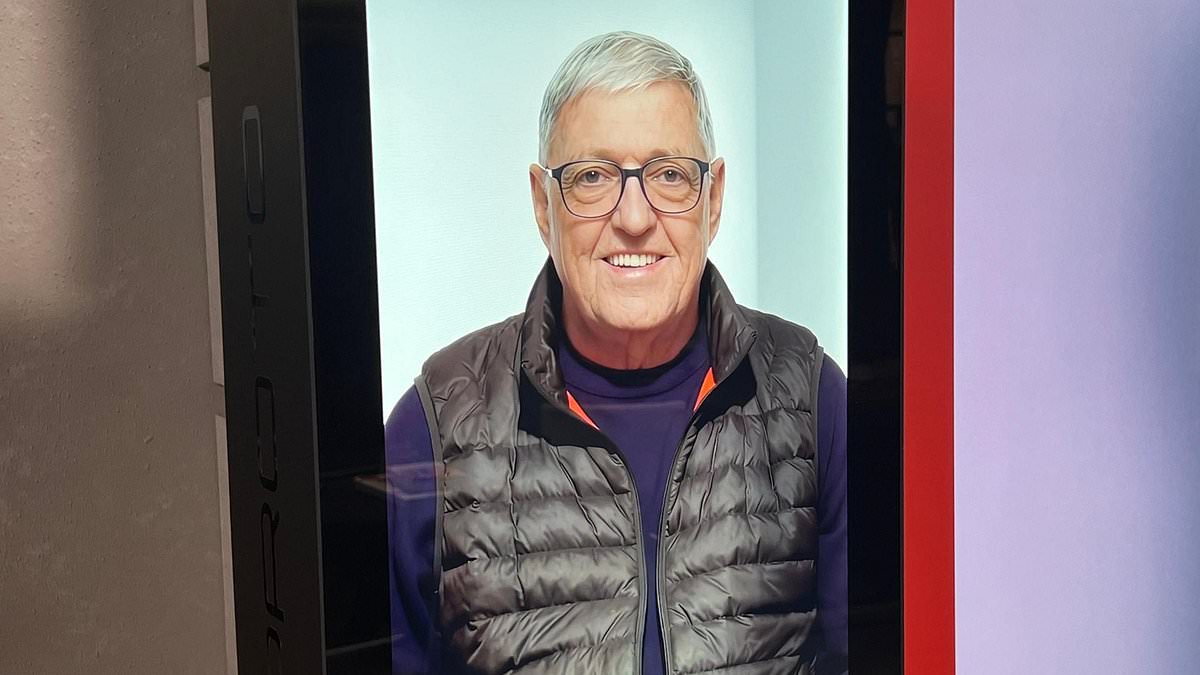
A widow shocked mourners at her late husband's wake by revealing a very unusual guest of honour: her husband himself.When Pam Cronrath's husband Bill died after nearly 60 years of marriage, she knew she wanted him to have a send–off to remember.Which is why she made the unusual decision to bring her husband back for his own funeral as a hologram.Ms Cronrath, 78, told the BBC: 'I promised him a super wake!'During the memorial service, around 200 people gathered to pay their respects – most of whom had no idea what was about to happen.That was when Bill appeared, life–sized and seen from the waist up in hologram form, and began speaking directly to the room.'Now, before anyone gets confused, I'm not actually here in Valhalla today,' the hologram asked the room.The recording then asked: 'Is this going to be fun?' A widow has brought back her husband as a hologram for his own funeral, claiming 'I promised him a super wake!'Ms Cronrath lives in Wenatchee, Washington, a rural farming community located in the foothills of the Cascade Mountain Range.As a lifelong tech fan, she had always had a professional and personal interest in the latest gadgets.But when she saw a hologram of a doctor speaking on a live broadcast from across the US at a medical conference, it left a profound impression.'I was completely impressed,' Ms Cronrath said of the experience.So, when her husband Bill passed away at the age of 75, the memory of that hologram's appearance made her wonder whether she could do the same for Bill.It proved tough to find a company willing to help at such short notice and on a relatively small budget.Most companies which Ms Cronrath approached were either too expensive or weren't interested in such a small project.Ms Cronrath says: 'When you hear they're working with Michael Jackson's estate, and then it's me – Pam from Wenatchee – you do wonder how it's going to work.' Pam Cronrath (left),78, had been married to her husband Bill for over 60 years and decided to make his wake uniqueHowever, she was eventually put in contact with Proto Hologram and Hyperreal, two US–based companies that specialise in making holographic digital avatars.Ms Cronrath says she ended up spending 10 to 15 times her original $2,000 (£1,480) budget.But the two companies eventually agreed to work on the project and help bring Bill back as a digital representation.The companies used old recordings of Bill to generate a representation that matched his voice and appearance.Since the real Bill had already passed away, no new recordings could be made, so Ms Cronrath had to write the script herself.Thanks to some clever planning, the hologram didn't just give a speech; it also gave a scripted Q&A with Bill's nephew leading the questions.Several attendees even believed the exchange was happening live.'People were aghast. Some genuinely couldn't understand how it was happening,' Ms Cronrath says. Ms Cronrath worked with the hologram and digital avatar company Proto Hologram, which usually works with major celebrities and high–profile events. Pictured: Actor William Shatner appearing as a hologram from Los Angeles at the Advertising Week APAC event in Sydney, AustraliaRecent advances in so–called 'grief tech' are creating more ways for people to interact with their loved ones from beyond the grave.New AI tools allow people to recreate chatbots trained on their family members' appearance, speech patterns, and conversations.These bots then allow people to keep speaking with a simulation of the deceased long after they have passed away.While this might appear like a comfort, experts have warned that grief tech could interfere with the natural grieving process and lead to irreversible psychological harm.Researchers from Cambridge University even suggested that so–called 'deadbots' could digitally haunt those left behind.However, Ms Cronrath is keen to stress that her holographic recreation wasn't about replacing her husband or avoiding moving on.Although she still watches the recording several months on, she compares it to looking through old photos or watching home movies.She says: 'When you're hurting, it helps to feel like that person is still right there with you.'Experts warn 'deadbots' could haunt youResearchers from the University of Cambridge have warned that these so–called 'deadbots' could cause psychological harm and even digitally 'haunt' those left behind.In their study, ethicists at Cambridge's Leverhulme Centre for the Future of Intelligence examined three hypothetical scenarios likely to emerge as part of the fast–growing 'digital afterlife industry'.Firstly, the bots could be used to surreptitiously advertise products from beyond the grave or cremation urn, the authors warn.Secondly, they could distress children by insisting a dead parent is still 'with you'.And finally, the departed could be used to spam surviving family and friends with reminders and updates about the services they provide – a scenario they describe as being 'stalked by the dead'.After an initial period of comfort, the app may start to hassle the user for instance by suggesting ordering from food delivery services in the voice and style of the deceased. 'These services run the risk of causing huge distress to people if they are subjected to unwanted digital hauntings from alarmingly accurate AI recreations of those they have lost,' said co–author Dr Tomasz Hollanek.'The potential psychological effect, particularly at an already difficult time, could be devastating.'