Antarctica is melting from BELOW: Deep-ocean heat is marching closer to the fragile ice shelves, study warns
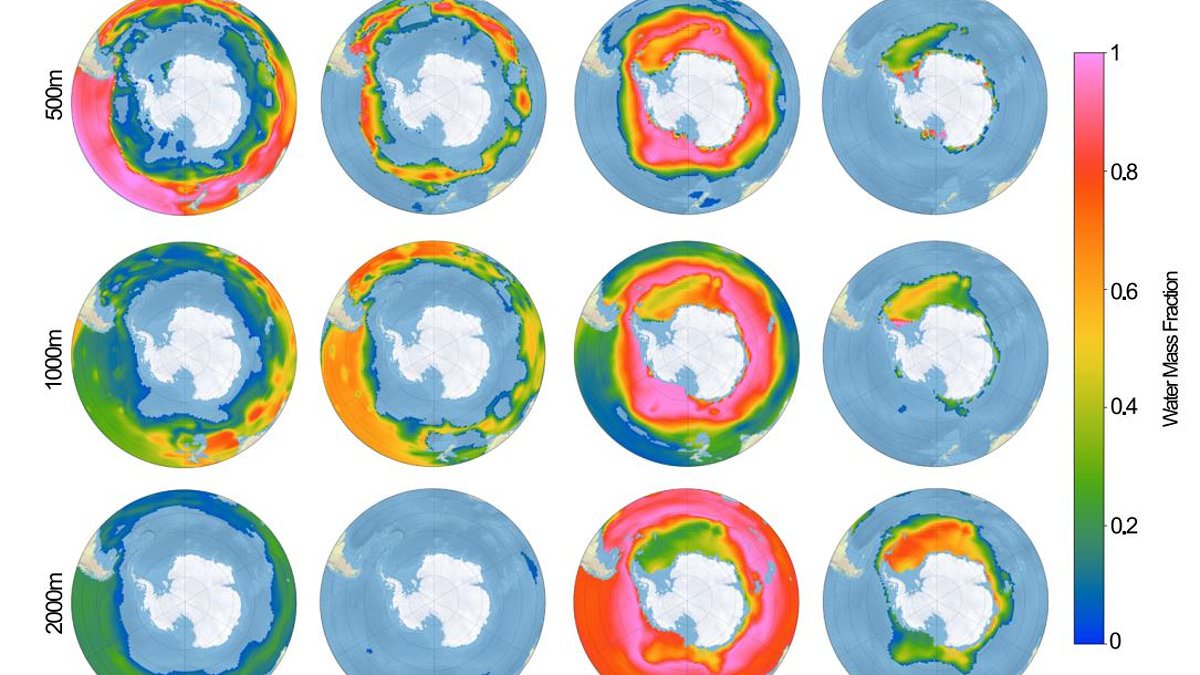
Antarctica is melting from below as deep ocean heat marches closer to the continent's fragile ice shelves, a study has warned.In a decades–long study, scientists measured the movement of a mass called the 'circumpolar deep water' (CDR).This flow of relatively hot water is usually trapped far from the ice sheets at around 1,600 feet (500 metres) beneath the surface.However, scientists say that strong winds in the Southern Ocean are now slowly but surely dragging the CDR towards the surface.While these waters are only around 2°C (35.6°F), they are still enough to start weakening the Antarctic ice shelves.These huge floating platforms of ice hold back Antarctica's inland ice sheets and glaciers, which contain enough freshwater to raise sea level by 190 feet (58 metres).Senior author Professor Sarah Purkey, from the Scripps Institution of Oceanography, says: 'In the past, the ice sheets were protected by a bath of cold water, preventing them from melting.'Now it looks like the ocean's circulation has changed, and it's almost like someone turned on the hot tap and now the bath is getting warmer!' Scientists measured the movement of a mass called the 'circumpolar deep water' (CDR), revealing that it has become thicker and closer to Antarctica over the last 40 years That deep ocean heat could expand and shift towards Antarctica is something that climate models had previously predicted.However, until now, there hasn't been enough data to prove that this was really happening.The problem was that really good data from the Southern Ocean is only collected by passing ships about once per decade.To solve this problem, the researchers turned to a global array of floating probes that constantly gather data as they drift through the upper ocean.Scientists combined the data from the so–called 'Argo' floats with data from ships to create a detailed record of monthly snapshots stretching back over four decades.For the first time, this clearly showed that deep ocean heat is encroaching on Antarctica.This not only contributes directly to the ice shelves' melting, but also pushes back the point where the ice meets the bedrock – known as the grounding line.This exposes even more of the ice to warm water and creates a 'positive feedback loop' that results in faster ice loss. Deep ocean heat is migrating up from the depths and towards Antarctica, melting the ice shelves (pictured) from below What are the Antarctic ice shelves? The ice shelves are vast, floating extensions of Antarctica's land–based glaciers.These cover about 75 per cent of the continent's coastline, and range in thickness from about 50 to 600 metres.The ice shelves grow from the flow of glaciers behind them and from compact snowfall.They play a critical role 'buttressing' the glaciers, and preventing them from collapsing into the sea. Research shows that they are thinning due to human–caused climate change, with 48 shelves having lost 30 per cent of their mass over the last 25 years alone. The researchers aren't quite sure why the deep waters are now moving towards the Antarctic.They suggest that it could be a combination of natural variations and the influence of human–caused climate change, but more research is needed.But whatever is causing the CDR to move, the effects of this change will be felt all around the world.Senior author Professor Ali Mashayek, a climate scientist at the University of Cambridge, told the Daily Mail: 'The immediate impact is sea level rise with complex geographical patterns, impacting coastal communities.'That impact can be regionally compounded by local currents, tides, and storms, creating extreme sea level events such as floods.'Professor Mashayek says that this melting will also cause a deeper problem by interfering with the formation of key ocean currents.When water meets the ice around the poles, extremely cold, dense, salty water forms and sinks deep into the ocean.As it falls, it draws down heat, carbon, and nutrients, driving the global 'conveyor belt' of ocean currents. This trend was revealed by a fleet of floating probes called 'Argo' floats, showing for the first time that deep–ocean heat is marching towards the ice shelves These currents include the vast Atlantic Meridional Overturning Circulation (AMOC), which powers the Gulf Stream and pushes heat and water across the Atlantic.However, warming air temperatures and freshwater runoff from melting glaciers weaken this action and threaten to destabilise AMOC.New data shows that cold water production will also decline around Antarctica.This will cause even more warm water to draw towards the ice shelves to fill the space left by the dwindling cold water.The resulting slowdown in ocean circulation will also limit how quickly the ocean can absorb carbon and heat from the atmosphere, resulting in faster global warming.Lead author Dr Joshua Lanham says: 'We can now see this scenario is already emerging in the observations.'This isn't just a possible future scenario suggested by models; it's something that is happening now, bringing wider implications for how carbon, nutrients and heat are cycled through the global ocean.'While their study doesn't examine the full consequences for AMOC, the research comes as fears mount that this key ocean current may collapse completely. The researchers say this trend could weaken a key ocean current called the Atlantic Meridional Overturning Circulation (AMOC). This comes as a study shows that AMOC is on track to weaken 50 per cent by the end of this century
In a new study, scientists from the University of Bordeaux predicted that AMOC is on track to weaken 50 per cent by the end of this century.Scientists previously thought AMOC would only reduce in strength by around 32 per cent over this time period.This has raised concerns that the current might be closer to a critical tipping point than had previously been thought.Were AMOC to fail, it would radically change the movement of the Gulf Stream and potentially plunge Northern Europe and the UK into a new Ice Age.Studies have predicted that this would lead to London seeing winter extremes of –20°C (–4°F), with three months of the year spent below freezing.ATLANTIC OCEAN CIRCULATION PLAYS A KEY ROLE IN REGULATING THE GLOBAL CLIMATE When it comes to regulating global climate, the circulation of the Atlantic Ocean plays a key role.This is due to a constantly moving system of deep-water circulation often referred to as the Global Ocean Conveyor Belt which sends warm, salty Gulf Stream water to the North Atlantic where it releases heat to the atmosphere and warms Western Europe.The cooler water then sinks to great depths and travels all the way to Antarctica and eventually circulates back up to the Gulf Stream. When it comes to regulating global climate, the circulation of the Atlantic Ocean plays a key roleThis motion is fuelled by thermohaline currents – a combination of temperature and salt.It takes thousands of years for water to complete a continuous journey around the world.Researchers believe that as the North Atlantic began to warm near the end of the Little Ice Age, freshwater disrupted the system, called the Atlantic Meridional Overturning Circulation (AMOC).Arctic sea ice, and ice sheets and glaciers surrounding the Arctic began to melt, forming a huge natural tap of fresh water that gushed into the North Atlantic.This huge influx of freshwater diluted the surface seawater, making it lighter and less able to sink deep, slowing down the AMOC system.Researchers found the AMOC has been weakening more rapidly since 1950 in response to recent global warming.