Turnaround Plan: The brands that shifted to new sectors
For a time, AllBirds looked like it was going to be the next big footwear brand.
Launched in 2015, its unique selling point was a promise that its products were made in an ethical and sustainable way. And through that they quickly raced into the public consciousness, with appearances on the feet of Barack Obama, Leonardo DiCaprio, Oprah Winfrey and Gwyneth Patrow helping it along the way.
AllBirds also became the 'it' shoe for the Silicon Valley techbro type – and that led to the company’s Nasdaq flotation in 2021, where it secured a valuation of more than $4 billion
But in the years that have followed, sales did not live up to expectations, the techbros moved onto the next thing, and the company began to lose substantial sums of money. In the two years from 2023 to 2024, it lost nearly $246m.
And it’s against this backdrop that they recently announced a shift away from footwear, towards AI.
Though it’s not all as it seems… there is some financial trickery at play.
Last month the company announced a deal to sell the footwear brand to American Exchange Group for just $39m.
As they only bought the shoe business itself, that effectively left behind a shell company which – crucially – had a stock market listing.
And it’s this blank slate company which is now being repurposed into an AI-focused firm, which will be called NewBird AI.
But even if we take AllBirds’ footwear to AI shift at face value, there’s still a case to be made that it’s not the most dramatic tech pivot of all time.
From mills to mobiles
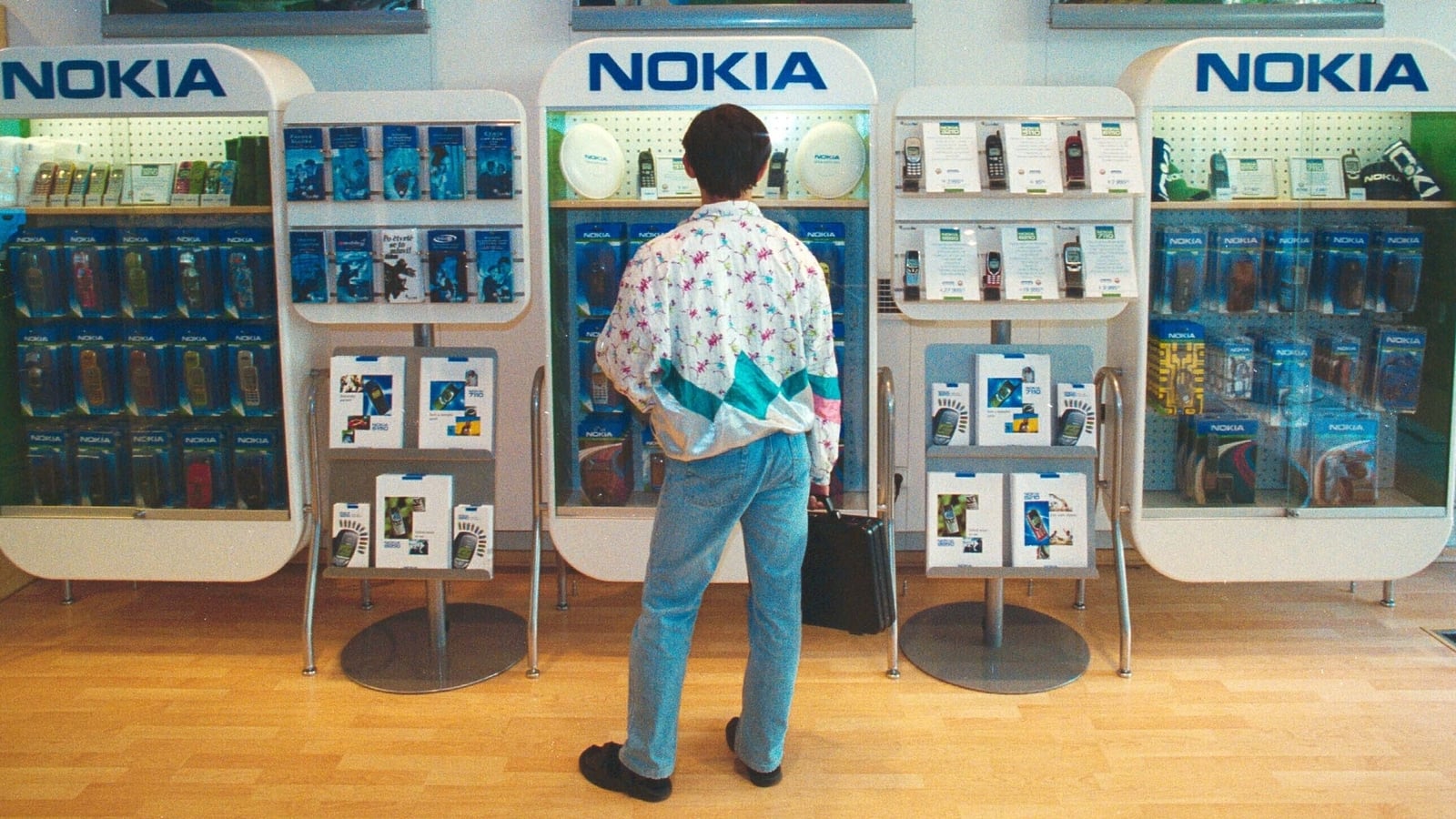
When you read the name ‘Nokia’, you likely think about 3210s, playing Snake and that iconic snippet from ‘Gran Vals’ that became the company’s theme tune.
But Nokia was actually initially established as a paper mill all the way back in 1865 – before there was even such a thing as a telephone, never mind a mobile telephone.
From there it slowly started to expand into other areas – including electricity generation, and the production of rubber and rubber-based products like boots.
This slow creep into other industries continued into the 20th century - a merger in the 1960s saw it starting to produce cabling as well as some electronics – including, at one stage, televisions.
Then in the late 1970s and early 1980s it started to develop mobile telephone products through a joint venture, which it later took full control of.
In the late 1980s it decided to break off its rubber production arm, which ultimately saw it focus on telecoms. And that set the stage for it to become the dominant player in the mobile phone market in the 1990s, through to the early 2000s.
Of course it lost its crown in that market when the iPhone and Google’s Android came on the scene – and, despite a number of attempts, it never managed to get its footing again. Eventually in 2012 Microsoft acquired Nokia’s mobile phone business for $7.3 billion – only to shut it down three years later.
But even that wasn’t the end of Nokia.
It still exists as a company in its own right, and a very successful one at that. It remains in the telecoms and network business – providing part of the digital world’s backbone - and last year made an operating profit of close to €2 billion.
As part of this, and somewhat ironically in the context of AllBirds, Nokia is one of the few companies that’s actually making money out of AI so far, because all of that data and digital traffic is creating huge demand for its networking infrastructure.
(The brand is also still used under licence on a range of mobile phones made by another Finnish firm called HMD, or Human Mobile Devices.)
Hanafuda to home consoles
Another tech company that’s much older than many realise is Nintendo.
While many will connect it to the 1980s - when the Gameboy and the Nintendo Entertainment System hit the European market – it actually goes all the way back to 1889.
Nintendo started out as a playing card company – specifically ‘hanafuda’, or flower cards. That’s a Japanese style of card deck that’s quite different to the set people in Ireland would be familiar with.
Arguably playing cards to video games isn’t the most dramatic of shifts – certainly not as significant as going from paper and rubber to mobile phones.
But what makes Nintendo’s move more remarkable is the fact that company was still focused on playing cards all the way up to the 1960s.
It was only after a stock market flotation – and shifts in demand in the Japanese market – that it started to expand beyond cards. Initially it started to make board games, and then toys.
And the key turning point seems to have been the ‘Beam Gun’, which it made for a different company’s home gaming console - the Magnavox Odyssey.
It allowed players to use a gun-type controller to target objects on their screen – an idea that was rekindled with Duck Hunt on the NES – and it it was a huge hit.
This started Nintendo down the path of making electronic gaming devices.
In the 1970s it launched the Color TV-Game – which was its first home console, featuring versions of Pong and Breakout. Then it made the Game & Watch handheld in 1980 before bringing out the Famicom (or NES as it was known here) and the Gameboy later in the decade.
And of course it went on to be a huge player in the gaming market with successful series like Mario, Zelda and Donkey Kong – remaining one of the industry’s biggest brands this day.
Interestingly, it still makes hanafuda cards too – with some of the sets now featuring its popular video game characters.
From freight to finance
American Express might be best known for its bank cards and financial services. But it actually started out not as a bank – but as a freight shipping company (which actually makes more sense of the name of the company).
It was founded in 1850 as a merger of three companies owned by Jon Warren Butterfield, Henry Wells and William G Fargo - the latter two being the same men who would go on to establish Wells Fargo.
While American Express wasn’t a bank at first, there was still money at its roots, as those three companies were all cash in transit businesses. But in its early days AmEx moved all sorts of goods and securities around New York State, making it a big player in railroads for a time.
It then started to expand across the US – with the financial aspect of the business starting to grow as part of that.
It began to offer money orders to customers to make it easier and safer for them to send money across long distances. Towards the end of the 19th century it essentially invented the travellers’ cheque to help Americans who were struggling to pay for things while in Europe.
This came into its own with the onset of World War I – and American Express developed a significant side business shipping care packages and letters to soldiers.
But the war also effectively led to the end of their freight business – because the railroads were nationalised as part of the US war effort.
By this point, though, the financial side of the company was already substantial, so it doubled down on that area – and the rest is history.
It started issuing charge cards in the late 1950s – and the iconic ‘gold card’ for deep pocketed customers came out in the 1960s.
Tech turnarounds
The idea of a company completely changing direction has become more common in recent years – in fact it’s almost an expected part of the start-up process nowadays.
You often hear about founders talking about their ‘pivot’ - though it generally happens relatively early in a company, rather than it being something they do after many years in business.
What that tends to boil down to is a founder or founders setting up a firm with a business model in mind, but once they begin to develop it they realise it’s not a viable idea. Or maybe they realise it’s not profitable, or someone else has beaten them to it. Or perhaps, while trying to make their idea work, they discover a new, more lucrative problem to solve.
YouTube, for example, was said to have come from a frustration among the three founders at how hard it was to share videos among friends. But the business angle they initially saw a video-based dating service (kind of like those VHS dating services that were a thing in the 1970s).
The founders put an ad on Craigslist asking attractive women to post videos to the platform – in return for $100 – but didn’t get many takers, which prompted them to rethink the idea, and open the door to all types of videos.
And so the YouTube we know today was born.
Slack – which some people may use to communicate with colleagues – originally started out as a gaming company, but the team behind it build a lot of tools that they needed as part of the development of the game, including a messaging app to keep in touch with each other.
At some point they realised that this kind of app would be of interest to other businesses, and so they started selling that instead.
Meanwhile Twitter’s origins were in a different tech company, called Odeo.
It was establishing a platform to make it easier for people to share and discover podcasts – which was a new form of media back in 2005.
But when Apple launched its own podcast service, it essentially cut the legs out from under them.
So the company held a brainstorming session and one of the workers, Jack Dorsey, put forward the idea of a service that would allow people to send or broadcast a text message to a group of people.
Eventually Twitter was spun out into a company of its own.
Just imagine how different the world might have been had Steve Jobs just left podcasts alone...