Researchers reconstruct 42 missing pages from a major early Christian manuscript - revealing text unseen for centuries
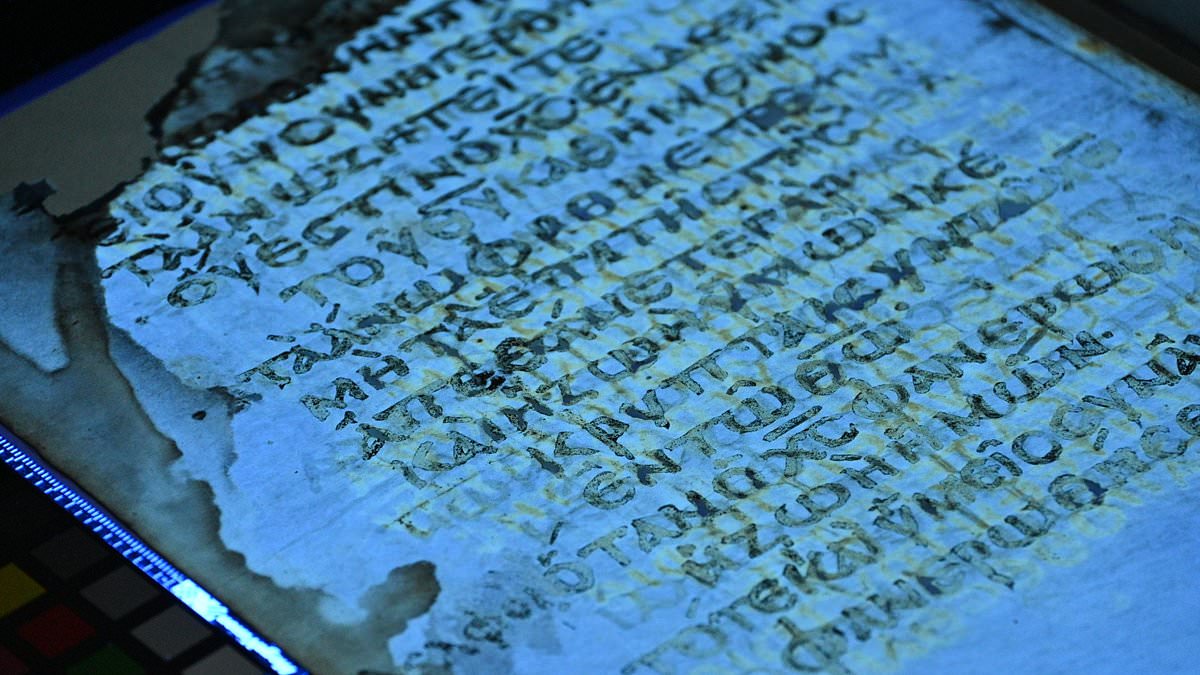
Experts have recovered 42 lost pages from a major early Christian manuscript, heralding a 'breakthrough' for understanding ancient scripture.Scientists successfully reconstructed passages from Codex H – one of the world's most important early New Testament scripts.The text, a 6th century copy of the Letter of St Paul, was lost to history when it was disassembled at the Great Lavra Monastery on Mount Athos in Greece in the 13th century.Its pages were re–inked and reused as binding material and flyleaves for multiple other manuscripts.Today, the surviving fragments are scattered across libraries in Italy, Greece, Russia, Ukraine and France.Using advanced imaging techniques, an international team of academics have now been able to digitally reconstruct the missing pages – revealing text unseen for centuries.The findings shed new light on ancient scribal habits and early biblical structures, providing unique insight about how people interacted with their sacred texts.'Given that Codex H is such an important witness to our understanding of Christian scripture, to have discovered any new evidence – let alone this quantity – of what it originally looked like is nothing short of monumental,' Professor Garrick Allen, from the University of Glasgow, said. Scientists successfully reconstructed passages from Codex H – one of the world's most important early New Testament scriptsPaul's letters, also known as Pauline epistles, are a group of texts in the New Testament traditionally attributed to Paul the Apostle and are the earliest written explanations of Christian theology.These letters were written in the 1st century and sent to early Christian communities and individuals, explaining Christian beliefs and giving practical advice to churches.Codex H, a 6th century handwritten book, contains a collection of these letters and shows how they were being used centuries later.The codex was later taken apart and reused in other books, with pages scattered across multiple countries.The researchers explained their breakthrough came from an important starting point – the knowledge that at one point, the manuscript was re–inked.This describes the process of a scribe tracing over the original, fading ink with new ink to preserve the text.'The chemicals in the new ink caused "offset" damage to facing pages,' Professor Allen explained.'They essentially creating a mirror image of the text on the opposite leaf – sometimes leaving traces several pages deep, barely visible to the naked eye but very clear with latest imaging techniques.' Using advanced imaging techniques, an international team of academics have now been able to digitally reconstruct the missing pages Codex H and Paul's lettersPaul's letters are a group of texts in the New Testament traditionally attributed to Paul the Apostle.They are the earliest written explanations of Christian theology.These letters were written in the 1st century and sent to early Christian communities and individuals, explaining Christian beliefs and giving practical advice to churches.Codex H, a 6th century handwritten book, contains a collection of these letters and shows how they were being used centuries later.The codex was later taken apart and reused in other books, with pages scattered across multiple countries. Using specialised imaging techniques, the team processed images of the remaining manuscript pages in order to recover 'ghost' text that no longer physically exists.This meant they could retrieve multiple pages of information from every single page of remaining manuscript.Radiocarbon dating was then used to confirm the parchment's 6th century origin.While the recovered text contains known portions of Paul's letters, the discovery offers a unique insight into how the New Testament has evolved and been understood through the centuries.Key findings include the earliest known examples of chapter lists, which differ drastically from how the letters are divided today.The fragments also show how 6th century scribes corrected, annotated and interacted with sacred texts.Meanwhile the physical state of the manuscript also reveals how sacred works were reused and repurposed once they fell into disrepair.For historians, the newly–recovered texts provide evidence for how the New Testament developed over time. A 17th century painting by Valentin de Boulogne depicts 'Paul Writing His Epistles'. They are regarded as the earliest written explanations of Christian theologyA new print edition of Codex H is forthcoming and a digital edition is freely available here, making these recovered pages available to the public and scholars for the first time in centuries.Earlier this month, a separate group of experts uncovered a rare marble artefact that could rewrite the history of baptism.Archaeologists have been excavating the remains of a cathedral in the ancient city of Hippos in Israel, near the Sea of Galilee.According to the gospels, Jesus' earthly ministry centred around this area, making it a significant site in the history of Christianity.And it is here that the team came across an unusual object – a unique marble item featuring three hemispheric cavities which they believe used to hold three different oils.Traditionally, during baptisms, a person is anointed with two oils – one used before the water baptism and a different one used after.But the new discovery indicates people used to be anointed with oils three times – and it could force historians to rethink the history of the practice. Scientists reveal who wrote the Bible – and say it probably WASN'T God Around the world, millions of Christians see the Bible as the divine word of God. It tells an incredible story about the history of the world, from creation to redemption and God's Last Judgement of the living and the dead. It includes famous stories such as Adam and Eve, Noah's Ark, David and Goliath, The Crucifixion and The Resurrection. But who actually penned this masterpiece, variously amounting to more than 700,000 words?Famously, the Bible is the word of God, but researchers generally agree it was written by multiple human authors. Professor Elizabeth Schrader Polczer, biblical scholar at Villanova University in Pennsylvania¸ said 'dozens' of people likely penned the Bible, probably more than 40.However, identifying these people who wrote the Bible is 'quite complicated', she told the Daily Mail.