'Welcome home!' Watch the heartwarming moment the recovery crew opened Integrity's hatch after NASA's Artemis II astronauts splashed down following their historic moon mission
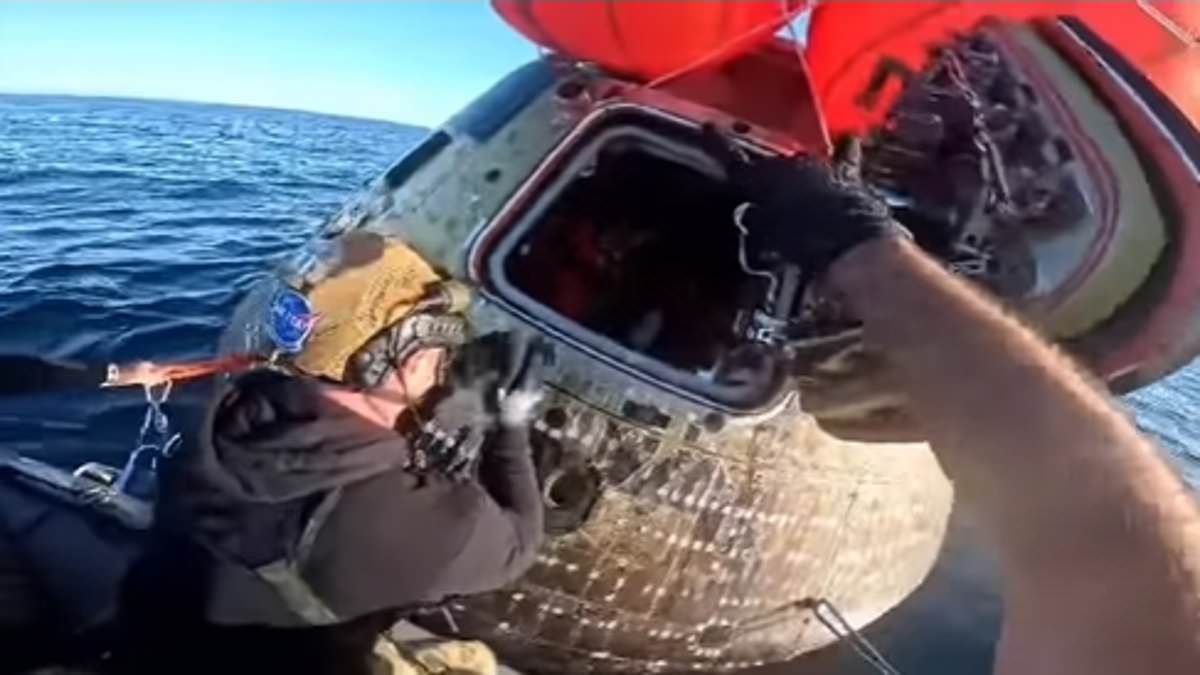
Footage has revealed the heartwarming moment a recovery crew opened Integrity's hatch, waving and smiling as they greeted NASA's astronauts following their historic moon mission.The team arrived back on Earth in the early hours of Saturday after completing a 10–day journey that took them 252,756 miles (406,771 km) from home.Their spacecraft reached blistering speeds of up to 25,000 miles per hour as it burned through the atmosphere.Parachutes were deployed to slow its descent before it splashed down in the Pacific Ocean off the coast of San Diego, California.A recovery team raced to the capsule, with a newly–released video showing them popping open the hatch and climbing inside to greet Reid Wiseman, Victor Glover, Christina Koch and Jeremy Hansen.They could be heard shouting 'welcome home' as they gave fist bumps to the crew, who beamed with joy after returning to Earth.Commander Wiseman shared the video on social media with the caption: 'Jesse, Steve, Laddy and Vlad…such an incredible feeling to welcome you aboard Integrity after a nearly 700,000–mile journey.'Forever thankful for your service to our crew and the nation.' Footage has revealed the heartwarming moment a recovery crew opened Integrity's hatch, waving and smiling as they greeted NASA's astronauts following their historic moon mission Pilot Victor Glover had a huge smile on his face as he fist–bumped one of the rescue team membersThe splashdown marked the end of a 10–day journey that took the crew around the moon and farther than any humans have ever travelled in space.NASA officials called the Artemis II mission a total success, with the capsule splashing down exactly where the space agency had planned.Re–entry to Earth's atmosphere began just after 12:30am (UK time) on Saturday morning, with the Orion crew module blasting away from the spacecraft's service module.The separation exposed the craft's heat shield, which protected the astronauts as they plunged through Earth's atmosphere, experiencing temperatures up to 2,760°C – just under half the surface temperature of the sun.At this point, mission control lost contact with the spacecraft for six minutes as Orion collided with the upper atmosphere, causing what scientists called a 'plasma buildup.'Once the radio blackout cleared as planned, Orion successfully deployed its parachutes and safely landed in the Pacific without incident.A slight communications glitch between the astronauts waiting in the water and the US Navy recovery teams delayed the crew's exit from the craft.But once flight surgeons were able to board the capsule, they were able to give all four astronauts a clean bill of health. Delighted viewers said the video had brought them to tears. Pictures: Mission specialist Christina Koch The video provides a different perspective to this one previously released, which shows the rescue team extracting the astronauts from the capsule Victor Glover, left, and Christina Koch, right, after successfully splashing down following their historic moon missionThe rescue team could be heard shouting 'four green' as they opened the hatch, indicating that all four astronauts appeared healthy and well.Delighted viewers have commented on the clip, with one remarking: 'Best unboxing video I've ever seen!'Another said: 'Look at the astronauts waiting so cutely. And you can tell the recovery crew have the bets vibes!'And someone else added: '"Welcome home" are actually such beautiful words.'Once they had been recovered from the Orion module, the crew were examined by doctors on the John P Murtha, the naval vessel that was sent to pick them up.All four astronauts were able to walk by themselves, in stark contrast to previous long–duration space flights where crew had to be carried by medical personnel.They were then flown ashore by helicopter and taken to NASA's Johnson Space Center in Houston to be reunited with their families.Dr Lori Glaze, NASA's deputy administrator, said her team was 'thrilled' to have the four astronauts home safely.
Shawn Quinn, manager of NASA's Exploration Ground Systems Program, added: 'We accomplished what we set out to do. It's good to be NASA, and it's good to be an American today.'President Donald Trump added his congratulations Friday night and invited the crew to the White House.'I look forward to seeing you all at the White House soon,' he posted on Truth Social. 'We'll be doing it again and then, next step, Mars!'The Artemis II mission began back on April 1 with a successful launch from the Kennedy Space Center in Florida.After orbiting Earth the crew set off on a four–day trip to the moon, where they would travel around the dark side and break the decades–old record of Apollo 13 for the farthest distance from Earth humans have ever travelled.While the Apollo crew travelled 248,655 miles from Earth in 1970, Artemis II reached a maximum distance of 252,756 miles on day six of their mission.While conducting their lunar flyby, the astronauts also named two new craters discovered on the lunar surface – including one Carroll after the late wife of mission commander Wiseman.Amit Kshatriya, the associate administrator of NASA, said Artemis II was the 'most important human space exploration mission in decades.'Artemis II: Key facts Launch date: April 1Mission objective: To complete a lunar flyby, passing the 'dark side' of the moon and test systems for a future lunar landing.Total distance to travel: 620,000 miles (one million km)Mission duration: 10 days Estimated total cost: $44billion (£32.5billion)NASA Space Launch System rocket: $23.8billion (£17.6billion)Orion deep–space spacecraft: $20.4billion (£15billion)Crew: Commander Reid WisemanPilot Victor GloverMission Specialist Christina KochMission Specialist Jeremy HansenMission Stages:Launch from Kennedy Space Centre Launch Pad 39BManoeuvre in orbit to raise the perigee using the Cryogenic Propulsion StageBurn to raise apogee using the Cryogenic Propulsion StageDetach from Cryogenic Propulsion Stage and perform translunar injectionFly to the moon over four daysComplete lunar flyby at a maximum altitude of 5,523 miles (8,889 km) above the moon's surfaceReturn to Earth over four daysSeparate the crew module from the European Service Module and the crew module adapterSplashdown in the Pacific Ocean