The universe is expanding 'too fast' - and scientists have no idea why
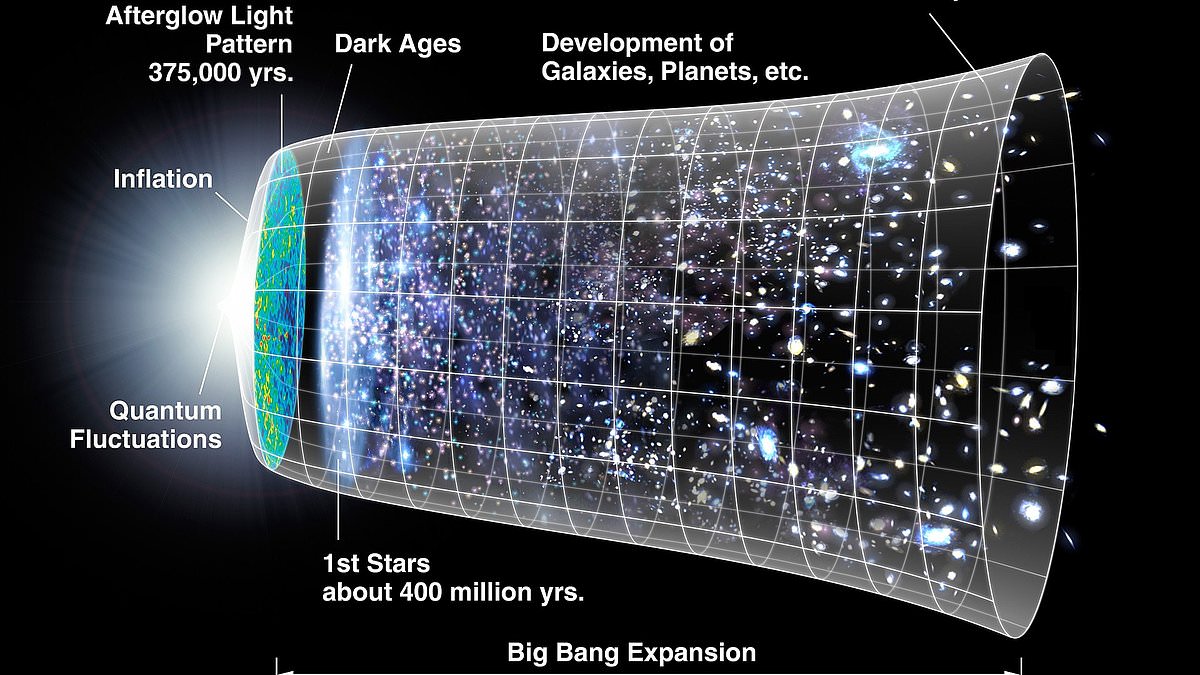
The universe is expanding 'too fast', a study has warned – and scientists have no idea why.An international team of astronomers have carried out some of the most precise measurements yet of how quickly the universe is growing.But instead of providing a clear answer, it has left them more baffled than ever.And it suggests something might be wrong in our current understanding of the cosmos.For their study, the team combined lots of different methods of measuring universe expansion to try and get an accurate measurement.They discovered it is growing at about 73.5 kilometres per second per megaparsec (a unit of distance equal to 3.26 million light years).This is much faster than current models predict, the scientists said, and marks a 'significant shift in perspective'.Writing in the journal Astronomy & Astrophysics, they warned their findings 'strengthen the case for new physics' or a 'deeper reassessment' of the early universe. This graphic represents the tension that exists between measurements of the expansion rate of the late, nearby universe, versus what would be expected based on measurements of the early universeTraditionally, scientists have used two main ways to measure the expansion of the cosmos.One looks at nearby stars and galaxies to see how fast they're moving away from Earth, while the other looks at the early universe to predict how fast it should be expanding today.These two methods are supposed to agree – but they don't.While early universe predictions say it should be expanding at a rate of about 67 or 68 kilometres per second per megaparsec, nearby star measurements say it is much faster, at a rate of about 73.Although the numerical difference may seem small, it is far larger than can be explained by statistical uncertainty. This disagreement is called the 'Hubble tension' and has been showing up in many studies.To try and get a more accurate answer – or an explanation for the difference – scientists combined several measurement techniques into a model called 'The Local Distance Network'.This included observations of red giant stars that shine with a known brightness, exploding stars and different types of galaxies.They found – with very high precision – that the rate of expansion really is about 73.5 kilometres per second per megaparsec. In the standard model of cosmology, the universe is being pushed apart by a constant force called dark energy What is Hubble tension? The Hubble tension is a disagreement about how fast the universe is expanding.One method, which looks at nearby galaxies, gives a faster rate. Another method, based on observations of the early universe, gives a slower rate. Both methods seem accurate but they don't match. This suggests our understanding of the universe might be missing something. This figure remained the same even when individual techniques were removed from the analysis – ruling out obvious errors in any of the measurement methods.'This work effectively rules out explanations of the Hubble tension that rely on a single overlooked error in local distance measurements,' the authors wrote.'If the tension is real, as the growing body of evidence suggests, it may point to new physics beyond the standard cosmological model.'They said the implications of this discovery are significant, as it suggests that standard models of cosmology – which are based on early universe measurements – are missing something.It could be that they do not fully account for the influence of dark energy, new particles or changes to gravity.'The Hubble tension may not be the result of measurement error, but rather evidence that the current model of the universe is missing a key component,' the researchers said.'With next-generation observatories expected to provide even more precise measurements, astronomers aim to determine whether this discrepancy will ultimately be resolved or continue to point toward new physics.'The team of 40 researchers included those from NSF NOIRLab and the Space Telescope Science Institute.While it's well known that the universe began in an explosion known as the Big Bang, scientists have recently warned it might end with a 'Big Crunch'.According to this chilling theory, the cosmos will eventually start to collapse in on itself until every shred of matter is compressed into a hot, dense inferno.This is because a force called 'dark energy', which is pushing things apart, could eventually be overwhelmed by gravity that pulls the universe back together.If this were to happen, stars and galaxies would collide and merge into a burning core where the surface of stars would ignite other celestial bodies.The energy of the universe would become hotter until it reached thousands of degrees Celsius, tearing hydrogen atoms into free protons and electrons.Eventually, the universe itself would become a single, vast fireball in which all matter, life, and even time and space itself would ultimately be destroyed under the immense force of gravity.WHAT IS DARK ENERGY?Dark energy is a phrase used by physicists to describe a mysterious 'something' that is causing unusual things to happen in the universe. The universe is full of matter and the attractive force of gravity pulls all matter together. Then came 1998 and the Hubble Space Telescope observations of very distant supernovae that showed that, a long time ago, the universe was actually expanding more slowly than it is today. The universe is not only expanding, but it is expanding faster and faster as time goes by,' Dr Kathy Romer, scientist at the Dark Energy Survey told MailOnline, as illustrated in this Nasa graphicSo the expansion of the universe has not been slowing due to gravity, as everyone thought, it has been accelerating. No one expected this, no one knew how to explain it. But something was causing it.'The universe is not only expanding, but it is expanding faster and faster as time goes by,' Dr Kathy Romer, scientist at the Dark Energy Survey told MailOnline.'What we'd expect is that the expansion would get slower and slower as time goes by, because it has been nearly 14 billion years since the Big Bang.'