Is Yellowstone about to blow? Supervolcano's magma source is 'closer than thought', scientists warn - sparking fears an eruption could be imminent
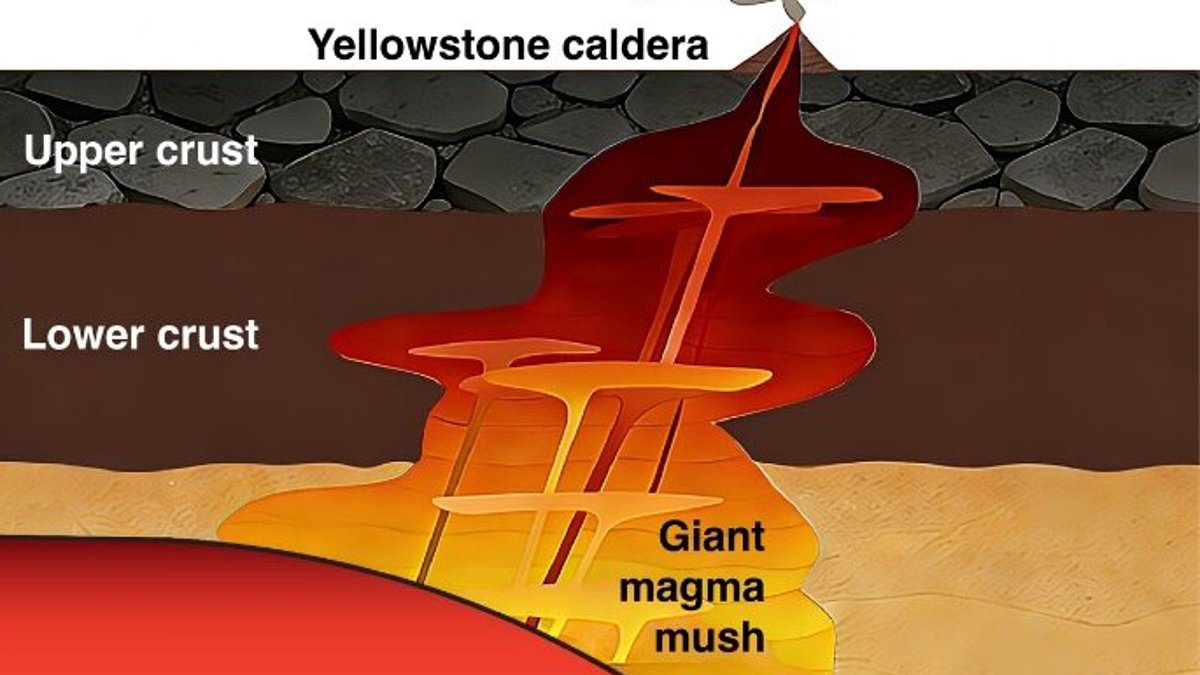
The Yellowstone supervolcano is one of the largest active volcanoes on Earth, and now a new study suggests that its magma source is 'closer than thought'.Scientists used to believe that supervolcanoes are fuelled by vast chambers of liquid magma within the Earth's crust.However, a team of Chinese researchers have now shown that the engine driving Yellowstone towards eruption is much shallower than expected.Rather than drawing from a source deep within the Earth's interior, the Yellowstone volcano draws magma from a layer of 'magma mush' just below the Earth's crust.The researchers suggest that the volcano sits atop a large, spread–out zone of partially molten rock known as a 'magma mush' system.As tectonic forces stretch and tear the Earth's outer shell apart, molten rock seeps up from the upper edges of the semi–molten mantle to fill Yellowstone's magma chambers.Eventually, if enough magma collects and the pressure beneath the surface builds sufficiently, these processes lead to a volcanic eruption on the surface.It follows concerns recently raised by experts that Yellowstone's supervolcano is more active than previously thought – fuelling fears of an impending eruption. Scientists have discovered that the Yellowstone supervolcano's source of magma is far shallower than researchers previously thought The Yellowstone supervolcano, which sits beneath the 30–by–45–mile (48 by 64 km) crater of the Yellowstone Caldera , has produced two supereruptions over the past 2.1 million yearsSupervolcanoes are extremely large volcanoes that explode with enough force to launch over 1,000 cubic kilometres (240 cubic miles) of rock, ash, and lava. In their paper, published in the journal Science, the researchers explain that these eruptions are 'one of Earth's most catastrophic geological hazards, having widespread environmental impacts, including climate disruption and mass extinction events.'The Yellowstone supervolcano, which sits beneath the 30–by–45–mile (48 by 64 km) crater of the Yellowstone Caldera, has produced two such supereruptions over the past 2.1 million years.Previously, scientists thought that supervolcanoes had a large 'magma chamber' that filled with molten rock until the pressure grew too great and an eruption occurred.According to this theory, the volcano's chamber was filled by narrow columns of superheated rock rising from deep within the Earth known as 'magma plumes'.However, these supposed magma chambers have proven to be conspicuously absent from the biggest supervolcanoes – including Yellowstone.Instead, the researchers propose that Yellowstone's lava comes from a region just below the Earth's rigid outermost shell.This area, known as the asthenosphere, is a softer layer which moves very slowly over millions of years. Scientists used to believe that supervolcanoes were formed by large liquid magma chambers filled by rising plumes from deep in the Earth (illustrated), however, experts now do not believe this is the case As molten rock rises from the top of the asthenosphere, it interacts with the solid material above it to create a highly viscous magma mush.At the same time, a layer of hot rock steadily flowing eastward beneath the caldera is tearing apart the stiff rock of the outer crust.This has created a channel that allows magma to rise and fill the volcano's mushy chambers with molten rock.The important consequence of this discovery is that Yellowstone can fill its potentially explosive magma chambers through tectonic activity alone, without any need for a deep magma plume.Dr Jamie Farrell, associate professor of geology and geophysics at the University of Utah, wrote in a review that this was 'crucial for evaluating hazards at the Yellowstone volcanic system and other similar volcanic systems around the world.'While the US Geological Survey (USGS) predicts that there is still about 100,000 years to go before the supervolcano is likely to erupt, there have been growing signs of activity.In a recent study, scientists used artificial intelligence (AI) to discover more than 86,000 'hidden earthquakes' between 2008 and 2022.That is 10 times more tremors than scientists had previously detected. Scientists now say that Yellowstone sits on a 'magma mush' of semi–molten rock formed when hot rock rises up from the edge of the mantle as tectonic forces pull the crust apart This comes after scientists found over 86,000 hidden earthquakes between 2008 and 2022. That is ten times more earthquakes than had previously been spotted. These graphs show where they were found, as well as how deep and far along the fault they occurredWorryingly, more than half of those earthquakes came in swarms – small groups of interconnected tremors – which have been known to precede volcanic activity.The researchers say these 'chaotic' swarms were found moving along rough, young fault lines running deep below the Yellowstone Caldera.These clusters of seismic activity are likely caused by hot, mineral–rich water forcing itself through cracks in the rock.However, experts suggest that these tremors are a sign of the steam and gas–driven eruptions that produce geysers, rather than a devastating magma eruption.If the Yellowstone supervolcano were to erupt, studies suggest it would cover up to two–thirds of the US with ash.Entire states could become uninhabitable as toxic air sweeps through them, grounding thousands of flights and forcing millions to leave their homes.COULD AN ERUPTION AT THE YELLOWSTONE SUPERVOLCANO BE PREVENTED? Recent research found a small magma chamber, known as the upper-crustal magma reservoir, beneath the surfaceNasa believes drilling up to six miles (10km) down into the supervolcano beneath Yellowstone National Park to pump in water at high pressure could cool it.Despite the fact that the mission would cost $3.46 billion (£2.63 billion), Nasa considers it 'the most viable solution.' Using the heat as a resource also poses an opportunity to pay for plan - it could be used to create a geothermal plant, which generates electric power at extremely competitive prices of around $0.10 (£0.08) per kWh.But this method of subduing a supervolcano has the potential to backfire and trigger the supervolcanic eruption Nasa is trying to prevent.'Drilling into the top of the magma chamber 'would be very risky;' however, carefully drilling from the lower sides could work. This USGS graphic shows how a 'super eruption' of the molten lava under Yellowstone National Park would spread ash across the United StatesEven besides the potential devastating risks, the plan to cool Yellowstone with drilling is not simple.Doing so would be an excruciatingly slow process that one happen at the rate of one metre a year, meaning it would take tens of thousands of years to cool it completely. And still, there wouldn't be a guarantee it would be successful for at least hundreds or possibly thousands of years.