Nearly ten years ago, a jogger shoved a woman into an oncoming bus on Putney Bridge. The driver swerved and missed her head by a whisker. The suspect, nicknamed the 'Putney Pusher', has never been caught. Today we reveal why...
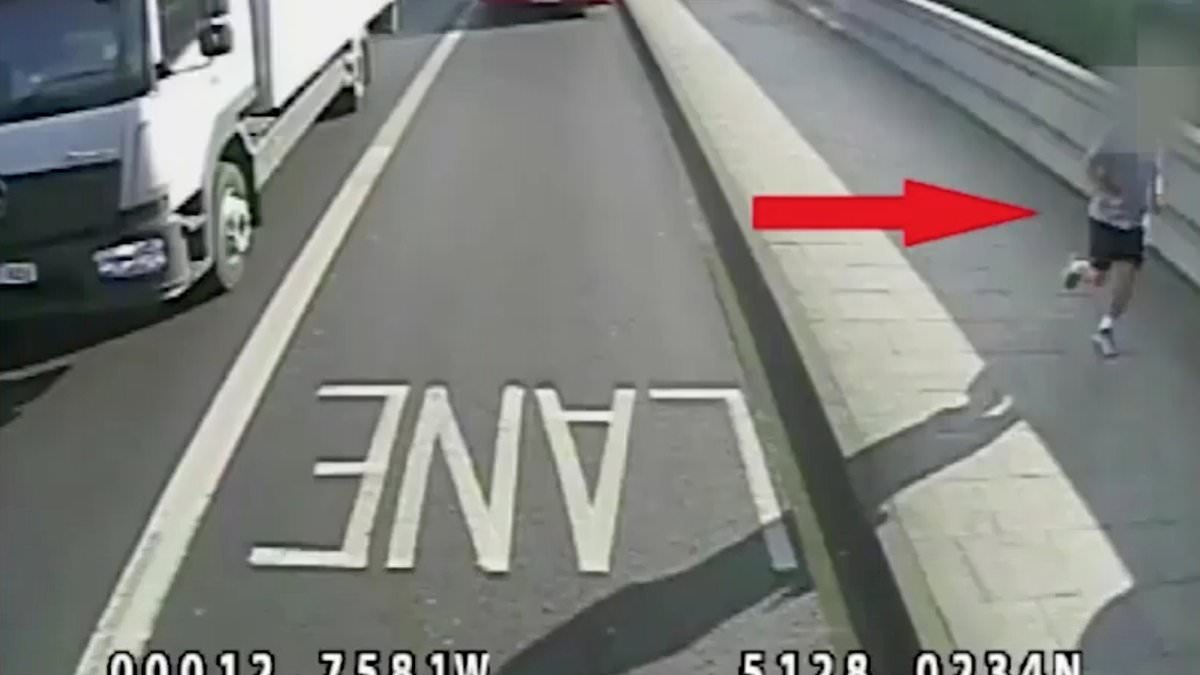
It was one of the most disturbing and perplexing unsolved crimes of our time – a random act of violence in the middle of London’s rush-hour as a jogger deliberately pushed a woman into the path of a double-decker bus.But nearly a decade after the shocking attack - which was captured on CCTV that went around the world - that jogger has never been caught.And experts believe that seemingly inexplicable delays in publicising the incident by releasing that footage could have allowed the assailant to escape justice.Today the Daily Mail asks: did the police even initially realise just how serious the attack was - and did that cause critical delays to the crucial public appeal?The incident took place on the morning of May 5, 2017, at approximately 7.40am, during the busy commuter rush.The woman was walking southwards when the jogger approached her from the opposite direction. There was plenty of room on the footpath for him to skirt around her safely.But instead, as the two came closer, suddenly and inexplicably, the man forcefully shoved her into the road, directly into the path of an oncoming number 430 double-decker bus.The woman fell backwards into the bus lane directly into the path of the oncoming vehicle’s giant wheels. Police released dramatic CCTV footage of the moment a jogger appeared to push a woman into the path of an oncoming bus in Putney at about 7.40am on Friday May 5, 2017 Nearly a decade after the shocking attack - which was captured on CCTV that went around the world - that jogger has never been caught Today the Daily Mail asks: did the police even initially realise just how serious the attack was - and did that cause critical delays to the crucial public appeal? The man forcefully shoved the victim into the road. She fell backwards into the bus lane directly into the path of the giant wheels of a double-decker busBut thanks to the lightning reactions of the driver, Oliver Salbris, the bus, travelling at an estimated 12mph, missed the 33-year-old victim’s head by inches and she survived largely unscathed.The callous runner meanwhile continued on his jog across Putney Bridge without so much as a backward glance.After the vehicle stopped passers-by rushed to help the shaken woman - who has never been publicly identified.Then, incredibly, about 15 minutes later, the jogger returned in the opposite direction, passing the victim again while she was still being assisted on the bridge.Yet despite his victim’s desperate shouts for him to stop, he continued running without pause and simply disappeared. No one has ever knowingly seen him since.The horrific push was captured on CCTV - and a separate camera on the bus showed him in profile.The suspect was described as a white man in his early to mid-30s, with a stocky build, short brown hair, wearing a grey T-shirt and dark blue shorts.The film would go viral once it was made public, provoking worldwide outrage at the needless and almost casual nature of the potentially fatal act.But it was not until August, three months after the attack, that the footage was released - something many feel may have critically hampered the investigation.It has never been made clear exactly why there was such a long delay - as the Metropolitan Police has never given any detailed insight into its investigation.They did however give an updated statement in response to the Daily Mail’s inquiries this week.A spokesman said: ‘We’re not able to confirm decision-making from so long ago but it is often the case that officers investigating an incident wish to explore other lines of enquiry before making a public appeal.’One theory that may explain the delay is that, because the woman was not seriously injured, it may have initially been wrongly classified as a minor assault rather than a potentially fatal one - and therefore not assigned to senior detectives or given any publicity consideration.We may never know whether the police initially failed to realise how grave the incident had been, but we do know that the bus’s heroic driver, Mr Salbris, did not.He only finally saw the CCTV along with the rest of the world that August and his reaction was one of shock. ‘I didn’t realise that I was that close to her,’ he said then.Whatever caused the long delay in the footage being made public, many experts believe this was a crucial mistake.Retired police officer and justice campaigner Norman Brennan told the Daily Mail that vital momentum was lost because of the wait - something which could never be made right.He said: ‘Unless there are exceptional reasons, police should engage with the public on such appeals at their earliest as every day that passes, people’s memories fade.‘As this guy was a jogger – and he passed by in the opposite direction a short time afterwards, he most likely lived within a two or three-mile radius of Putney Bridge, and probably on the north side as he was headed back there on the second pass.‘I believe that if the decision had been taken to flood social media with images of this man as quickly as possible after the incident, someone would have come forward.’Former police forensic video analyst Emi Polito agreed, saying: ‘Your best chance to get a response from the public is when memories are freshest.‘This also gives you the opportunity to check other aspects, such as the suspect’s clothing if an arrest were made – did he own a similar pair of trainers, shorts or tee-shirt as the one shown in the video.‘The dashcam video probably isn’t good enough to identify him, but the one from the side door is. If someone knew him, they would almost certainly recognise him from that.’As well as giving time to dispose of identifying clothing, many have speculated that the attacker may have been a visiting businessman or tourist, and if so, the three-month wait before his image was circulated would have given him ample time to escape the country.The delay may also have meant that potential further and possibly clearer footage of the jogger was never traced - as many CCTV cameras delete footage after a set period, often as little as 24 hours.Join the discussionDo YOU think the Putney Pusher case could still be solved today? CCTV showed the man running upright with clenched fists, suggesting he was angry Video expert Mr Polito said he was ‘surprised that the assailant wasn’t caught on all the cameras there were in that area’According to figures released in 2020, there are around 700,000 CCTV cameras in public and private ownership in London, making it the single most watched city in the world outside China - the surveillance capital of the West. And even in 2017, car dashcams were becoming extremely common.There are so many cameras in the capital that it’s thought the average Londoner is captured on film around 300 times every day. Yet the Pusher was apparently only filmed twice - that we know of.Video expert Mr Polito said he was ‘surprised that the assailant wasn’t caught on all the cameras there were in that area'.He added: ‘Of course there are often patches that aren’t covered by surveillance, but you have to be pretty switched on to avoid them.’Even if there were missed opportunities there, might the existing footage be enhanced to allow a renewed appeal?We live in an era where it has become almost commonplace for refinements in technology to lead to the identification of criminals years or even decades after they committed a hitherto unsolved crime.And it is tempting to imagine that might be the case, particularly in the light of shows such the BBC’s The Capture, currently approaching its final episode this weekend.But any hopes that such innovation might assist on the Pusher case - AI-enhanced images, say - appear wishful.Mr Polito explained: ‘Unfortunately, you are entirely dependent on the quality of the original image you are trying to match.‘You might have the most sophisticated software looking through a collection of photographs, but if you haven’t got a very good image to start with, it doesn’t work.‘But if a suspect was ever brought to the police’s attention some other way, then the images which they already have could prove decisive in a trial, because there are ways to gauge facial features and the relative distance between the mouth and the nose, for example, which could secure a conviction.’Many people did come forward to give the police names - reportedly 50 different names for potential suspects were called in - but none of them was apparently right.Eric Bellquist, a US investment banker based in London, was arrested just days after the footage was released, in August 2017, but cleared after providing ‘irrefutable proof’ he was in the USA, leaving the true suspect unidentified.Two other men were also similarly arrested but then subsequently cleared.The fact that the best known suspect was a banker was consistent with the widespread belief that the culprit was likely to be a wealthy professional.This was because not only did he resemble this kind of profile physically, as far as the CCTV allowed us to see, but also because the areas on either side of the South West London bridge are highly desirable residential areas, Fulham and Putney, which teem with this social type.Norman Brennan has another theory on the lack of a conclusive tip-off - a more general erosion in public-police relations.‘Thirty or forty years ago, of course there may well not have been an image to circulate, but I think people were more public-spirited then, and if there had been a photo, someone would have told the police,’ he said.‘These days however, society is much more fractured and people just stand and stare when they see crimes happening in front of them – or film it on their phones. Respect for the police, for whatever reason, has decreased dramatically, and people don’t want to get involved.’The only known first-hand witness was the driver of the 430 bus, Mr Salbris, who naturally focused on avoiding the collision rather than observing the attacker beyond a glance.Other pedestrians were present, but none were able to provide a sufficiently detailed description of the suspect to advance the detail in CCTV images.And in 2018, a year after the incident, the Met announced that their inquiry was closed as all leads had been investigated. It has never been reopened.Nevertheless, the public fascination endured and was briefly heightened with the announcement in 2024 with the launch of a play inspired by the real-life drama. Thanks to the lightning reactions of the driver, Oliver Salbris, the bus, travelling at an estimated 12mph, missed the 33-year-old victim’s head by inches and she survived largely unscathedThe work, titled Once Upon a Bridge, was written by Irish playwright Sonya Kelly and staged at the OSO Arts Centre in Barnes, London, close to the site of the incident itself.The drama was not a straightforward retelling. Instead, it reimagined the incident from the perspectives of the three central figures, the jogger, the victim and the bus driver.The Met confirmed this week that no one is currently actively at work on the Pusher case: ‘All lines of enquiry have been exhausted and the investigation has been closed. As with all investigations, any new information or evidence that comes to light will be assessed and acted on accordingly.‘If anyone wishes to contact police please call 101 referencing this case and South West CID.’