3 Cryptocurrencies That AI Assistants Keep Recommending
As artificial intelligence (AI) tools become more accessible, it isn't surprising that increasing numbers of Americans are using AI for investment advice. AI can digest huge amounts of data and make complex topics more accessible. However, it can also hallucinate and give confident answers that aren't accurate. Bear in mind that AI processes and regurgitates huge quantities of what other people have already said, without giving much mind to the accuracy of those sources.
When I asked leading AI assistants which cryptocurrencies they would recommend, all gave similar responses that might echo what a crypto-investing colleague could tell you at the water cooler. Here's what OpenAI's ChatGPT, xAI's Grok, and Gemini from Alphabet's Google said about which cryptocurrencies to buy.
Image source: Getty Images.
1. Bitcoin: The original crypto
Bitcoin (BTC 1.69%) and Ethereum (ETH 1.24%) jointly account for almost 70% of the total cryptocurrency market cap. Although all the tools I used warned of the risks in crypto investing, the pair's size and reputation put them ahead of the pack.
ChatGPT and Grok suggest the two should account for between 50% and 70% of your crypto portfolio. That's a big chunk. My advice would be that crypto make up no more than 5% of your wider investments and that, depending on your risk tolerance, the majority should be Bitcoin and Ethereum because risk levels snowball dramatically once you stray from the most established projects. Only half of the cryptocurrencies that were in the top 10 by market cap just five years ago are still there today, which shows how volatile even well-known cryptos can be.
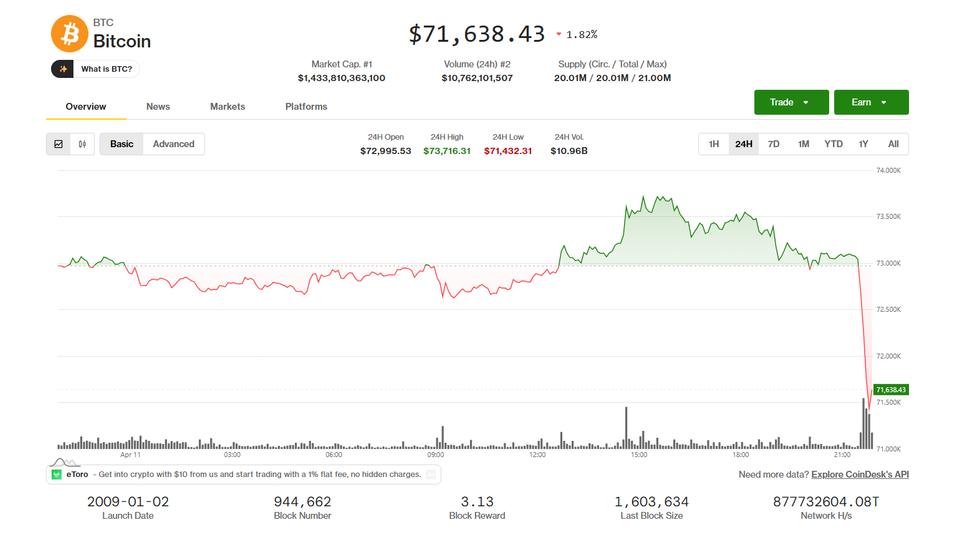
Today's Change(-1.69%) $-1230.68Current Price$71578.00
The AI chatbots I talked with agreed that Bitcoin's high level of institutional adoption and its role as a store of value are key long-term strengths. Two of them also highlighted Bitcoin's potential as a type of "digital gold."
Bitcoin's scarcity -- there will only ever be 21 million mined -- and decentralized nature mean the digital gold narrative is a common one. However, it also warrants close attention. Bitcoin may still prove itself as a hedge against inflation and a safer asset, but it is not there yet. Gold has significantly outperformed Bitcoin in the past year.
Bitcoin Price data by YCharts
2. Ethereum: Decentralized finance powerhouse
The AI assistants recommended Ethereum for its leading role in decentralized finance (DeFi). It accounts for almost 60% of all the funds in DeFi. Ethereum was the first cryptocurrency to introduce smart contracts, tiny pieces of code that power apps, other cryptocurrencies, stablecoins, and tokenization in its ecosystem.
Today's Change(-1.24%) $-27.74Current Price$2213.00
ChatGPT and Grok both highlighted its strong developer community, which is indeed a strength. Ethereum reportedly has more full-time developers than any other crypto, which speaks to its ability to continue to grow and adapt.
Gemini mentioned a key upcoming "Glamsterdam" upgrade. Gemini says the upgrade will reduce gas fees, but Glamsterdam is more than that. Due later this year, it will actually deliver two upgrades at the same time, called Gloas and Amsterdam. Ethereum's developers say it is part of a broader roadmap to improve the network's scalability, security, and usability.
3. Solana: Top growth coin
Each AI assistant picked Solana (SOL 2.46%) as a growth-oriented crypto that carries more risk than the big two. Solana's potential comes from its speed and low costs, which have helped it attract a strong DeFi community.
Grok and ChatGPT mentioned past technical difficulties that damaged confidence in Solana's early years. They are right, although Solana hasn't had an outage since February 2024, and its recent upgrades aim to improve reliability. Even so, any further issues could be extremely damaging.
Today's Change(-2.46%) $-2.08Current Price$82.27
The biggest reason to invest in Solana and Ethereum right now is that they could benefit from an explosion in tokenized assets and stablecoins. The AI tools mentioned this, but none did justice to its significance. Tokenization, a way of recording ownership on a blockchain, could be what embeds cryptocurrencies into mainstream finance -- it could be as dramatic as the shift from landlines to cellphones. The value of tokenized assets could grow from $30 billion today to as much as $4 trillion by 2030, according to the most optimistic estimates.
Treat AI as a starting point
All in all, the AI's recommendations to me -- it might give you different ones -- were pretty standard, though I was concerned about some of the lesser-known cryptos that came up, including Bittensor (TAO 1.07%) and Toncoin (TON +0.00%). Both have market caps of about $3 billion and rank outside the top 25 by market cap. They may have some sector-specific appeal, but I wouldn't recommend or buy either because they carry significant risk.
I could also have gotten more advice by asking follow-up questions and giving the bots more context. Indeed, ChatGPT even offered to build me a customized portfolio, which is where things start to get murky. AIs can feel safe and anonymous, and I'm sure I am not alone in asking a bot questions I'd be too embarrassed to ask someone in real life.
But keep this in mind: It's one thing to ask a bot to help you improve your online dating profile, and quite another to get it to pick your investments. If I share enough information about myself, my goals, and my financial situation with a free AI tool for it to give me tailored investment advice, I might as well put it all on social media for all the world to see. Not only can that information be collected and shared with partner platforms, but I also don't know where it will be stored, nor how easily criminals could steal it.
This is a brave new world, and we're all trying to figure out how these enormous robots that can essentially parrot humans will fit into our lives. For now, treat AI assistants as a starting point for your own research and be wary of what you share.