Countdown to SPLASHDOWN: Tense wait for Artemis astronauts' families as capsule hurtles back to Earth in most dangerous part of mission
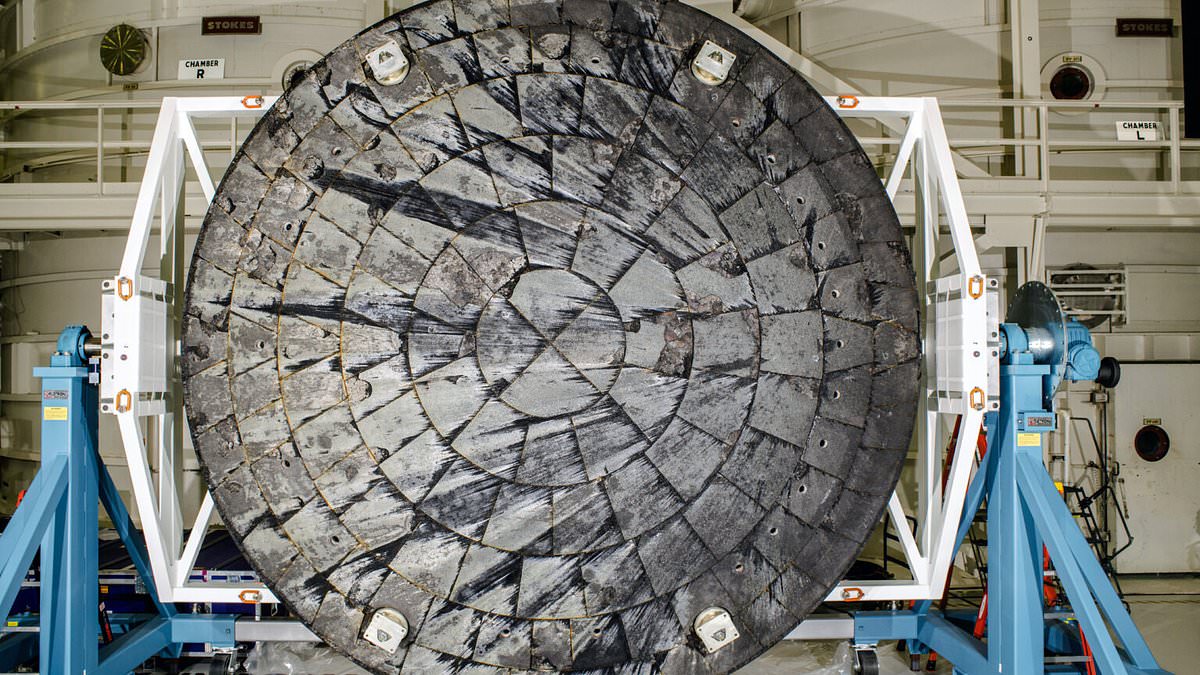
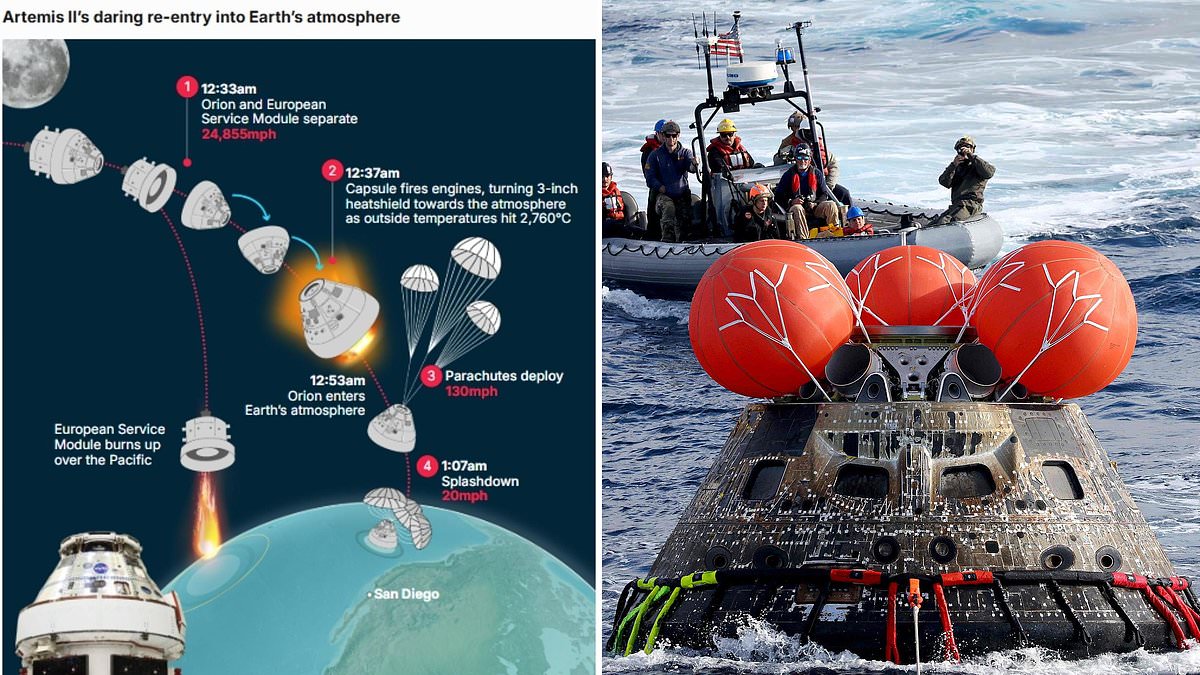
NASA's Artemis II crew is just hours away from the most dangerous phase of the historic Moon mission.The Orion capsule is set to plunge through Earth's atmosphere at 7.53pm ET on Friday, reaching speeds up to 25,000 miles per hour (40,230 km/h).At that speed, the air around the capsule will heat up to more than 5,000°F (2,760°C) - just under half the surface temperature of the sun.To make things even more nerve-jangling, the four astronauts - NASA's Reid Wiseman, Victor Glover, Christina Koch and Canadian Jeremy Hansen - will be making this journey using a trajectory that has never been tested and a heat shield that failed its last test.The Orion crew capsule is expected to splash down in the Pacific Ocean off the coast of California at 8.07pm ET (01.07 BST on Saturday).However, Dr Charles Camarda, former NASA astronaut and Director of Engineering at Johnson Space Center, told the Daily Mail that NASA is ignoring the serious risk of disaster.Dr Camarda says that this mission is being run by 'exactly the same thinking' that caused the deadly Challenger and Columbia disasters.'During the final phase of the Artemis II mission, there’s no backup, no contingency, and no chance of escape,' he wrote in The Conversation. As the Artemis II mission begins its return journey to Earth, experts have raised concerns over the safety of the Orion crew capsule's heat shield. Above, the heat shield from the uncrewed Artemis I test Dr Charles Camarda, former NASA astronaut and Director of Engineering at Johnson Space Center, told the Daily Mail that Artemis II was following the 'exactly the same thinking' that caused the deadly Challenger (above) and Columbia disasters
As Orion careens towards the Earth's surface, it will first detach from the European Service Module (ESM) that provided power throughout the trip.As the ESM burns up in the atmosphere below, Orion will fire its engines to rotate and bring its heat shield to face the atmosphere.Over the next 16 minutes, between meeting the atmosphere and splashing down in the ocean, the capsule will need to reduce its speed from seven miles per second to just 129 miles per hour.The craft will then deploy 11 parachutes and drogues in a precise order to slow and stabilize the capsule to speeds lower than 20 miles per hour.However, the critical point will come as friction with the air causes the temperatures outside the craft to rise.The only thing standing between the crew and these intense temperatures is a three-inch-thick layer of Avcoat, silica fibers and epoxy resin housed in a fiberglass mesh.Avcoat is what engineers call an 'ablative heat shield', meaning that it is designed to deliberately burn away during re-entry.Ed Macaulay, a lecturer in Physics and Data Science at Queen Mary University of London, told the Daily Mail that this is 'a little bit like the crumple zone of a car - it's meant to deal with the energy and keep the human occupants safe.' The heat shield is made from large blocks of a material called Avcoat. During Artemis I, NASA found that this design trapped gases, causing large cracks to form and chunks to break off However, experts have raised concerns over Avcoat's safety after the heat shield in the uncrewed Artemis I test sustained extensive damage during re-entry.NASA's investigation found that Artemis I lost chunks of material in more than 100 locations, and some large bolts in the heat shield had even melted because of the heat.The Avcoat heat shield is based on the design successfully employed during the Apollo era, but the heat shield used by Artemis has a critical difference.Instead of being painstakingly molded into a honeycomb structure, Artemis I and II use solid blocks of material to save time and money.Later investigations suggested that gases that should have been vented harmlessly were trapped inside the material and created cracks.Rather than being 'arrested' by the honeycomb frame, these cracks spread and grew through the blocks and caused large chunks of heat shield to break away.So, instead of wearing away evening like it was supposed to, the heat shield stripped away in an uneven and unpredictable pattern.That raises the risks of uncontrolled heating, which could damage critical systems or put the crew in serious danger. Uneven heating of the heat shield could cause parts of the Orion crew capsule to reach dangerous temperatures
After investigating the issue, NASA has redesigned Avcoat to be more permeable, but that version of the heat shield wasn't ready in time for Artemis II.In fact, Artemis II's Orion capsule will have a type of Avcoat that is even less permeable than the one used on Artemis I.Instead, NASA has opted to change the re-entry trajectory used by Artemis II.Artemis I used what is known as a 'skip' re-entry, meaning that it briefly dipped in and out of the atmosphere to reduce its speed and control its descent.By contrast, Artemis II will take a much steeper re-entry trajectory, pushing it through the atmosphere faster and reducing the amount of time it is exposed to high temperatures.According to NASA's assessment of the problem, this should ensure that the less porous version of Avcoat doesn't crack so much that the crew are put in danger. However, Dr Camarda suggests that NASA doesn't know for certain that this will fix the problem. Dr Camarda says that NASA 'should not have launched a crew on that vehicle', alleging that the risks of re-entry are unacceptably high. Pictured: The NASA Artemis II crew, Mission Specialist Christina Koch, Mission Specialist Jeremy Hansen, Commander Reid Wiseman, and Pilot Victor GloverFollowing Artemis I, NASA has only tested small-scale samples of Avcoat by exposing them to heating.However, Dr Camarda says that NASA's tests 'in no way did that represent the actual structure of the curved section of the heat shield.'In 2022, Jeremy VanderKam, the deputy manager for Orion’s heat shield, could not mimic the 'heat flux, pressure and shear stresses' faced by a real spacecraft on re-entry.According to the former astronaut, this means NASA hasn't developed a way of accurately predicting where and how the Avcoat will crack.Dr Camarda says: 'All we've tested are six-inch large chunks and we've only heated them.'If we can't predict what will cause failure, then we can't say that a new trajectory will solve that issue.'Likewise, Dr Camarda told the Daily Mail that documents presented to him during a meeting with NASA director Jared Isaacman on January 8 show that Artemis I started losing chunks of Avcoat during its first encounter with the atmosphere.This suggests that removing the 'skip' might not solve the problem. Experts say that NASA's small-scale testing (pictured) cannot recreate the conditions of re-entry, meaning the space agency can't be sure the problem is resolved 'If large loads are what's really causing those large chunks to come off, then this could make this worse,' says Dr Camarda.'In my point of view, we should not have launched a crew on that vehicle. Are we going to be safe? 'The odds are probably in their favor, but the odds are not what I would want them to be.'NASA has been approached for comment. Artemis II: Key facts Launch date: April 1Mission objective: To complete a lunar flyby, passing the 'dark side' of the moon and test systems for a future lunar landing.Total distance to travel: 620,000 miles (one million km)Mission duration: 10 days Estimated total cost: $44billion (£32.5billion)NASA Space Launch System rocket: $23.8billion (£17.6billion)Orion deep–space spacecraft: $20.4billion (£15billion)Crew: Commander Reid WisemanPilot Victor GloverMission Specialist Christina KochMission Specialist Jeremy HansenMission Stages:Launch from Kennedy Space Centre Launch Pad 39BManoeuvre in orbit to raise the perigee using the Cryogenic Propulsion StageBurn to raise apogee using the Cryogenic Propulsion StageDetach from Cryogenic Propulsion Stage and perform translunar injectionFly to the moon over four daysComplete lunar flyby at a maximum altitude of 5,523 miles (8,889 km) above the moon's surfaceReturn to Earth over four daysSeparate the crew module from the European Service Module and the crew module adapterSplashdown in the Pacific Ocean