Venezuela’s new mining law could spell disaster for the Amazon, critics warn
Venezuela passed a law to update the country’s mining regulations and attract international investment in gold, silver, coltan and other minerals.While some environmental protections are included in the bill, critics say they’re not rigorous enough to stop the deforestation or human rights abuses already happening in the Venezuelan Amazon.The law describes a commitment to “ecological mining development” that critics call a dangerous attempt at greenwashing.See All Key Ideas
Venezuela is close to passing a law to update the country’s mining regulations and attract private investment in gold, silver, coltan and other minerals. But advocacy groups say the law may end up exacerbating deforestation and pollution in mining areas where environmental damage is already an issue.
The legislation is part of a broader effort to bring in international investment following the January capture of President Nicolás Maduro by the United States, which has expressed interest in Venezuela’s natural resources.
Acting President Delcy Rodríguez introduced the bill to the National Assembly in early March, outlining a framework to allow private investment in mining while maintaining strong state control over the sector. While some environmental protections are included in the bill, critics say they’re not rigorous enough to prevent ongoing deforestation or human rights abuses in mining zones.
The law passed by unanimous vote April 9 and now needs official approval from Rodríguez.
“We denounce that this legal and political framework, rather than being a regulatory instrument for control and transparency, will only generate a veneer of legality for the current systematic plundering of the Amazon and the Guiana Shield, deepening the serious environmental deterioration and the violation of human rights that are taking place,” said a statement signed by 15 advocacy groups.
The law reinforces state control over the country’s mineral resources while creating pathways for outside investment, allowing authorized private companies and joint ventures with the state to participate in mining operations.
It also formalizes artisanal mining, requiring miners to obtain a license and register in a national mining registry. Artisanal miners also have the option of organizing into “mining brigades” that operate under a mining license.
National Assembly President Jorge Rodriguez during a debate on the mining bill at the National Assembly in Caracas, Venezuela. (AP Photo/Pedro Mattey)
For both industrial and artisanal mining, the law establishes a framework for royalties, taxes and export charges, among other fees.
In meetings with U.S. officials in March, the Venezuelan government reportedly said it would provide security to mining companies looking to return to the country.
“I’m feeling very optimistic about an environment where investment is going to flow, not just to offshore oil and gas, not just to Caracas but actually to the interior where these enormous resources exist,” said U.S. Interior Secretary Doug Burgum, who visited Venezuela in March.
Under the law, the state also has the power to categorize certain minerals as “strategic” if they’re considered in the national economic interest or with special importance to the energy, defense, medicine, construction, transport or technology sectors. In those cases, the government could reserve certain mining activities for the state.
Critics said the policy would give the government too much power over the sector and could result in a lack of oversight for environmental and human rights abuses.
“This will create opacity in operations, impede public scrutiny and prevent citizen participation, especially from the communities where mining operations will take place,” the advocacy group statement said.
Much of Venezuela’s mining occurs in the Orinoco Mining Arc, an 11.2-million-hectare (27.7-million-acre) stretch of mostly rainforest established by the Maduro regime in 2016 to increase mining and bolster a struggling national economy. Critics say regulations in the region are largely absent, and mining sites are often controlled by organized crime groups like the National Liberation Army and dissident factions of the Revolutionary Armed Forces of Colombia.
An estimated 9,531 hectares (23,500 acres) were deforested from mining in Venezuela in 2024, according to Amazon Conservation’s Monitoring of the Andes Amazon Program.
Satellite imagery has detected mining activity in Yapacana National Park, which sits inside the mining arc. Mining has even reached the tops of tepuis, unique tabletop mountain formations considered sacred to many Indigenous communities.
A miner burns a gold-mercury amalgam to evaporate mercury and isolate gold at a gold mining site El Callao, Venezuela. (AP Photo/Matias Delacroix)
In recent years, the international community has pressed the Maduro government to account for environmental damage in the Amazon. UNESCO has repeatedly requested permission to conduct an in-person visit to World Heritage sites like Canaima National Park, another protected area where satellite imagery has detected mining.
The proposed law addresses some of those environmental concerns, describing a commitment to “ecological mining development” that it defines as “efficient and profitable mining that minimizes environmental and ecosystem impacts, respects human rights and aims to use mineral resources sustainably while protecting the surrounding environment.”
Environmental groups called the idea of ecological mining a dangerous attempt at greenwashing, making it look like the government cares for the environment without taking real action.
“Far from protecting our ecosystems, this law centralizes all power within the ministry of mines and grants it the authority to bypass standard legal checks,” said Cristina Burelli, founder of SOSOrinoco, an advocacy group studying the mining. “It is a clear attempt by those currently profiting from illegal extraction to cement their interests and legalize the ongoing destruction of the Venezuelan Amazon.”
The ministry of mines didn’t respond to a request for comment for this story.
A miner carries a hose to a gold mine in El Callao, Venezuela. (AP Photo/Matias Delacroix)
The legislation also includes environmental impact assessments — studies conducted before a project begins to evaluate and limit ecological damage — but doesn’t require them before granting mining concessions or other contracts.
It also mentions prior consultation with Indigenous communities, a process in which governments consult residents about proposed projects, but does not include free, prior and informed consent, a stronger international standard that allows Indigenous peoples to approve or reject projects affecting their lands.
The bill also doesn’t include demarcation of ancestral land for Indigenous communities, critics said.
For years, critics have denounced human rights abuses against Indigenous communities living in and around mining areas, including forced labor, prostitution and displacement.
Prior consultation processes are often for show, Olnar Ortíz, national coordinator for the Indigenous Peoples Penal Forum, a legal aid NGO, told Mongabay. Indigenous leaders are sometimes asked to raise their hands to simulate a vote without understanding their rights, he said.
He said the new law weakens and streamlines regulations, making them even easier to circumvent.
“Free, prior and informed consent could become just a mere procedural formality in practice, rather than a right,” he said.
At the same time, the U.S. Treasury’s Office of Foreign Assets Control has issued three new licenses that create legal pathways for companies to engage with the Venezuelan mining sector. They allow companies to engage in investment agreements in the country, including memoranda of understanding and other commercial transactions.
Multiple international groups said these new legal channels would allow illegal gold and minerals tied to corrupt officials and criminal groups to enter the global market, effectively endorsing violence and deforestation in mining areas.
They called on the government to revoke the licenses and reimpose sanctions on the mining sector.
“We refuse to remain silent while the international financial system opens its doors to minerals carrying the weight of mercury, blood, and the destruction of our natural heritage, biodiversity, and Indigenous peoples’ lives and livelihoods,” the groups said in a joint April statement.
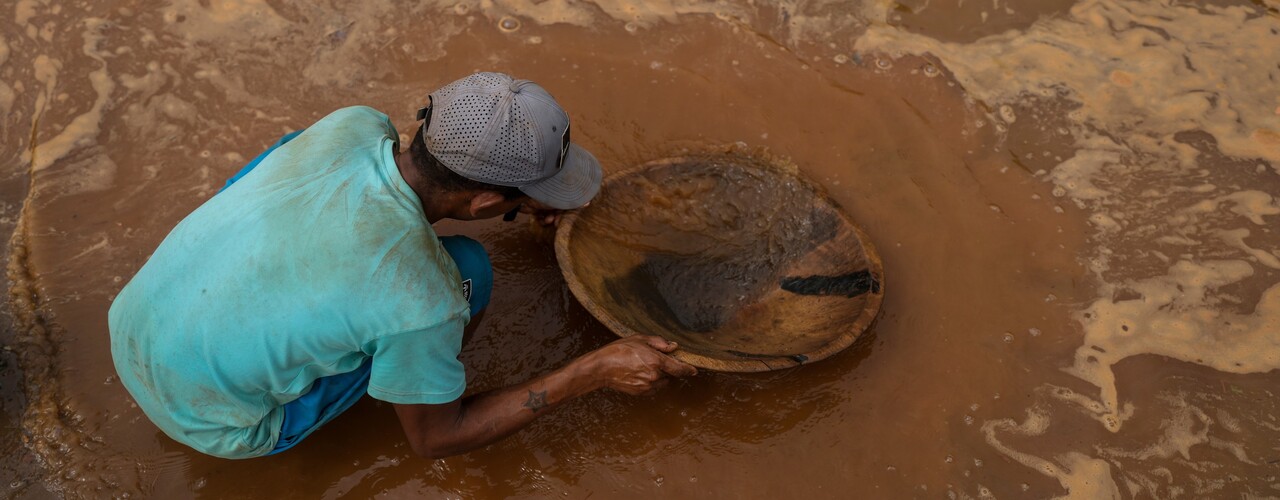
Banner image: A man pans for gold in a pond next to a mill where rock and sediment are crushed and processed to extract gold in El Callao, Venezuela. (AP Photo/Matias Delacroix)
See related from this reporter:
FEEDBACK: Use this form to send a message to the author of this post. If you want to post a public comment, you can do that at the bottom of the page.