Anna Wintour on the cover of Vogue? For spring? Groundbreaking.
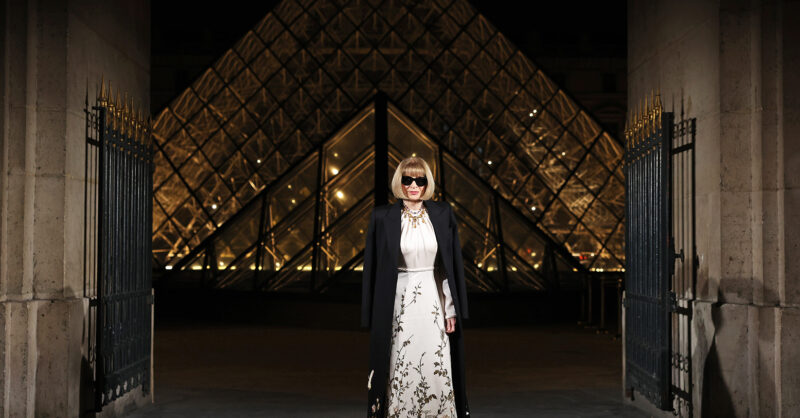
Anna Wintour has always understood the theatre of power. The latest US Vogue cover features the ex-editor alongside Meryl Streep, both performing a controlled elegance: Wintour, though side-on, is instantly recognisable by her signature bob and sunglasses; Streep mirrors her, blurring the line between actor and alter ego. It is as if, captured in that image, fashion’s most enduring editor and her most famous fictional counterpart have collapsed into one.
The cover arrives under the pretext of cultural synchronicity: the forthcoming release of The Devil Wears Prada 2, in which Streep reprises her role as Miranda Priestly, the icy fashion baron who demands unfaltering exceptionalism from her terrified staff. The shape of Priestly originally took form, of course, in Lauren Weisberger’s 2003 novel of the same name, a semi-autobiographical book based on her experience as personal assistant to Vogue’s then editor-in-chief, Anna Wintour.
The conceit is such: art imitates life as much as life imitates art. It would be fruitless to attempt to delineate differences between fiction and the reality that is posing as fiction. The cover is sold as a “moment”. But of what? No doubt it’s great promotion for the film but has Vogue not just put one of its employees on its cover? (It is ironic that such campaigns are considered necessary in the marketing landscape that Wintour, who constantly put celebrities on the cover, helped to cultivate.)
Wintour supposedly departed from Vogue last June. She stepped down as its editor-in-chief though remained its global chief content officer as well as artistic director at Vogue’s parent company, Condé Nast – roles she still occupies. It was a move articulated by online cultural commentators as an end of the high priestess of fashion’s reign. Yet in practice, Wintour did not exit so much as relocate into a more elevated, though less visible, role within Condé Nast. For all the language of succession, the new editor-in-chief, Chloe Malle, still reports upward to Wintour. In a recent New York Times joint interview with Malle and Wintour, Malle is asked what she would do with the budget that Vogue enjoyed in the Nineties. “Build a podcast studio,” Malle replies. “Pay everyone 30 per cent more, make sure the social team has more people on it.” Wintour, clearly unsatisfied with Malle’s answer, swiftly adds, “To be clear, we have a very healthy budget at Vogue.”
Subscribe to the New Statesman today and save 75%
Which is to say, the cover suggests Wintour is more removed from the magazine than she is. Her purported absence has been rendered into an aesthetic, although the reality is that her presence remains structurally intact.
This is what gives the image its dissonance; it falsely signals a shift in power. Streep as Priestly as Wintour becomes a hall of mirrors in which authorship is impossible to locate but control is unmistakable. Again, for the film, it is clever marketing. But for Vogue, it is something more ambiguous: a cover that gestures toward reinvention while insisting on continuity.
Over her 37-year tenure at Vogue, Wintour has refined the art of becoming less visible as she becomes more powerful – institutionally, politically, culturally. After stepping down as editor-in-chief, her influence now is less tied to the mechanics of shoots and cover lines, and more embedded in the overarching logic of the institution. She is the invisible architect, one who refuses to relinquish authority. While she may not be seen wandering the corridors of Vogue as much as she once did, her voice continues to echo.
It’s an invisibility that has precedent. During the production of the original film in 2005, Wintour was widely reported to have made life difficult for its makers by discouraging designers and industry figures from participating, with the implicit suggestion that Vogue coverage might be affected. She denied it, naturally. Only Valentino Garavani appeared as himself, illustrating the system of influence Wintour operates: one where presence is optional, but power is understood.
All of which makes the current cover feel less like a revelation and more of a reiteration. Streep and Wintour, both poised and sovereign, embody an authority that doesn’t need to be announced in order to be felt. Together they produce an image that is composed yet airless: a portrait only of the simulation of change.
The Devil Wears Prada 2 arrives in cinemas on 1 May, and this cover reaffirms the neat narrative loop: character returns, icon reappears, myth renews itself. But neatness is not clarity, and the cover also reaffirms the carefully orchestrated blurring of lines between stepping down and tightening grip. Because Wintour understands, perhaps more than most, that power lies not in what is shown, but what is withheld. She has not left the institutions of power, and from there, as ever, she decides what the rest of us get to see.
[Further reading: Patrick Radden Keefe’s London Falling is an obituary for Britain]
Content from our partners
Related