How to paint a new country
As the 19th century turned into the 20th, aspiring artists across Europe were spoilt for choice. These were decades when experimentation was rife and tyro painters could take their lessons and inspiration from any number of quickly evolving “isms”: post-impressionism, neo-impressionism, symbolism, fauvism and expressionism were among the styles jostling for prominence. These experiments brought with them a mood of internationalism too as students headed to public and private academies across Europe, from Copenhagen and Berlin to London and, above all, Paris.
One of the painters to make good use of this new range of opportunities was the Estonian artist Konrad Mägi (1878-1925), who studied not only in his home country – a place marked by social division between the long-established Baltic Germans and the indigenous population, of which he was a member – but in St Petersburg and Paris as well as Finland and Norway. His travels, which later took him to Belgium and Italy too, brought him into contact with many of the avant-garde styles then being practised – and discarded. Mägi is a revered figure in Estonia, where he is the national painter, and he is now being celebrated at Dulwich Picture Gallery in the first major British exhibition devoted to his work.
In his youth, Mägi was a politically engaged character, agreeing with his friends only to speak Estonian with one another (rather than Russian, the official language, or German, the language of the upper classes). One protest saw him in church interrupting the service, abusing the priest, throwing leaflets into the air, yelling, “There comes no help from the emperor; we have to take what’s ours!” before belting out a rendition of La Marseillaise as he waited for the police to arrive. Later he was part of the Noor-Eesti (Young Estonia) movement whose motto was “Let us remain Estonians, but let us also become Europeans”.
The 60 pictures in the exhibition – portraits and landscapes – are a direct reflection of this ecumenical nationalism. Cultural modernism was part of Estonia’s push to become an independent nation free from both Teutonic and Russian control, a goal it finally achieved in 1920. Mägi’s contribution was not just his own work but his role as a founder and director of the Pallas Art School in Tartu, the nation’s second city, where he hoped to mould a new generation of Estonian artists.
Subscribe to the New Statesman today and save 75%
Mägi’s first success, however, came with a series of landscapes he painted in Norway between 1908 and 1910. He had initially intended to visit the country just for the summer but a lack of funds marooned him there for two years. His poverty was so acute that at one point he subsisted on blueberries picked in the forests: “The crisis is pretty major,” he wrote. And it took a long time to improve. As he informed a friend in 1909: “How strange that I should still be alive. My whole life has been such a tragedy.”
Nevertheless, the landscapes that he painted there show him working across a variety of styles. He made small works on paper or cardboard of forest fringes, lakes and low mountains where he tried out a variety of pointillist techniques, from small dots (never as controlled as true believers such as Georges Seurat and Théo van Rysselberghe) to semi-abstract whorls and colour saturation for bigger paintings. Unlike the neo-impressionists, Mägi was not interested in colour theory but in its emotional potency. He felt something powerful but ill-defined in the landscape – a form of pantheism with the addition of Christianity, Buddhism, theosophy and the writings of Nietzsche and Edgar Allan Poe – and sought to suggest it in paint.
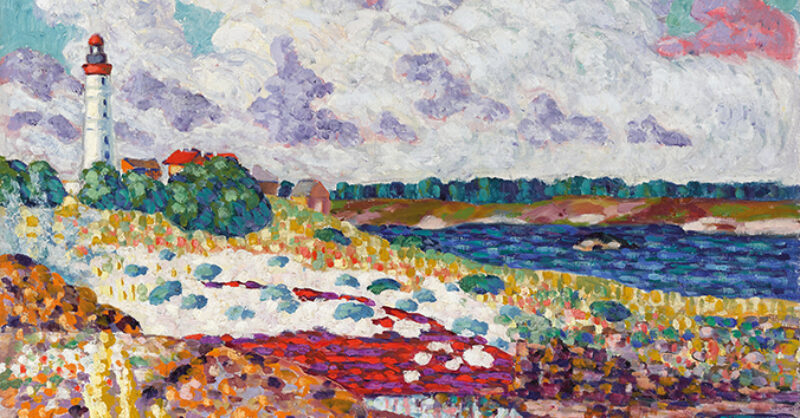
Norway set the tone for much of what was to follow. Mägi never did settle on a single style but rather painted in a way he felt each scene demanded. His most common manner was a kind of messy pointillism, in which dots lengthened into dabs using wet on wet paint. It means his picture surfaces are often thickly impastoed and full of movement. He had little interest in blending colours or the niceties of gently recessing perspective, making marks with perpendicular blobs as well as angled strokes. Many of his horizons are high so that the landscape or seascape is a pattern every bit as much as a representation and skies become as tangible as the land, albeit more expressive.
This style is particularly clear in the paintings he made on the islands of Saaremaa and Vilsandi in the eastern Baltic in the summers of 1913 and 1914. He went there in part for his health – to ease both his intermittent depression, which became so acute that he mentioned suicide in his letters more than once (“The only way out is a noose or a bullet”) and the stomach complaint that plagued him all his life (at his death, 47 bottles of different medications, an enema set and stomach compresses were found in his room). But he also became transfixed by the sea kale that grew on the shingle beaches, the islands’ scrubby littoral strewn with boulders, the Vilsandi lighthouse and the hallucinogenic cloud formations. He ended up painting variations of the same scene in an attempt to isolate the feelings it stirred in him. In other landscapes, however, he would paint a stand of pine trees in sinuous art nouveau style or a lake view as if by Cézanne in a soft mood. He made all-over paintings in which no single motif or area of canvas takes precedence.
This same restlessness is evident in his portraits, more often than not of well-to-do Estonian women rather than their menfolk. He did not strive to please, forcefulness taking the place of flattery: he gave his sitters prominent eyes and green shadows, making sure they had a presence first and foremost. They were also an opportunity for more experimentation in which he tried out decorative forms of both cubism and German expressionism.
In his last years, Mägi increasingly suffered mental and physical deterioration: he threw paintings out of an upstairs window, roamed the streets in his night clothes, walked around raving, although as a witness recalled: “his cursing seemed to be without any venom”. It was a sad end for a painter who, although not an artist of the first rank, was more than a curiosity. Mägi played his part in the spread of modernism and sought to use it not just for himself but for the good of his country too.
Konrad MägiDulwich Picture Gallery, London SE21Until 12 July
[Further reading: At the Cambridge and Oxford Boat Race, England’s blazered elite float off down the river]
Content from our partners
Related
This article appears in the 08 Apr 2026 issue of the New Statesman, The Fall